You may have seen this report in the Cambridge News:
Buses which cause ‘too much pollution for London are being sent to Cambridge instead’
County councillor John Williams fears Stagecoach is “taking advantage of lighter restrictions in Cambridge”
Old London buses rejected for being too polluting are ending up on Cambridge’s streets according to members of the Greater Cambridge Partnership Joint Assembly.
A number of councillors present at the group’s meeting on Thursday, June 6, raised concerns as measures to address pollution and congestion were discussed.
Cambridge City Councillor, Mike Davey, Labour, said: “I’m not sure I quite understand why we should be dependent on what London doesn’t want.
Cambridge Area Bus Users want cleaner, greener buses, but wanted to check the facts before rushing to comment.
We are indebted to a correspondent who sent us a full list of these ex-London vehicles and a link to the Transport for London (TfL) Ultra Low Emission Zone (ULEZ) vehicle-checker site.
The ten ex-Stagecoach London Scania Omnicity vehicles are:
| Stagecoach fleet Nº | Registration mark |
| 15074 | LX09AEY |
| 15075 | LX09AEZ |
| 15078 | LX09AFF |
| 15081 | LX09AFN |
| 15083 | LX09AFU |
| 15085 | LX09AFY |
| 15087 | LX09AGO |
| 15089 | LX09AGV |
| 15090 | LX09AGY |
| 15092 | LX09AHA |
We pasted the registration mark of each vehicle into the TfL Ultra Low Emission Zone (ULEZ) vehicle-checker site. In each case we found that the vehicle was ULEZ-compliant. One example is shown, below. But don’t take our word for it – copy’n’paste any of the ten registration marks into the TfL Ultra Low Emission Zone (ULEZ) vehicle-checker site.
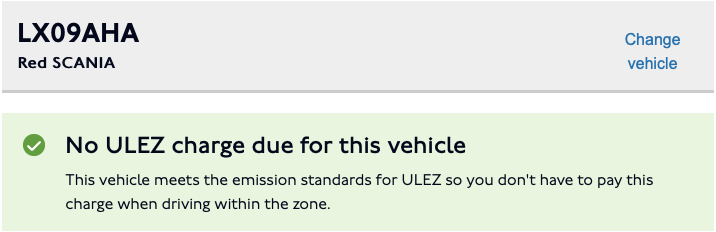
Note: Buses operated under contract to TfL are not exempt from ULEZ charges. Every TfL-contact bus operated in the ULEZ now meets at minimum Euro VI emissions standards. In other words, these ten vehicles meet the latest standards for low NOx PM10 and PM2.5 emissions. They have been retro-fitted for compliance.
So, there are no dirty buses in Cambridge?
Not quite.
- Stagecoach Cambridge has a small number of pre-Euro V standard vehicles which will be phased out as the retro-fitted ex-London ULEZ-compliant vehicles are phased in.
- Cambridgeshire County Council are part of the problem, see this video of Gary Forbes-Burns, Operations Support Manager at Ascendal Group (Parent of Whippet Coaches) speaking to the Cambridge Area Bus Users Annual General Meeting on 15 June 2019.
One thing which probably does need to be noted, though, is that the latest round of Cambridgeshire County Council tenders specifies that, anything which does not come into Cambridge only has to be level Euro III, anything that came into Cambridge has to be Euro IV. That’s something that’s there that can give a very quick win. And other local authorities are pushing for much higher Euro levels than that. [our emphasis]
Gary Forbes-Burns, Operations Support Manager at Ascendal Group
Which prompted this rejoinder:
Is an individual bus cleaner than the newest car? Yes, some of them are actually.*
Ross Barton, Operations Director, Stagecoach East
Barton is doubtless referring to the tighter testing regimes for heavy Euro VI engines vs the Euro 6 diesel car/van. See below for further details.
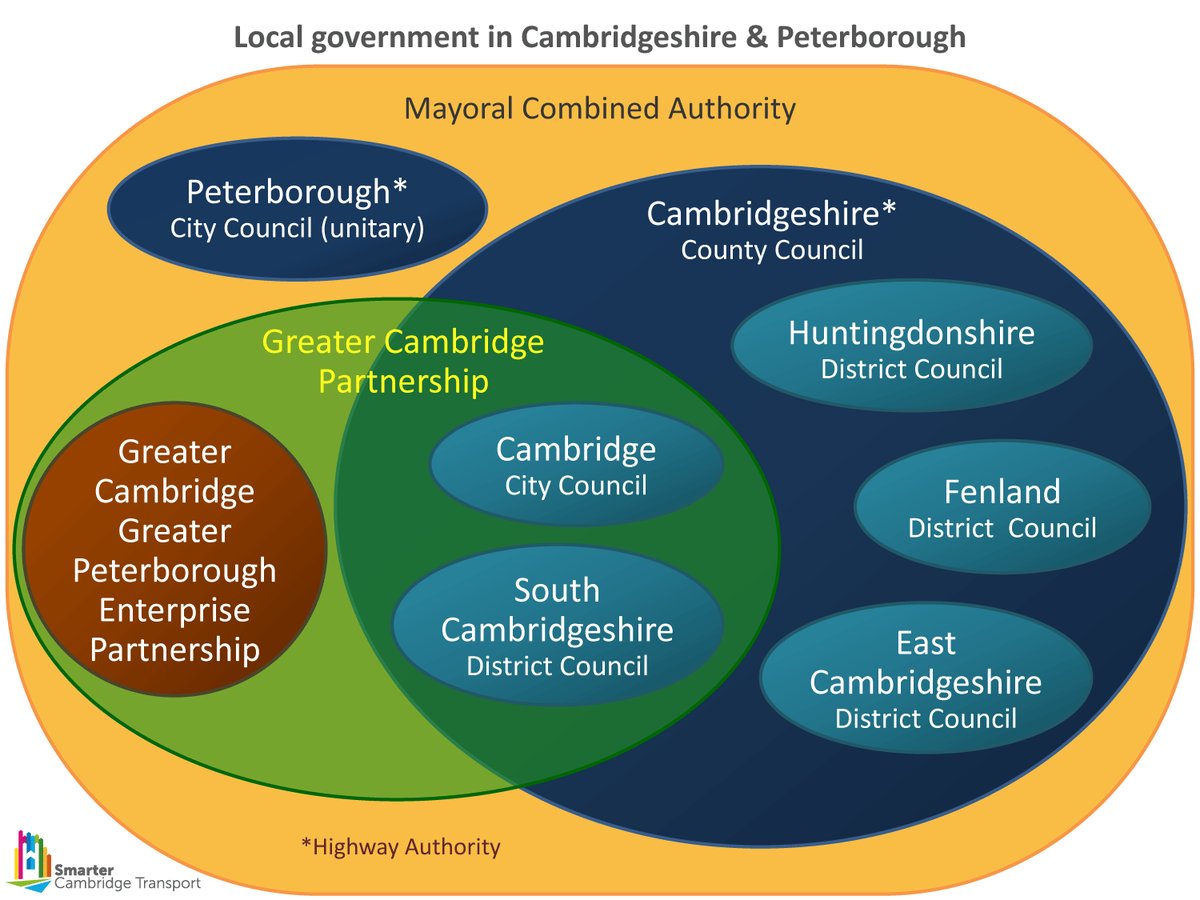
It would appear that, despite the Greater Cambridge Partnership (of which Cambridgeshire County Council is a constituent member) wanting to drive up standards for air quality – they are actively considering an ULEZ – the County are undermining the Partnership.
And, yes, we have a confusing plethora of tiers of local governance as this Smarter Cambridge Transport graphic shows.
Air pollution and climate changes
One of the problems we have, when discussing ‘greener’ transport, is the failure to distinguish between cutting the CO2 emissions from all internal-combustion engines (including non-chargeable hybrids) – which add to the ‘greenhouse effect‘ and reducing the NOx PM10 and PM2.5 emissions which cause air pollution.
And don’t forget…
Whilst Cambridge Area Bus Users believes that all major operators, in all regions, need to be trialling electric and hybrid vehicles, the Euro VI diesel bus is still an important part of the solution, according to Professor David Begg.
Begg, visiting professor in sustainable transport at Plymouth University, publisher of Transport Times (a leading UK trade magazine), and running a series of transport related awards schemes in conjunction with Department for Transport (DfT), Transport Scotland and Transport for London (TfL), argues here that the Euro VI bus is an essential part of ULEZs.
Prior to carrying out research on vehicle emissions earlier this year I subscribed to the view that all diesel vehicles should be banned from Clean Air Zones. I now see the latest Euro VI Diesel bus as a crucial part of the solution to our air quality challenge.
If diesel buses are banned from Clean Air Zones bus passengers will experience a reduction in service levels of at least 80%. A reduction of service of this magnitude will not only be disastrous for bus passengers it will also have severe consequences for city economies, road congestion and social inclusion, causing levels of social deprivation to rise by nearly a third.
What surprised me in my research was just how clean Euro VI buses are and the extent to which diesel bus technology has progressed. It’s a pity that car manufacturers have not made the same progress nor inspired the same level of confidence in their vehicles when it comes to emission standards.
Professor David Begg, ‘Why the Euro VI bus is essential to the success of Clean Air Zones‘ in Greener Journeys, 14th November 2017
For those wishing to explore the details…
European emission standards for heavy-duty diesel engines, g/kWh
| Tier | Date | CO | HC | NOx | NH3 [ppm] | PM |
| Euro I | 1992 < 85 kW | 4.5 | 1.1 | 8.0 | 0.612 | |
| Euro I | 1992 > 85 kW | 4.5 | 1.1 | 8.0 | 0.36 | |
| Euro II | Oct 1995 | 4.0 | 1.1 | 7.0 | 0.25 | |
| Euro II | Oct 1997 | 4.0 | 1.1 | 7.0 | 0.15 | |
| Euro III | Oct 1999 EEVs only | 1.5 | 0.25 | 2.0 | 0.02 | |
| Euro III | Oct 2000 | 2.1 | 0.66 | 5.0 | 0.10 0.13* | |
| Euro IV | Oct 2005 | 1.5 | 0.46 | 3.5 | 0.02 | |
| Euro V | Oct 2008 | 1.5 | 0.46 | 2.0 | 0.02 | |
| Euro VI | Dec 2012 | 4.0 | 0.16 | 0.46 | 10 | 0.01 |
[Adapted from European emission standards, Wikipedia]
The International Council on Clean Transportation has published A technical summary of Euro 6/VI vehicle emission standards (PDF) which explains (inter alia) the tighter testing regimes for heavy Euro VI engines vs the Euro 6 diesel car/van.
Please note that any advertisements which appear in association with these posts are not indicative of any endorsement by Cambridge Area Bus Users. They are placed there by a WordPress algorithm.
Please add your comments.

 Cambridge Area Bus Users