Greater Cambridge Growth: Planning for Bus Services

Cambridge Area Bus Users was particularly concerned about Policy I/ST – Sustainable Transport and connectivity. In our view this policy is ineffective in ensuring that new developments are highly permeable by buses.


(Note: Greater Cambridge Shared Plannning is the Shared Planning Service between Cambridge City Council and South Cambridgeshire District Council. It is not the same body as Greater Cambridge Partnership which is the delivery body for the devolved City Deal signed in 2014)


Our PDF – New Developments – street layout for efficient bus operation – is based on our response to the Greater Cambridge Local Plan. It draws heavily on advice contained in two publications:

Below are some excerpts from our supporting evidence.


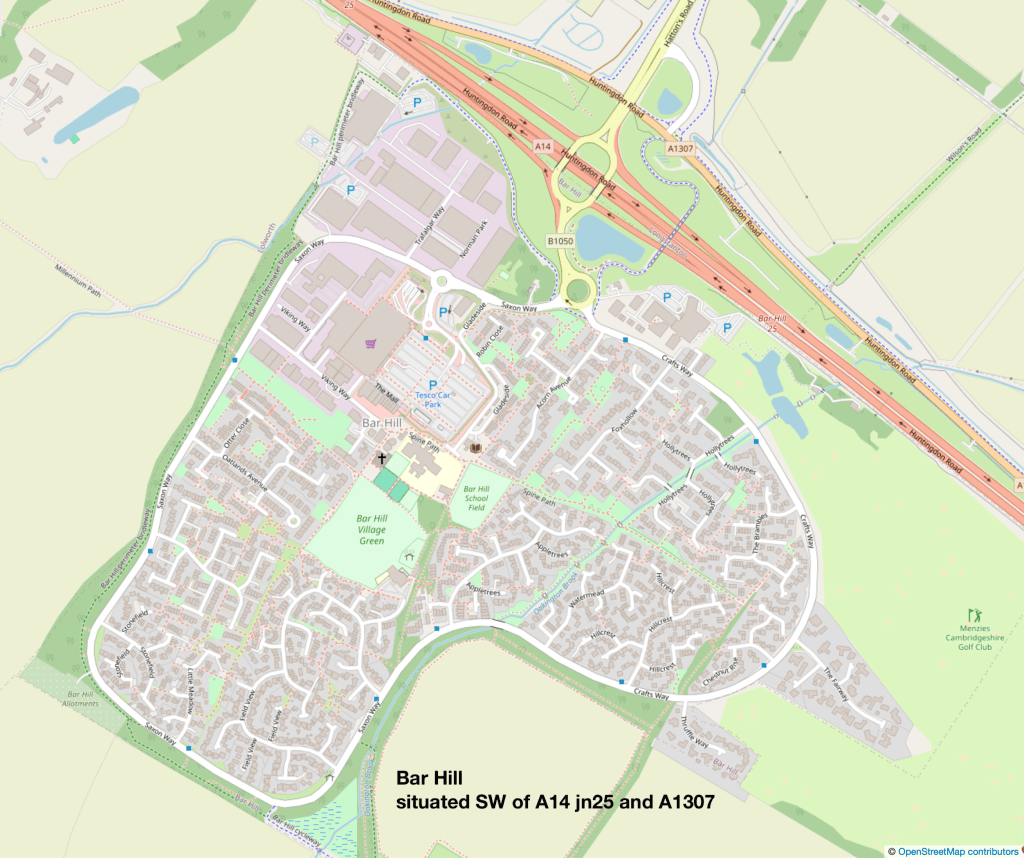
Map of Bar Hill

Bar Hill, established in the 1960s, SW of what was, at the time, the A604 Cambridge – Huntingdon road was a missed opportunity for bus permeability. In particular the possibility of being served by attractive, fast, Cambridge – Bar Hill – Huntingdon services, was lost as a result of the car-centric layout of an orbital distributor road with residential culs-de-sacs. This imposes an unattractive, loop service on the bus operator, with a time penalty of around 10 minutes to access, loop and exit the settlement. Albeit there is a network of footways throughout the village, to encourage active travel, the highway layout is fundamentally flawed in failing to plan for attractive bus services.

Construction of Cambourne, situated south of the A428 and east of the A1198, began in June 1998, with the first house occupied in August 1999. The road layout exemplifies the gratuitous curves and tight bends with poor visibility which should be avoided in planning for bus permeability in new developments.
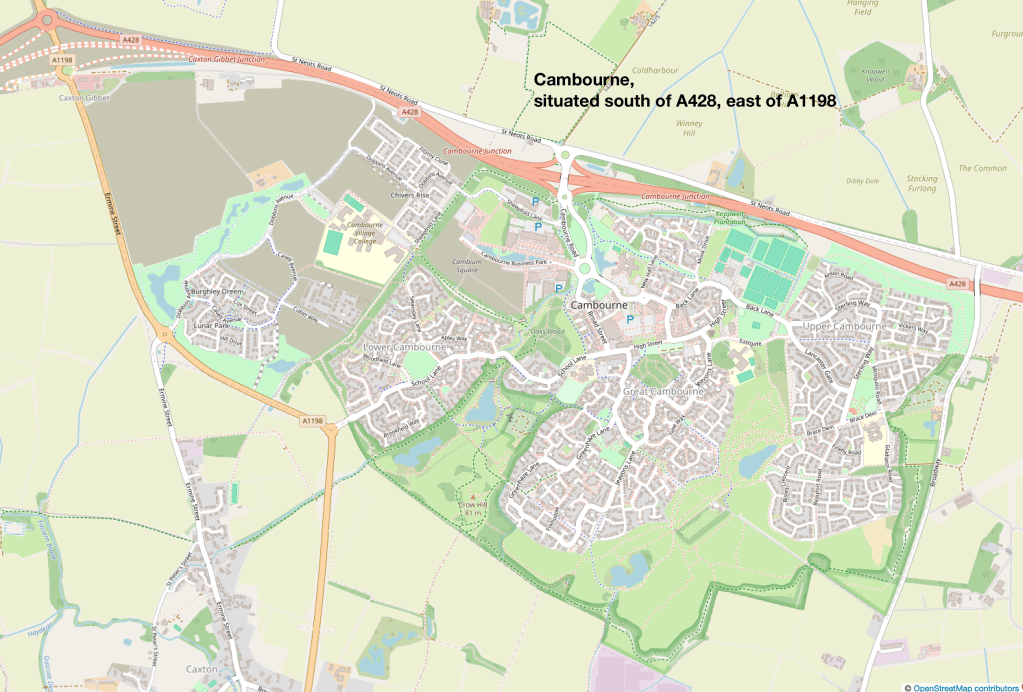
Map of Cambourne

With only northern (A428) and western (A1198) entry/egress to the ‘super village’, Stagecoach East’s service 4 must follow a difficult and indirect pair of loops, to serve Great Cambourne and Upper Cambourne, as shown on the route map, below.
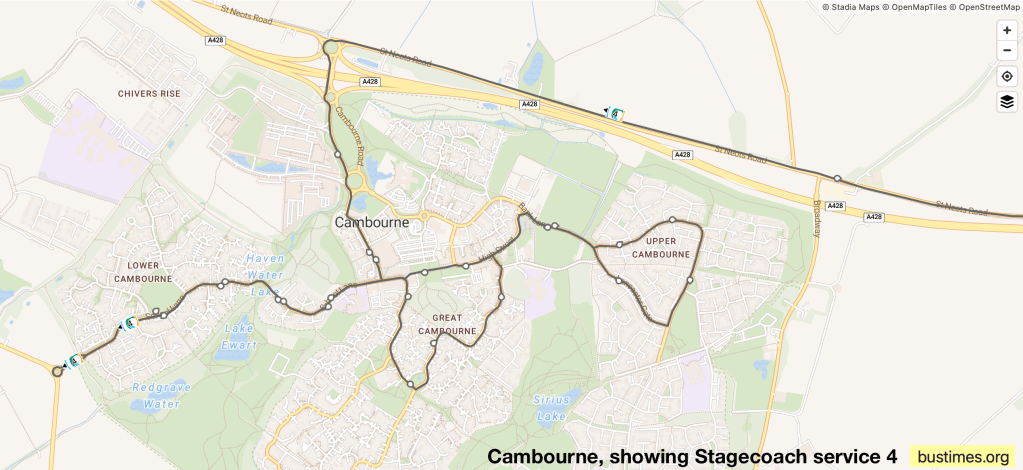
Map of Cambourne, showing route of Stagecoach citi 4

Passengers travelling to/from Cambridge thus have much slower services because of the lack of planning for any direct, east-west bus priority route through the settlement. The time penalty disadvantage of the sub-optimal nature of bus route 4 further imposes costs on the bus operator, threatening the sustainability of the service. Furthermore, the southernmost parts of the settlement are not served by buses, leaving residences in Jeavons Lane and Whittle Way some considerable distance (600m – 800m) from the nearest bus stop.

Additionally, the smooth operation of Stagecoach’s route 4 and the two through services – Whippet’s routes 18 and X3 – are hampered by the gratuitous curves, tight bends and poorly regulated car parking on the shared section along School Lane and Broad Street.


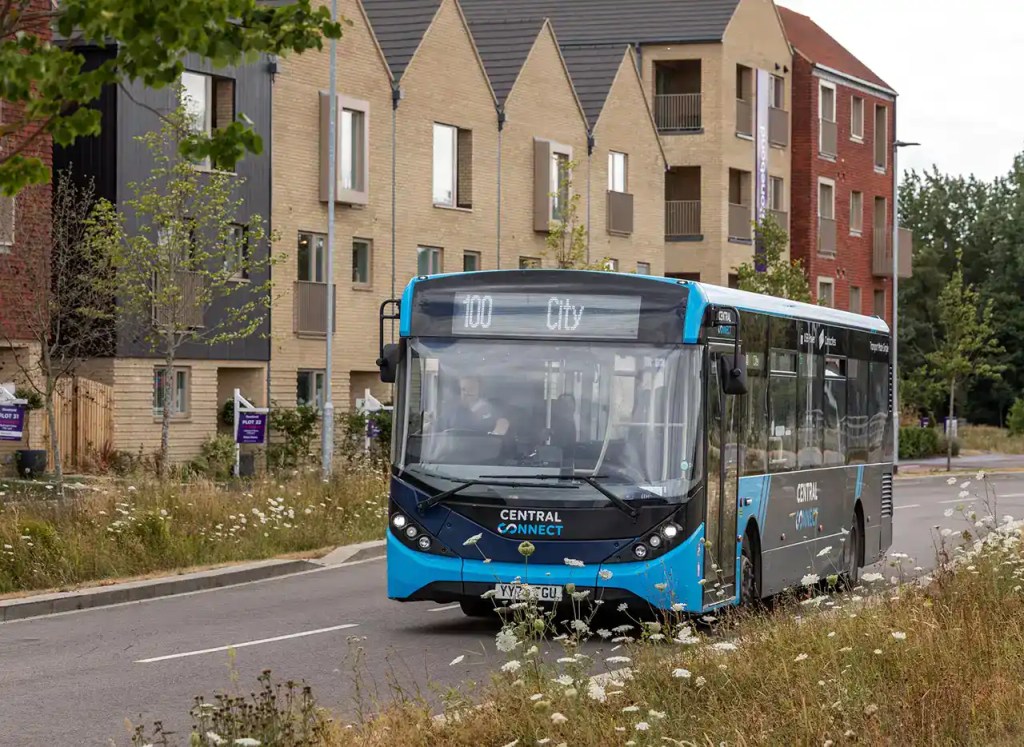
central-connect-bus-service-waterbeach

The Waterbeach new town development of around 11,000 homes, being built on the site of the former Waterbeach Barracks and Airfield, has been designed to prioritise active travel and public transport from the start. The western sector of the development is led by Urban&Civic as the master developer and has included a Sustainable Travel Hub, installed ready for the arrival of the first residents, and an initially half-hourly shuttle bus service connecting to Waterbeach Station, the Science Park, and Cambridge city centre [Waterbeach website: Connections]. Phase 2 will include a “bus only main link” through the site, connecting destinations including schools, a health facility and a new town centre [Waterbeach website, news blog, 19 May 2026].


For the full details of our submission see – New Developments – street layout for efficient bus operation – which is based on our response to the Greater Cambridge Local Plan.

For more on the Cambridgeshire Sustainable Travel Alliance’s objections see: Travel Alliance’s objections to the Local Plan.
Combined Authority Must Invest in Improved Bus Services


Cambridgeshire and Peterborough Combined Authority is holding an additional bus franchising consultation. Changes to how buses would be brought under local control are proposed, in large part as a consequence of Mayor Paul Bristow’s decision to freeze the Mayoral precept (the portion of council tax the Mayor levies). The Travel Alliance urges you to respond to the consultation questionnaire calling for increased investment by the Combined Authority in buses and an expanded public transport network.

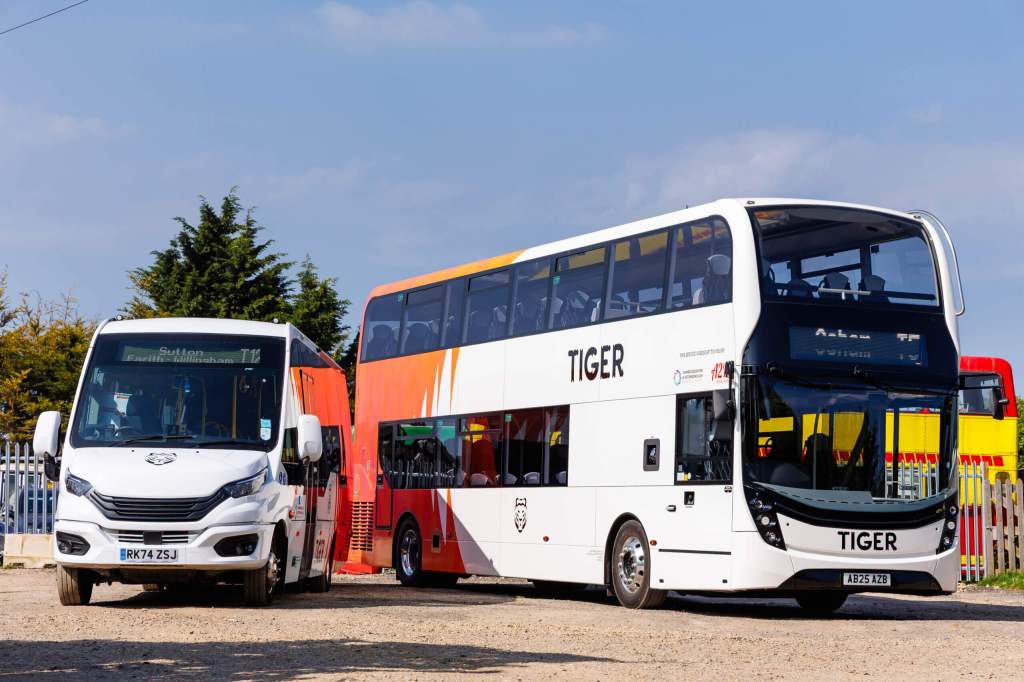
Image from Cambridgeshire and Peterborough Combined Authority of two buses in the 'Tiger' colours.

The Mayor’s decision to freeze the Mayoral Council Tax Precept has led to a significant change in the financial assumptions underlying the original franchising business case. The previously planned Mayoral Precept increase for an average Band D household from the current 10p/day to 16.5p/day by 2032 and 20p/day in 30 years time is much lower than the amount of Council Tax currently levied by the Police and Crime Commissioner (86p/day), and by the Fire Authority (25p/day). It is also lower (in some cases much lower) than many parish precepts: South Cambridgeshire’s parish precepts, for example, are currently as much as 53.5p/day (Great Shelford) with a South Cambridgeshire average of 26.5/day.


Cambridge Area Bus Users collaborated with Cambridgeshire Sustainable Travel Alliance to produce a guide to the Combined Authority’s Bus Franchising Supplementary Consultation

The full guide can be found on the Travel Alliance website: Consultation guide – Don’t miss your chance to call for more investment in buses.

How many stops before I get off?

If you’ve been travelling by bus in and around Cambridge recently, you should have noticed more buses announcing and displaying the next stop.


Under the Public Service Vehicles (Accessible Information) Regulations 2023, bus operators across Great Britain are now legally required to provide both audible and visible next-stop and route information on all local buses. This is a win for accessibility, making bus travel in the Cambridge area more reassuring for visually or hearing-impaired passengers, tourists, and everyday commuters alike.

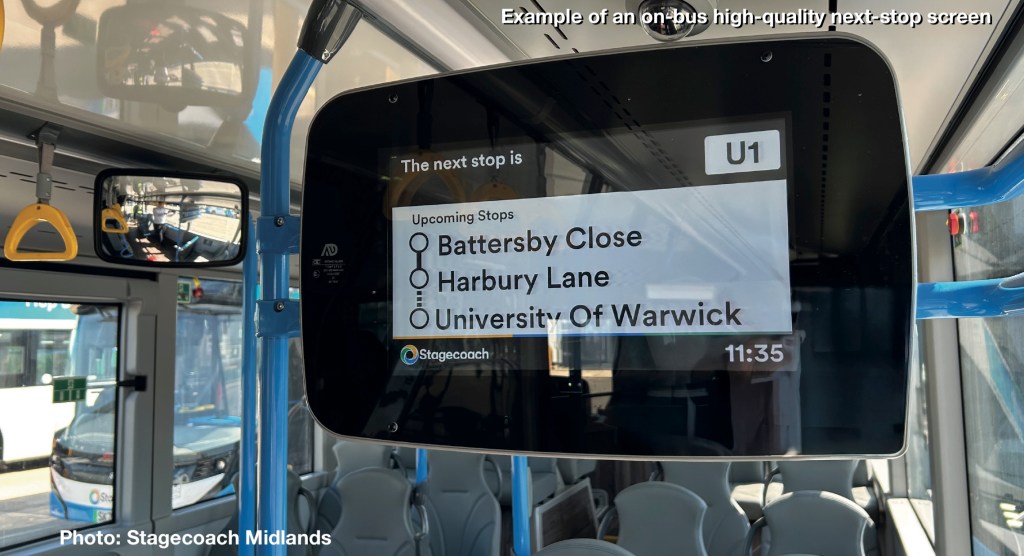
Example of an on-bus high-quality next-stop screen displaying
Route: U1
Upcoming Stops
Battersby Close
Harbury Lane
University Of Warwick
Time: 11:35
Photo credit: Stagecoach Midlands
Not all screens will be as good as this!

  • The regulations do not apply to demand-responsive transport services, such as Tiger-On-Demand, because it is impractical when the route and stopping places are not pre-defined.
  • Services operated by minibuses (vehicles designed to carry 16 or fewer passengers) are exempt from providing accessible information.

Here is Cambridge Area Bus Users‘ focus:

Although the law is now in full effect, equipment isn’t helpful if it’s muted, switched off, or glitching. We will be actively monitoring services across local bus operators. If you’ve travelled on a bus with faulty or inactive audiovisual announcements, please report it to the bus operator. See our Information: Operators page for contact details. Whenever possible email the operator and copy us in to the email on contact.cabu@gmail.com.

As Greater Cambridge heads toward a franchised bus network, basic next-stop announcements should only be the starting point. We want to see rich, contextual passenger information – especially at key hubs. Imagine hearing:

Next Stop: Addenbrooke’s Hospital. Interchange here for Route 13 towards Linton/Haverhill and Route 7 towards Sawston.

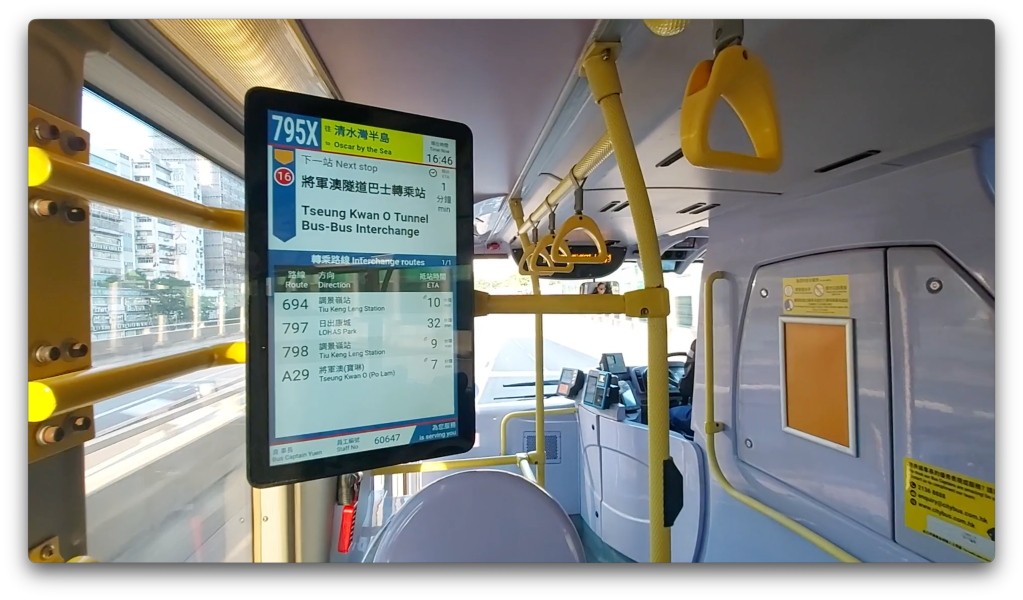
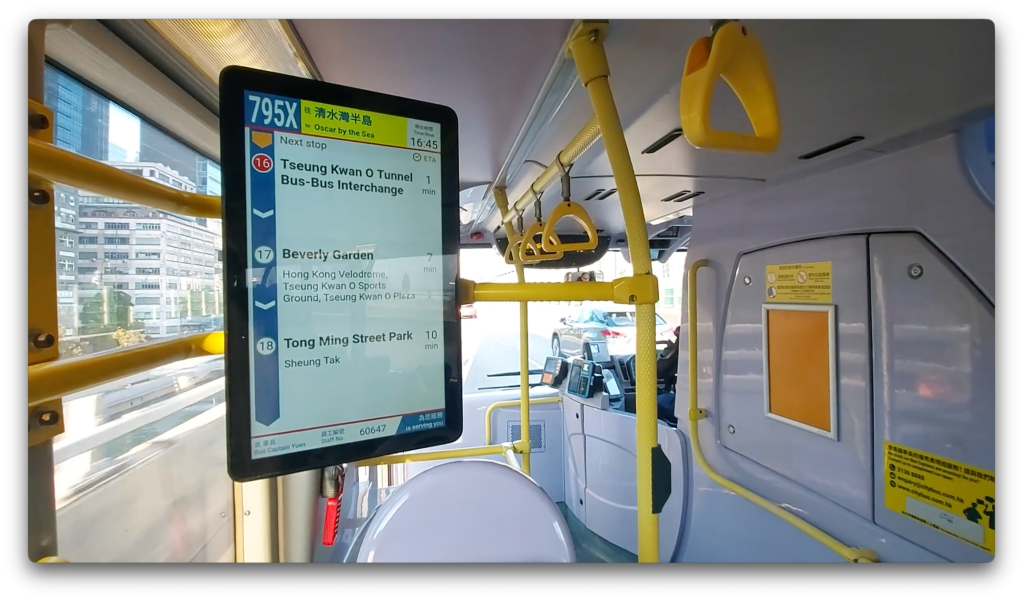
Why stop at static announcements? Some systems around the world are starting to adopt dynamic onboard displays that show live real-time arrival countdowns for connecting services at upcoming interchanges. (See this slideshow from Hong Kong.) We believe the Cambridge area – world renowned for its technological expertise – deserves similar forward-thinking changes as part of the Cambridgeshire and Peterborough Combined Authority’s bus franchising vision.


Have they been working well, or are there routes where compliance is falling short?

You are welcome to help us compile data to monitor compliance, using this email link: Bus AV Announcement Compliance. Note, however, that we cannot take up complaints on your behalf. For more information, see our Making a Complaint about Bus Services page.


Statement regarding approval for the Cambourne to Cambridge Busway

In light of the recent decision to approve the proposed Cambourne to Cambridge busway, Cambridge Area Bus Users makes the following statement:


Cambridge Area Bus Users is generally supportive of initiatives that will lead to improved services for passengers. This is especially important in the Cambridge area in the absence of any serious attempt to address congestion that impacts on the efficiency of bus services, and a more effective use of the road network.

The recent approval by government inspectors of the Greater Cambridge Partnership’s proposals for a dedicated busway between Cambourne and Cambridge might be seen as a largely positive development. It is not. There is no plan for the route or routes that buses will take at the end of the busway in the Grange Road area; the segregated bus infrastructure stops once it reaches the outskirts of Cambridge and is missing where it is most needed; a route to Grange Road fails to address the needs of those attempting to reach the major travel destinations in the north, south, east, or centre of Cambridge; the proposed schedule of services fails to meet the capacity needs of the planned 2000-space car park at Scotland Farm, let alone the residents in 19,500 homes in Cambourne or the new development at Bourn Airfield. It will not help residents reach jobs, customers reach shops, youngsters get to school, or those not in education, employment, or training access the opportunities they need.

Lacking the ambition and scale that Cambridge so desperately needs, the busway as proposed will fail to address our current transport challenges, forcing more people into cars, depressing the local economy and inhibiting growth.

Crucially, since the initial plans for the busway were formed over a decade ago, Cambridge has moved on, and the project is outdated and has been superseded by events. We have plans for East-West Rail to have a station at Cambourne, providing a significant access corridor to Cambridge South. The Greater Cambridge Development Corporation is a new body established to facilitate urban development in Cambridge and South Cambridgeshire, focusing on delivering infrastructure alongside new homes, specifically including Transport links. The Cambridgeshire and Peterborough Combined Authority has an elected Mayor responsible for the Local Transport Plan, with plans for a Mass Rapid Transit system. The operation of the bus network is planned to move to a franchised model. Any new transport infrastructure should be part of a fully integrated plan, rather than isolated piecemeal efforts.

It is CABU’s view that no work should commence on the proposed busway until the issues surrounding where and how passengers go from Grange Road has been resolved, that adequate capacity and performance have been demonstrated, and that it is demonstrated how the proposal integrates with the wider transport strategy for Greater Cambridge; unless it can be shown that the busway as planned can meet those requirements, we should look to alternative proposals that can meet the needs of those travelling around Cambridge.


For more information, contact us.

Whippet changes (66, X2, X3) from 6th September

Whippet are introducing a number of changes on routes 66, X2 and X3 from next Sunday, 6th September. In the case of routes 66 and X3 this includes ADDITIONAL SERVICES!

There are minor changes to improve punctuality on route 66, Monday-Friday only. And on Sundays there’s an additional service in each direction, Fenstanton-Godmanchester.

The new X2 timetable has been modified to allow for journeys during school terms taking longer than during the holidays. Or being quicker during school holidays, depending how you view these things.

Changes to help with punctuality are also being introduced on the X3, Monday-Friday. But on Sundays, there’s a doubling of services between Cambourne and Cambridge, with buses running every 30 minutes during the day. There’s also one additional Huntingdon-Cambridge journey.

Further details and links to the new timetable for each service are available from the Whippet website.

Bus Stops: The Good, The Bad, And The Ugly


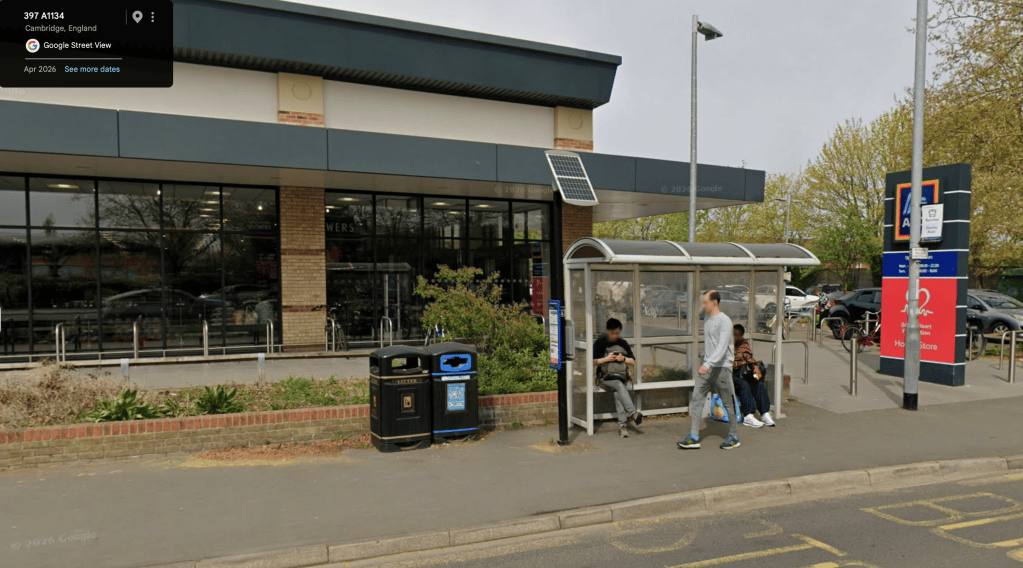
Just an unremarkable stop. What’s special about that?

As caption and subsequent text
Stanley Road (outbound) 0500CCITY165 (outside Aldi, Newmarket Road, Cambridge). Click the image to explore on Google Maps.

At first glance this is an unremarkable stop. There are, however, a number of features which suggest that whoever commissioned and installed the infrastructure was actually thinking about the needs of bus passengers.

This stop is provided with a shelter, with integral seating, set back at the edge of the highway boundary. A bus stop flag has been mounted on an adjacent street-lighting column. Real-time passenger information, of e-paper type, powered by a solar panel, is installed close to the shelter at the upstream end. A lockable case contains printed route/timetable information. There are no obstructions for passengers boarding/alighting. Litter bins are well-sited. A raised kerb aids easy boarding/alighting, which is of particular benefit to wheelchair-using passengers and parents with children in buggies.


What’s so bad about that? There’s a shelter.

As caption and subsequent text
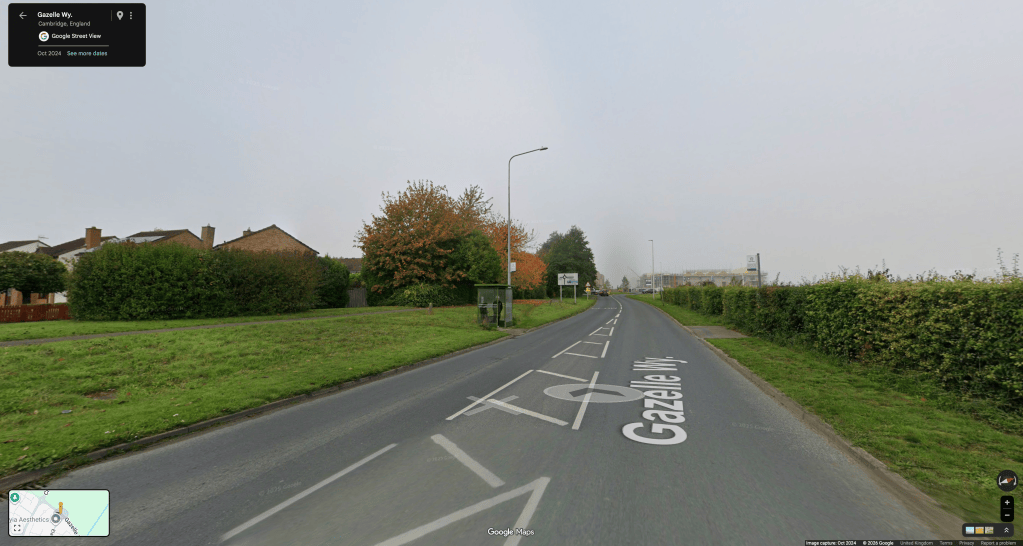
Eland Way (NaPTAN 0500STEVE013) towards Addenbrooke’s and city (left) and (NaPTAN 0500STEVE016) towards Tesco and Fulbourn (right) on Gazelle Way Fulbourn/Cherry Hinton. Click the image to explore on Google Maps.

Addenbrooke’s and city-bound passengers benefit from a shelter with integrated seating and hardstanding, whilst Fulbourn-bound passengers have no shelter. Both stops benefit from timetable cases, although the city-bound timetable is cunningly hidden the wrong side of the lamp-post. However neither stop could be considered accessible. Reaching the stop on the left involves slithering down a grassy bank; the stop on the right additionally involves the hazard of crossing a 40mph road with no pedestrian crossing.


Another one with a shelter? Are we being picky?

As caption and subsequent text
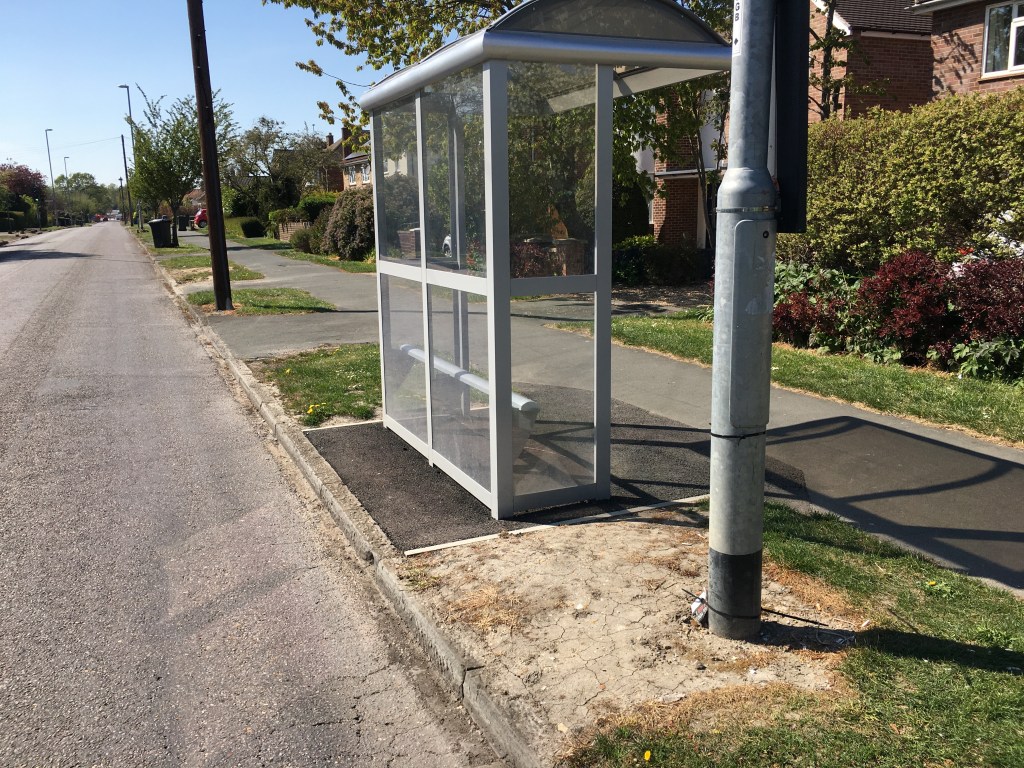
Almoners’ Avenue (NaPTAN 0500CCITY267) on Queen Edith’s Way towards Cherry Hinton. Click the image to explore on Google Maps.

There is, indeed, a shelter, with hardstanding and integrated seating, and a printed timetable in a locked case. However, neither the contractors nor whoever commissioned the infrastructure seem to have considered where passengers would board, or alight from, buses. The adjacent patch of parched, dry soil is fine for able-bodied passengers in good weather.

When that patch is wet, muddy and slippery, it is a hazard for all passengers, but particularly those using wheelchairs or other mobility aids.

PS: explore this stop on Google Maps. Should it now be in the ‘Ugly’ category?


Ah, point taken.

As caption and subsequent text
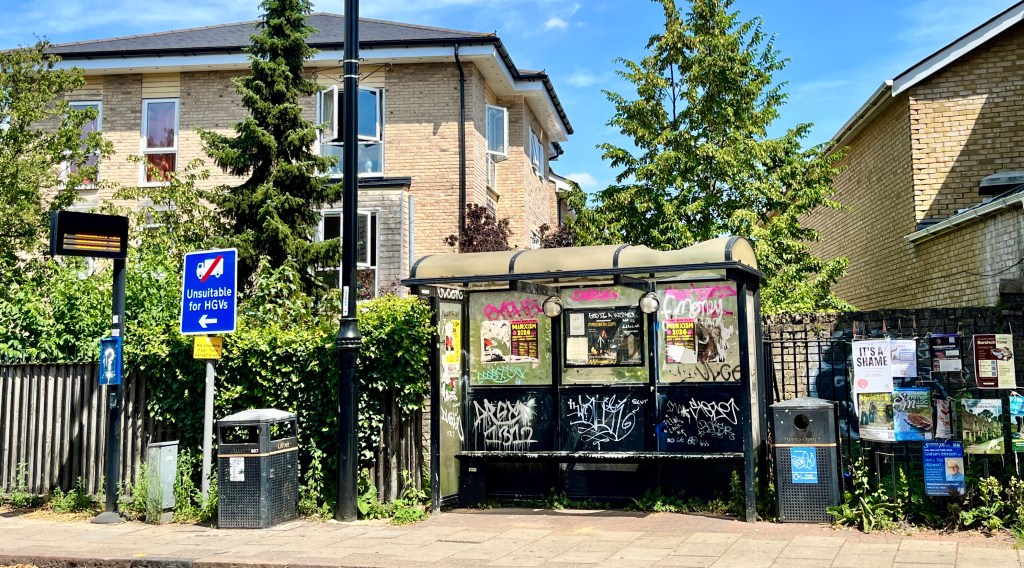
The bus stop infrastructure at Gwydir Street stop (towards Addenbrooke’s, NaPTAN 0500CCITY404) on Cambridge’s Mill Road. Click the image to explore on Google Maps.

The shelter has a broken roof, is covered in graffiti and fly-posting. The pole supporting the adjacent real-time passenger information display also hosts a timetable case, which is empty and graffitied. We are uncertain who is responsible for this shelter…


Responsibility for bus stops in the Cambridge area is split between various bodies. Here is brief digest:

  • Cambridgeshire County Council (the Highway Authority) is the body which has traditionally approved the siting of bus stops – although the Cambridgeshire and Peterborough Combined Authority is now the Transport Authority, so there are overlapping responsibilities.
  • Bus stop locations should then be entered on the National Public Transport Access Nodes (NaPTAN) database.
  • The Combined Authority and/or Highway Authority is responsible  for providing good hard-standing for bus stops; and should provide a bus-stop pole, unless an adjacent street-lighting column can be used.
  • Provision of a bus stop flag is, currently, the responsibility of the bus operator, as is a timetable case and printed timetable.
  • Real-Time Passenger Information displays (pole-mounted, integral within a shelter, or of the more modern, compact e-paper type), if provided, is the responsibility of the Combined Authority. The RTPI feed is operated by contractor Vix Technology on behalf of the Combined Authority.
  • Bus shelters are, generally, the responsibility of the lower-tier authorities (eg Cambridge City Council, South Cambridgeshire District Council) who may have agreements with advertising companies (eg Bauer Media Outdoor UK, formerly Clear Channel/JC Decaux) which provide and maintain some shelters (in return for the right to sell static or moving advertisements). Additionally Parish Councils may choose to install shelters and seating. (Good examples can be found in the Histon & Impington and Great Shelford parishes.)
  • However, when roads are re-modelled (Hills Road, Histon Road, Milton Road) using Greater Cambridge Partnership money it is unclear who has responsibility for design of siting of stop and shelters.
  • Cambridge Area Bus Users is not aware of the existence of any bus stop design manual published or followed by the Combined Authority to guide new installations, or programmes of improvement.

Cambridgeshire and Peterborough Combined Authority have a poor inheritance, from when Cambridgeshire County Council were the Transport Authority.

Back in April 2019, a (then) senior county councillor and (then) public transport officer, explained that:

Bus stop locations are the decision of the county council in consultation with bus operators and are then entered on the National Public Transport Access Nodes (NaPTAN) database. A pole may be provided where a convenient piece of street furniture, such as a street lighting column, is not available. It is the responsibility of the operator to mount their flag on the pole. Timetable frame and flag are installed by the bus operator. Only about half the stops have a flag, the rest are unmarked.

It was only on 15th November 2023, following public questions on behalf of Cambridge Area Bus Users, that the Cambridgeshire and Peterborough Combined Authority’s Transport & Infrastructure Committee agreed that:

(7.2.e) The CPCA would go through an options process to understand what was the right approach for a combined authority to take in regard to ownership and maintenance of bus stop infrastructure.

Translation: The Combined Authority know the locations of bus tops (from the NaPTAN database) but we’ve no real idea what’s installed at each location: pole? bus stop flag? timetable case?shelter? seat? Oh, and we don’t really know who installed what, still less who is responsible for maintaining what.

The Deputy Mayor at that time, Anna Smith, did promise that there would be a nominated officer charged with oversight of bus stop infrastructure. See: Transport & Infrastructure Committee Draft Minutes Wednesday 15th November 2023.


At the Cambridgeshire and Peterborough Combined Authority Transport Committee on 4th March 2026 a programme of Bus Stop Infrastructure Improvements was agreed.

To see if there are improvements planned for a bus stop which you use, read/download the Bus Stop/Shelter Infrastructure Improvements programme PDF produced by Systra for Cambridgeshire and Peterborough Combined Authority. The criteria for selection can be found in this report to the committee: Bus Stop/Shelter Infrastructure Improvements Report.


The October 2023 joint position paper from Cambridge Area Bus Users and Living Streets, Cambridge has a good summary of our views. Additional links are provided for those who would like to read more.


  • Our Executive Committee diligently report failures of the RTPI system – both of hardware and data.
  • We are looking, more strategically, on why some services do not seem to track, or to give a realistic estimate of bus arrival times.
  • A survey of printed information (or the lack thereof) at key locations is also being undertaken.
  • Our Executive Committee member for St Ives has worked with others to produce an information leaflet and vastly improved printed information in and around St Ives Bus Station.

All of these will form the subject of forthcoming posts.


Forthcoming changes to services U1, U2 and T3

Minor changes are coming up on Whippet’s Universal services and on the Stagecoach T3.

On 30th August, the summer service on Whippet’s Universal services U1 and U2 comes to an end. A slightly-revised version of the previous timetable, with minor changes to most peak-time journeys, will operate from 31st August. The new timetables can be found here.

From 1st September, Stagecoach service T3 will be rerouted in the Great Shelford/Stapleford area. It will no longer use Station Road in Great Shelford (and will avoid the problems that the station level crossing can cause). Instead, buses from Grantchester will continue down London Road (calling at the Granta Terrace stop), before turning left to serve the stops at St Andrew’s Church and The Limes on Mingle Lane. On rejoining Hinton Way the existing route remains unchanged. In the reverse direction, buses will turn left from Hinton Way into Mingle Lane, and then proceed via St Andrew’s Church to London Road.

The new timetable isn’t available for download from the Stagecoach website at the time of writing (25th August), but is available for consultation at Traveline. Changes to timings are slight.

Buses after Cambridge United weekday home matches

For 10 weeks during last winter, Stagecoach ran buses following Cambridge United’s weekday home matches to get spectators back to Newmarket Road Park & Ride.

Happily, Stagecoach have confirmed to us that these journeys will continue for the 2026-27 season. Buses leave from outside the Cledara Abbey Stadium at 2130 and 2200 and operate as service PR2F. There are also services in the opposite direction at 2120 and 2150.

Annual General Meeting and Executive Committee Summer 2026 update

Cambridge Area Bus Users’ Annual General Meeting was held on Saturday 11 July 2026 at 14:45, in the Great Western Room, The Signal Box Centre, 82 Glenalmond Avenue, Cambridge, CB2 8DB
Eighteen members were present, with apologies received from another ten members.


Hugh Taylor (Vice Chair 2025-26), Richard Wood (Secretary 2025-26) and Miranda Fyfe (Treasurer 2025-26) contributed opening remarks, including a special thanks to Peter Griffin (Chair 2025-26, who needs to move to Nottingham for family reasons) for steering the Executive Committee through the first post re-launch year; an overview of the Executive Committee’s work over the year; and the financial report, respectively.

Executive Committee member Sarah Hughes (also Campaigns Officer of the Cambridgeshire Sustainable Travel Alliance) added further detail of Cambridge Area Bus Users’ collaborative work with the Sustainable Travel Alliance and with Cambridge Citizens.

For full details, view/download the Report on Cambridge Area Bus Users Annual General Meeting 2026 (PDF)

The work of St Ives Executive Committee member Anthony Stanton, in collaboration with St Ives Cares, St Ives Town Council and others in producing publicity to promote local bus services was also highlighted. View/download the excellent St Ives Bus Leaflet (PDF). The Executive Committee believes that this is an exemplar of how our transport authority (Cambridgeshire and Peterborough Combined Authority) should be marketing our bus services.


In 2018, Cambridge Area Bus Users was established as an affiliate of Bus Users UK. the constitution adopted at the Inaugural General Meeting reflected this. Bus Users UK no longer have an affiliate structure. An update to our constitution was required. View/Download the 2026 constitution here.


The following ten members of Cambridge Area Bus Users were elected, nem con:

Aland Chan
Miranda Fyfe
Geoff Heathcock
Sarah Hughes
Mark Reader
Anthony Stanton
Hugh Taylor
Martin Thorne
Peter Tribble
Richard Wood

At the first Executive Committee meeting for 2026-27 held online on 4th August 2026 the officer positions were agreed as follows:

Chair: Hugh Taylor
Secretary: Richard Wood
Treasurer: Miranda Fyfe
Vice-Chair: Peter Tribble


  • St Ives Bus publicity (see above) and improvements to information in St Ives bus station and the Station Road stop
  • Frequent reports on errors with at-stop and online real-time bus information
  • Liaising with Living Streets, Cambridge, and Highway Officers about improving safe pedestrian routes across Emmanuel Street and St Andrew’s Street
  • Liaising with the Cambridge Citizens group campaign to retain and enhance the Tiger Pass for  young passengers
  • Collaborating with planners and designers working on improvements to Mill Road, Cambridge, to improve bus stop infrastructure
  • Pressing Cambridgeshire and Peterborough Combined Authority for improvements to bus stop infrastructure (see separate, forthcoming post)
  • Questioning Cambridgeshire and Peterborough Combined Authority about funding for improved bus services
  • Meeting with senior management of bus operators and with key politicians to share insights
  • Continuing work on improving and updating our website
  • Increasing and improving the relevance of our social media channels
  • Responding to the Cambridgeshire and Peterborough Combined Authority Bus Network Review (see separate post)

With Cambridge Area Bus Users having returned to active campaigning, we hope that many more of those on our mailing list will be inspired to make the suggested £5 per year (£10/year for a family) contribution towards this work.

Members can make one-off payments or regular (Standing Order) payments into our bank account or you can  donate using PayPal (opens in a new tab). Our bank account details are:

Bankers: Barclays
Account name: Cambridge Area Bus Users
Sort Code: 20-17-20
Account No: 33197727

(Please note: we are unable to support Direct Debits. Sorry.)


Combined Authority Bus Network Review

Cambridgeshire and Peterborough Combined Authority recently undertook a public consultation on what they described as a “Bus Network Review” (PDF). Note this “consultation” is now closed.

Cambridge Area Bus Users could not really see the point of spending time and money on these short-term changes, which simply replace one set of partly-unsatisfactory routes and times with a set that’s marginally improved, but which remains straitjacketed by the need to avoid conflicting with “commercial” services. So the revisions don’t necessarily make problems go away, and they won’t until we have franchised services that can combine sections from the current “commercial” and “supported” sectors into one meaningful county-wide network. See our explainer on Franchising.

The Bus Users’ group has been very concerned, for some time, by the limited promotion of Cambridgeshire and Peterborough Combined Authority-supported bus services. This directly links to the use (and, therefore, viability) of these services. This consultation, similarly, did not appear to be directly promoted to the bus passengers it is going to affect (eg at key bus stops).

It’s unfortunate – but not unexpected – that the Combined Authority’s concept of a “bus network” extends only to routes and timetables. The continued lack of through fares where connections are to be made (even when these are all under CPCA control) and the continued exclusion of some services from the Multibus* scheme – even when they’re operating Cambridgeshire and Peterborough Combined Authority-supported services (you would expect signing up for Multibus to be a contractual requirement) – rather diminishes the concept of a “bus network”. Apparently ticketing isn’t thought of as an element of the “bus network”. It definitely is by passengers!

*Some information on the Multibus scheme is available on the hard-to-find TransportCPCA » Home » Buses » Bus tickets page.

Read/download Cambridge Area Bus Users’ response to the Combined Authority Bus Network Review (PDF).


Hi there,

I hope this email finds you well.

Thank you for signing up to receive updates on the Bus Network Review engagement.

The public engagement has now closed, and we’d like to thank everyone who took the time to share their views. We received over 1,000 responses from residents across Cambridgeshire and Peterborough, providing valuable feedback on the proposed changes to local bus services.

We are now carefully reviewing all of the feedback. This will help us refine the proposals before they are presented to the Combined Authority Board in September.

No decisions have been made at this stage. Members of the Combined Authority Board will consider the revised proposals before deciding on any future changes to the bus network.

We’ll continue to keep you updated as the project progresses and will let you know once the Board has considered the proposals.

Thank you again to everyone who took the time to get involved. Your feedback will play an important role in helping shape the future of local bus services across Cambridgeshire and Peterborough.

Kind regards,
Communications Team
consultations@cambridgeshirepeterborough-ca.gov.uk
Tel: 01480 277180