Temporary cycling and walking measures are being put in place across Cambridgeshire during the Coronavirus crisis to help people get out and socially distance during this pandemic.
Many of Cambridgeshire County Council’s schemes will be authorised under an Experimental Traffic Regulation Order (ETRO) which will be in place for 18 months, of which the first six months are a consultation period.
Information above is taken from the Cambridgeshire County Council’s press release, which you can read here: Cycling and walking support in midst of pandemic. The PDF of the full range of proposals discussed at the council’s Highways and Transport committee meeting on 16th June 2020 can be read/downloaded here. It should be noted that this scheme (and others throughout the county) are subject to Statutory Guidance from the DfT.
Many of these schemes will have an impact upon bus services. Cambridge Area Bus Users hope that these will be mostly positive in creating routes that are less accessible by private care but remain accessible to buses and remove congestion. It is quite possible, however, that some schemes will adversely affect some bus services.
Cambridge Area Bus Users would like to hear from you about what is working well, and what is not.
You can add your comments, below this blogpost, or email contact.cabu@gmail.com with details and photos of anything you would like to see published on this site contact.cabu@gmail.com with details and photos of anything you would like to see published on this site, to tell us what you think, and we will pass on your suggestions.
This is not, however, the place for formal feedback on the temporary changes.
You can give feedback either via email at:
policyandregulation@cambridgeshire.gov.uk
or in writing to:
Policy and Regulation Team
Highways Depot
Stanton Way
HUNTINGDON
PE29 6PY
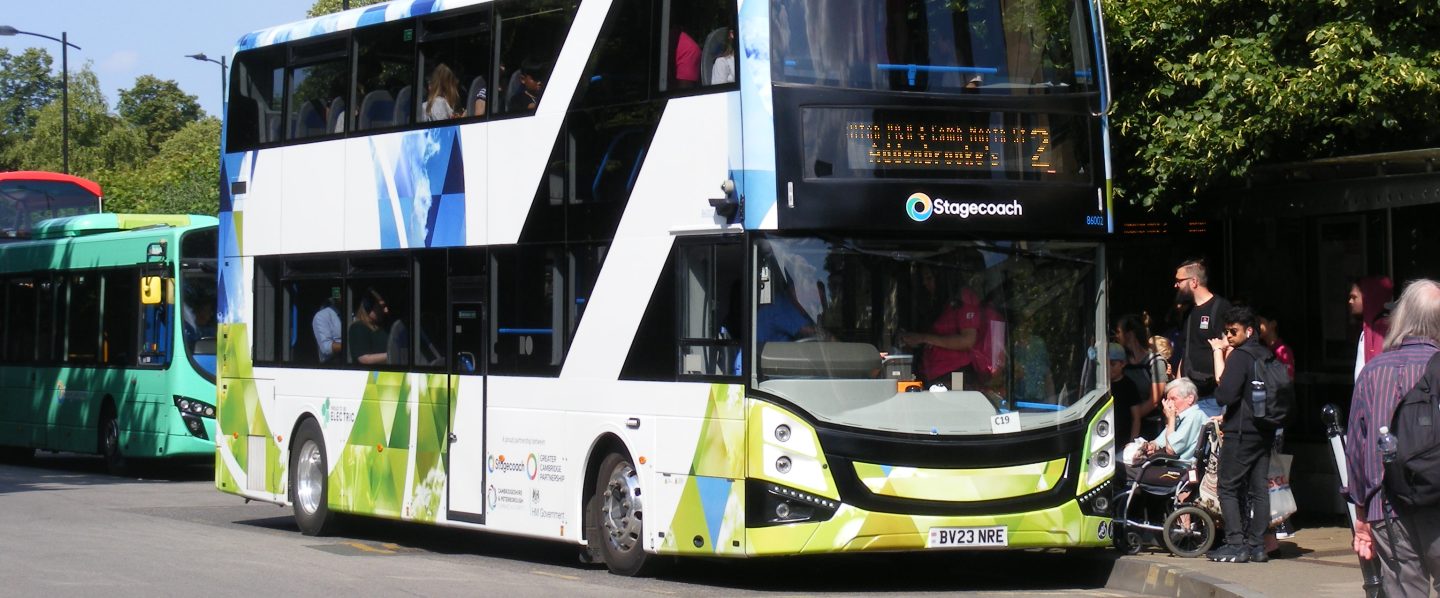
Residents along Stagecoach in Cambridge’s citi2 bus route hope that traffic-reduction measures on Cambridge’s notoriously-congested Mill Road could lead to a full restoration of services to Addenbrooke’s Hospital. We have a separate blogpost on that issue here, click through: Full service to Addenbrooke’s.


Both are correct, Ruth.
The Experimental Traffic Regulation Orders run for 18 months. The first six months are a consultation period. I’ve amended the relevant paragraph in the post to clarify this.
The Mill Road Bridges community group website’s blogpost – Wider footways, barriers and bridge closure – is updated as new issues arise, with links to news articles, videos and photos. It has (at the time of writing) over 140 comments.
LikeLike
The government message ‘don’t use public transport’ is causing a devastating effect on buses, trams and trains at a time when a ‘green agenda’ is supposed to be government policy. Public transport is being progressively destroyed after so many years when it got better. It looks like a thing of the past, and those who can’t drive cars, walk or cycle will have to sit at home and rot. ‘Don’t use public transport’ will cause most routes to be abandoned, sooner or later. No good will come of it.
LikeLike
Many thanks for the info. I did contact the relevant email address, and got a standard response which states the following:
The measures are shortly due to come into operation on an experimental basis and will initially run for A PERIOD OF SIX MONTHS. Further information about the scheme can be found on our website – https://www.cambridgeshire.gov.uk/residents/travel-roads-and-parking/roads-and-pathways/roadworks-and-faults/experimental-traffic-regulation-orders . At end of that period, the Council will consider all feedback received and will decide how best to proceed. We will provide further information about the decision-making process at that time.
The only difference is that my response says for a period of 6 months, whilst yours says for a period of 18 months. I wonder which one is correct?
Kind regards Ruth
LikeLike