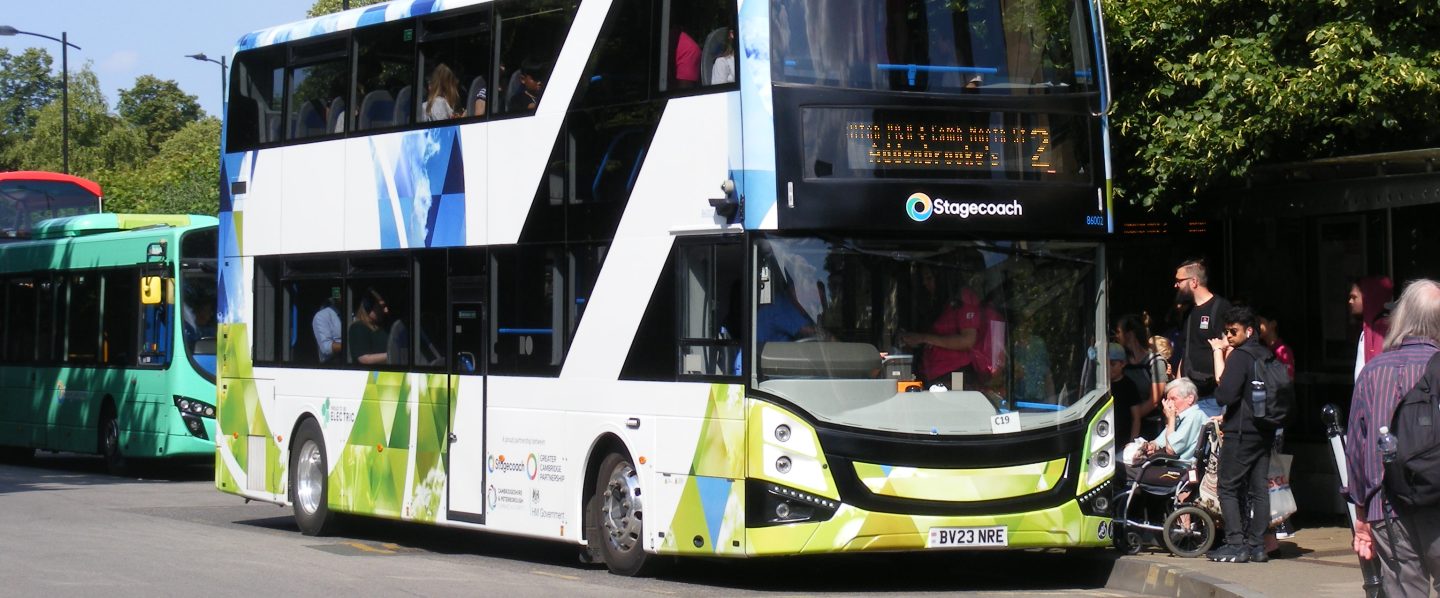
No, it’s not the Greater Cambridge Partnership (the body with the devolved government money) this time; it’s the Cambridgeshire and Peterborough Combined Authority (the body with the devolved powers).
The Cambridgeshire & Peterborough Combined Authority is asking regional residents to share their views on its bus strategy. Its vision is for a “comprehensive network of bus services across Cambridgeshire and Peterborough that people find convenient, easy to use, reliable and good value for money, that is inclusive and offers a viable alternative to the car.”
The Authority aims to more than double bus passenger journeys compared to 2019 levels, to around 60-75 million. Its strategy document does not contain details on specific bus routes or services but instead sets out the “strategic aims, objectives, and aspirations of the Combined Authority which will enable it to bid for further funding and shape the network to meet the needs of the people of the region.” 80% of those that responded to the Authoriy’s survey on buses wanted to see improvements (both bus users and non-bus users) and the Combined Authority believe better public transport will be essential to support the region’s other goals, for example tackling climate change, reducing inequality and delivering sustainable growth.
In collaboration with Cambridge Sustainable Travel Alliance on response advice, we encourage you to have your say. A detailed guide follows below. Share your views before the consultation closes on Friday 24 February through the Cambridgeshire and Peterborough Combined Authority Bus Strategy page.
Before submitting your comments, we recommend skim-reading the Bus Strategy Document (PDF). Click the image below to read/download the document.
Guide to the Bus Strategy Survey
Respond as you see fit, but feel free to incorporate any of the suggested responses which are included in this guide.
Sections one and two
These sections of the survey (Q1-4) requires personal answers as they ask about age, location and how often you use a bus.
Section three: bus strategy vision
The vision is for a comprehensive network of bus services across Cambridgeshire and Peterborough that people find convenient, easy to use, reliable and good value for money, that is inclusive and offers a viable alternative to the car.
The Combined Authority wants to create a more connected region, which will encourage active and sustainable travel, improve health and wellbeing and reduce private vehicle journeys.
Success in achieving the vision will mean more travel by bus and less reliance on car travel. This in turn will help us maintain economic growth, care for the environment and improve quality of life.
To realise the vision, this Strategy seeks to achieve the following:
- A comprehensive bus network, better connecting people to places across all parts of the region and beyond.
- Buses are part of a fully integrated and planned transport system.
- A more affordable network, with simplified fares and capping across the network
- Transitioning to new, low emission vehicles, providing all the benefits of modern bus travel
- A more understandable bus network, services and fares, with clear information and easy ticketing.
- Faster and more reliable journeys by bus, delivered with more effective bus priority measures.
- High quality passenger waiting facilities
- Good quality services with high levels of satisfaction amongst customers.
- A doubling of bus passengers (based on 2019/20 levels) by 2030.
- Less traffic and congestion by attracting car users to buses.
- Better bus infrastructure, including bus shelters and wider real time information coverage
Q 5 Asks: How much do you agree with the Vision of the Bus Strategy Vision?
Please explain why, if you wish, and add any other comments you may have.
See page 9 of the bus strategy document here.
Our suggested response: AGREE
Our reasoning:
We can not recommend a ‘Strongly agree’ response as the vision does not encompass everything we would expect to see in a comprehensive bus strategy.
Our comments:
This strategy should be more ambitious.
Doubling bus passengers by 2030 sounds unambitious given the recent cuts, the impacts of the pandemic and the reduction of car miles required by that date (15%).
In order for this vision to be achievable the Cambridgeshire and Peterborough Combined Authority will need to bring buses back under public control. This should be explicitly explained in the vision.
“Transitioning to new, low emission vehicles, providing all the benefits of modern bus travel” sounds weak compared to the strategies in other cities. For comparison, the vision for the West Midlands says: “A world-class integrated, reliable, zero emission transport system providing inclusive travel for all”. Cambridgeshire’s bus strategy should be at least as good as other places.
The strategy also fails to adequately integrate with other local travel strategies.
This vision should include everything listed as well as:
- There must be safe, speedy and accessible pedestrian movement between bus stops and between buses and other transport modes e.g. trains. All stops should be connected to a footway which is suitable for use by passengers using wheelchairs or other mobility aids.
- All stops should display printed timetable and key fare information and a location-named bus stop flag with the phrase ‘Towards [key destination(s)]’.
- Wherever possible a shelter, with seating, lighting, and timetable and real-time bus information should be provided.
- Key edge-of-town and edge-of-village locations should be developed as ‘travel hubs’ with secure cycle-parking facilities and interchange facilities with demand-responsive transport.
- Reliable bus services that users can trust.
In addition the aspiration of “Buses are part of a fully integrated and planned transport system.” should explicitly mention cycling and walking including safe routes to bus stops and secure, accessible cycle parking.
Note for members/followers: For more detail on bringing buses back under public control, see our explainer Bus Franchising, Quality Partnerships, and other ways of Improving bus services.
Section four: Bus Strategy Aims
The aim of the Bus Strategy is to pave the way for a bus network that is convenient, attractive and easy to use, characterised by all of the following attributes:
CONVENIENT
- Routes connecting to places and activities that people want to get to.
- All areas are well served by bus.
- Direct routes with little deviation.
- Frequent services with limited waiting time in-between.
- Services are available all day and into the evening, every day.
- Range of tickets to meet different needs.
ATTRACTIVE
- The network is simple and easy to understand.
- Buses enjoy a great public image and everyone is happy to use them.
- Services can be relied upon and run to time, without delay.
- Cost of using a bus is considered good value for money, with targeted fares offers that incentivise some groups.
- Buses run direct and quick.
- Buses are clean, comfortable and pleasant to ride on.
- Services are well marketed and there is plenty of clear information in a range of formats, available via different media.
- Waiting environments are attractive, offer seating and information, and people feel safe using them.
- Pleasant and helpful drivers, able to assist when needed.
- Zero emission buses, offering a quiet and smooth ride.
EASY
- A single understandable network that functions as one, with connecting services, branding and system-wide ticketing.
- Ability for people to transfer between bus and other travel modes (walk, cycle, e-scooter, car, coach, train).
- A clear service offer, backed by a Passenger Charter.
- Buses run at regular time intervals and with consistent frequencies.
- Stable services with minimal changes, removing uncertainty and confusion.
- Simple fares with payment through a range of methods.
- A system that is accessible and can be used by all.
- Plenty of information is readily available.
Question 6 asks: How much do you agree with the Aims of the Bus Strategy?
Please explain why, if you wish, and add any other comments you may have.
See page 10 of the bus strategy document here.
Our suggested response: STRONGLY AGREE
Our reasoning:
We strongly agree however we think these aims are vague and very open to interpretation. There is no clarity about how success will be measured, which is vital if service providers are to be held to account.
Suggested comments:
Convenient:
The document refers to a table about frequency which is not present in the document. Without this inclusion we cannot express support for any frequency. ‘Frequent’ will inevitably mean different things on different services.
There needs to be a rationale for ‘range of tickets’. Having a ‘range’ should not be prioritised over simple ticketing that can be easily understood by all users.
There must be a clear definition of ‘evening’. It is essential that buses are available for hospitality and shift workers. Service hours must be specifically stated.
Rural routes should meet or exceed the aspirations of the Campaign to Protect Rural England’s ‘Every village, every hour’ campaign.
There should be a ‘no stranded passengers’ aim including avoiding overlong journeys owing to delays and missed connections.
The strategy states that “all areas are well served by bus”. Once again, this is a vague aim that is open to interpretation. a clear definition of “well served” must be provided.
Attractive:The aims the Combined Authority has stated here are by and large sensible. We believe the core elements for an attractive bus service are:
- Reliable, times and places
- Staff are customer focussed
- Buses are of a good and comfortable standard
When these standards are met the Authority will have the opportunity for authentic marketing of buses as an attractive travel choice.
Easy:
The strategy should view the concept of ‘easy’ from the perspective of a visitor to Cambridgeshire with no prior experience of our bus service. Would a visitor find it easy to find out how to use our buses, where and when our buses travel, and how ticketing works?
The point “Buses run at regular time intervals and with consistent frequencies,” is crucial – people must be able to rely on the bus departing and arriving on time (with real time information if things go wrong.)
The point “Ability for people to transfer between bus and other travel modes (walk, cycle, e-scooter, car, coach, train)” should elaborate on what the transfer experience should be like. For example – transfer safely, easily and affordably. It should also elaborate on the impact that ticketing systems will have on transfers. There should be shared ticketing so that new tickets are not required when transferring across operators and transport modes.
This section should also include the aim of simplicity. Passengers should be certain that they have the best/most suitable ticket and route without the complex comparison of options which is currently required.
Note for members/followers: For more detail on bringing buses back under public control, see our explainer Bus Franchising, Quality Partnerships, and other ways of Improving bus services.
Section five: Delivering the Bus Strategy
Four main principles underpin the Combined Authority’s approach to delivering the bus service improvements in this Strategy:
- Achieving a continuous cycle of passenger growth and service improvement
- Using the best operational model of provision to achieve the necessary step change in the most effective way
- Partnership
- Integration
Question 7 asks: How much do you agree with the four main principles of delivering the Bus Strategy?
See pages 11-12 of the bus strategy document here.
Our suggested response: AGREE
Our reasoning:
We agree with the direction of the principles for delivery, however, once again, they are too vague – and jargon-ridden – to ensure accountability. It must be clear that successful delivery will require franchising and road space reallocation.
(Franchising – requiring operators to bid to run bus routes – offers the best way of re-regulating buses, gives the Cambridgeshire and Peterborough Combined Authority power to sets fares and timetables, and will also permit profitable routes to cross-subsidise routes which cannot cover costs from fare-box revenue. See our explainer Bus Franchising, Quality Partnerships, and other ways of Improving bus services.)
Suggested comments:
“Achieving a continuous cycle of passenger growth and service improvement”
Growth in passenger numbers/journey numbers is essential to maintain the income to sustain the bus service.
The strategy should be explicit that bus priority measures are about prioritising buses over motor vehicles so that there is road space for buses to flow. Investing in buses that will be constantly stuck in traffic will be pointless.
Bus prioritisation strategies must be in line with the ‘hierarchy of road users’ – a concept that places those road users most at risk in the event of a collision at the top of the hierarchy – and be considered with other transport strategies like the Greater Cambridge Partnership’s proposed Sustainable Travel Zone. Bus priority must not be at the expense of active travel.
“Using the best operational model of provision to achieve the necessary step change in the most effective way.”
This principle should be rewritten in language that is meaningful to bus users and free of corporate jargon.
This strategy must be clear about how bus driver recruitment and retention will be improved. There should be more information about better conditions, pay, career progression and flexible working hours for bus drivers.
Consideration should be given to following the example of the West Yorkshire Combined Authority which has appointed a training provider to run a ‘Route to Success’ programme, in partnership with local bus operators, designed to bolster the number of bus drivers in the region.
The operational model must also consider partnership and on this issue we strongly recommend franchising.
Partnership
For bus services to be sustainable and this vision achievable there must be increases in passenger numbers. The strategy must be clear about how it will be delivered: the Cambridge Sustainable Travel Alliance’s view is that franchising will be required.
Integration
This principle must elaborate on improvements being made possible by integration with other transport strategies (e.g. Cambridge City Access). Buses can’t run at regular time intervals with consistent frequencies unless priority measures allow them to avoid traffic jams.
Section six: Combined Authority Strategies
Question 8 asks: How would you prioritise our strategies?
See page 13 of the bus strategy document here.
Please drag and drop the strategies into your preferred priority order, starting with your top priority first, or number them from 1 to 7 using the dropdown boxes, with number 1 being your top priority.
Cambridge Area Bus Users recommends the following order:
- Information and getting the message out
- Bus services for rural areas
- Value for money and simple, integrated ticketing
- An integrated coherent network linking people to the places they want to get to
- Getting to places quickly and on time
- Bus services that people want to get on
- Delighting customers
Our comments:
All of the above strategies are vital in persuading people to switch travel modes and ‘trust the bus’. Is it appropriate to rank them when all the aspects are needed to work with each other? All are required for a satisfactory bus experience and growth in buses. However…
- Bus information (fares, timetables, places served and stop locations) is currently very poor. ‘Information and getting the message out’ will be a quick, easy and cheap improvement.
- People unable to drive, or otherwise without a car, in rural areas, are cut off from employment, educational, cultural and social opportunities.
- There are, currently, a confusing range of tickets, mainly valid only on one operator’s services, whilst queries to the driver about ‘best value’ delay boarding and lengthen journey times. They also discourage bus travel.
- Major operators’ maps don’t show other operators’ services. There should be clear journey planning information with multi-operator ticketing and recognised interchange points.
- Getting to places quickly and on time seems dependent upon the points above.
- ‘Bus services that people want to get on’ are dependent upon the factors above..
- ‘Delighting customers’ is an outcome if all the strategies above are effective.
Section seven: And Finally
Q 9 Asks: Do you have any further comments on the Bus Strategy?
Our comments:
The strategy document and the consultation survey are poor quality with missing information and mismatched text between the strategy and survey. The survey fails to be accessible to many people, with the
Bus Strategy Document having poor compatibility, in places, with screen-readers used by people with limited vision. The survey is, thereby, at a risk of not considering all user experiences when further developing the Combined Authority’s strategy.
The strategy must be explicit about pursuing bus franchising as the crucial step to improving bus services. (See our explainer: Bus Franchising, Quality Partnerships, and other ways of Improving bus services.)
The strategy must go beyond the bus stop and include access to the bus stop (pavements etc) by connecting with wider strategies for pavements, pedestrians’ network, cycling infrastructure and cycle parking.
The strategy is disappointing in its lack of vision and of specific aims and strategy for ensuring that bus services are fully accessible to people living with disabilities. There must be a clear strategy about accessibility.
There are no references in the Bus Strategy document (whether in more or less acceptable terms) to ‘disabled/disability’, ‘hearing loss’, ‘deaf’, ‘visual disability’, ‘sight loss’, ’blind’, ‘reduced mobility’ or ‘mobility aids’. This suggests that the needs of a huge swathe of potential bus users have been disregarded.
While well-used buses run on fossil fuels are still better than private cars, and there are mentions of ‘zero emission electric buses’ there must be greater clarity on the strategy to move to zero emissions.


This will be the next diversion from decent bus services, someone will put this on the Cambridge agenda and – bingo! Cambridge Autonomous Metro v.2.0, and millions more down the drain – Major investment to kick-start very light rail revolution
LikeLike
I agree – political structures are more like a wheelbarrow with a missing wheel. And there are always axes grinding. Reports such as this are usually sensible and if implemented would do a lot of good. But somehow they are always truncated, cut back or even shelved with nothing done. Exciting projects like monorails, ultra light trams or underground autonomous vehicles often appear at such times, and effort towards functional, socially valuable, tried-and-tested transport is diverted away by ‘brave new world’ futurism that, after vast expenditure, never comes to pass. The so-called Cambridge Autonomous Metro is just a more recent example of a ‘solution’ put forward by politicians to the detriment of a decent bus service. I expect someone will come up with some new version of the ‘autonomous metro’ and divert attention away from what is really needed.
LikeLike
Problem is, Nigel, political institutions are less like self-driving vehicles and more like wheelbarrows… We campaigners have to do some heavy lifting and pushing.
It’s notable that the car-lobby around Cambridge are pushing the line that buses cannot be improved.
During the BBC Look East, Politics East, “Cambridge Congestion Charge Big Debate” Lucy Frazer MP (SE Cambs) said, “The demand-responsive transport that they [Greater Cambridge Partnership] are proposing is untested…”
That is not in accordance with the facts. Lincolnshire has 22 years of experience, with CallConnect.
“CallConnect is an on demand bus service. Since 2001 our buses have been serving hamlets, villages and market towns throughout Lincolnshire and neighbouring counties. We offer passengers the flexibility to connect to their local communities and other transport options.”
LikeLike
How many times in my long life have I read statements like this, full of optimistic promises that nevertheless fail to materialise? Over and over again, analyses are made that are presented as the harbingers of a bold new future, but then little is done and things fall into the default mode of laissez-faire. Everyone knows what should be don to improve public transport, but it will not be implemented. The history of public transport in the UK over the last 50 years is one of numerous brave projects, soon cancelled,, while overall there is decline. What is different this time?
LikeLike