Stagecoach 905 – new timetable from Sunday 1st June

Stagecoach are making further changes to their 905 service (Cambridge-St Neots-Bedford). In addition to improving reliability, the changes are also intended to “enhance evening and Sunday connections with Service X5”.

The revised timetable, at time of writing, is temporarily missing from the Stagecoach website and from alternatives such as Traveline and Bustimes.org. Check back nearer the time. is available here.

New services from Tuesday 27th May

A number of new services are being introduced by the Combined Authority (CPCA) with effect from Tuesday 27th May. Contracts have been let to a number of operators.

The immediate Cambridge area will be served by five of the seven new routes.

The CPCA is using its “Tiger” branding for these routes, but passengers will probably be relieved to know that the service numbers will abbreviate this to “T”.

All services operate Monday-Saturday, excluding Bank Holidays.

T1. Operated by Whippet. This is described as a “Cambridge to Huntingdon Express”, although it’s no faster than Whippet’s existing X3. The route follows that of the Stagecoach Busway B (excluding the diversion into Cambridge North tation) as far as Swavesey, then cuts across to Fenstanton and direct to Huntingdon Rail Station. Journeys towards Cambridge also serve Huntingdon Bus Station.

T2. Operated by Stagecoach. This service essentially forms a semicircular route around northern Cambridge, from Newmarket Park & Ride to Madingley Road Park & Ride, via Milton Park & Ride, Impington, Histon and Huntingdon roads Cambridge, and Eddington.

T3. Operated by Stagecoach. The end points of this route are the Ida Darwin Hospital and Grantchester. Amongst the places served along the way are Addenbrooke’s Hospital, Babraham Road Park & Ride, Great Shelford and Trumpington Park & Ride.

T4. Operated by Stagecoach. This one adds to the number of places with direct buses to Addenbrooke’s Hospital. From the Biomedical Campus it serves Fulbourn, the Wilbrahams and Bottisham, continuing to Newmarket mostly along the route already served by Stephenson’s service 11.

T5. Operated by A2B. This service finally reinstates Soham’s direct link with Cambridge (or vice versa, perhaps?). Appropriately it follows the route of the former Cambus service 122 – in more recent times this is the route of Stephenson’s service 11 between Cambridge and Burwell, then continuing to Fordham and Soham.

(For the sake of completeness, the other two new Tiger services being launched on 27th May are the T7 – Chatteris to Wisbech – and the T12 – Longstanton P&R to Sutton.)

More information about these Tiger services (but not timetables – or even links to them) is available from the CPCA website.

Timetables are available from the respective operator’s websites:

In addition, all of the timetable data (including specific stops served) can easily be accessed at other sites, such as bustimes.org.

Stagecoach Busway changes from Sunday 20th April

Stagecoach are introducing changes to Busway services from Sunday 20th April.

The principal change concerns Sunday services during the main part of the day on the “core” section of Busway between St Ives Park & Ride and Cambridge city centre.

Whilst journeys to and from Hinchingbrooke Hospital and Trumpington Park and Ride remain unchanged, the service will now be rounded out with two “A” trips in each direction every hour between St Ives Park and Ride and Cambridge city centre in place of the current single trip on route “B”. The structure of the resulting timetable means that these four buses an hour will be evenly spaced on this “core” section. It’s goodbye to the half-hour gap between buses during the main daytime period.

Additional changes Iapplying all week) involve rerouting of northbound “A” buses to avoid the frequently-congested Gonville Place. So Parkside will no longer be served. There’s also a route change at the northern end of the route in St Ives.

And there will be only two journeys per hour, Monday-Friday, between St Ives Park & Ride and Marley Road, in place of the current three.

There are minor changes to peak-hour weekday timings on route “B”.

Finally, on service 5, the 1730 from Cambridge will no longer operate along the Busway and will terminate at Longstanton Park & Ride.

Further information can be found on the Stagecoach website, which also provides links to the new timetables for all three services.

Revisions to all Whippet routes from 3rd March

Whippet are revising the timetables on all their routes from Monday 3rd March.

In all cases there are minor changes to (try to) improve punctuality. But there are also some more significant changes, as noted below.

18A, 66, X3. Additional buses will operate on Saturdays, thanks to funding from the Combined Authority.

X3. Peak time services starting or ending at Papworth Everard will also serve Hilton and Fenstanton.

More details, and links to the new timetables, are available from the Whippet website.

Minor changes to Stagecoach services 1, 3, 4, 905 and PR1 from 23rd February 2025

Stagecoach are making minor changes to services 1 (Arbury/Fulbourn), 3 (Fison Road/Cherry Hinton), 4 (Cambridge/Cambourne), 905 (Cambridge/St Neots/Bedford) and PR1 (Madingley Road Park & Ride) from Sunday 23rd February. They form part of a larger series of such changes being introduced across Stagecoach East from that date.

The usual booklet is available on the Stagecoach website giving more information (not that there’s much to say on this occasion). And the new timetables can be downloaded as well.

Changes to Whippet rural routes from 2nd December

Whippet are making changes – some major, some minor – to their rural routes from Monday 2nd December.

The main change of relevance to the immediate Cambridge area is to the combined X2/X3 operation. On weekdays an additional hourly service will be added to the timetable between Huntingdon and Cambridge City Centre (not continuing towards the Railway Station and Biomedical Campus), thereby providing a half-hourly frequency throughout most of the day. And there’s an additional X2 departure from Emmanuel Street at 1845, heading to Huntingdon via Addenbrooke’s. There are consequential changes to most departure times, so it will be important to check the new timetable for specific information you might require.

On service 18 there are a couple of minor punctuality-related changes. And, further from Cambridge, an improved frequency, plus additional more minor alterations, on the 66 (St Neots/Huntingdon).

Further information, and links to all of the new timetables, is available on the Whippet website.

Busway B changes from Sunday 3rd November

Busway users need to brace themselves for yet more changes – this will be the fifth Busway timetable to operate in 2024 alone – coming into operation next Sunday, November 3rd, just nine weeks after the previous set. The latest revisions apply only to the Monday to Friday B service, so users of the A need read no further.

There will be a significant reduction in the number of journeys operating between Cambridge City Centre and the Biomedical Campus and/or Long Road 6th Form College. The number of southbound trips along this section of the route is being reduced from thirteen to just five. Northbound journeys are reduced from the current thirteen to four. It’s worth remembering that this southern stretch is served only during peak hours.

But there is better news for passengers between St Ives and Cambridge City Centre. There will be an additional five journeys overall in each direction between the Park & Ride and Drummer Street.

There are also changes to departure times of many services along the whole of route B.

Stagecoach’s announcement notes the significant congestion impacting journey times between the city and the Biomedical Campus. With little immediate (or medium-term) prospect of anything changing in this regard, prospects for the future in this regard look bleak.

A copy of the new timetable is available from the Stagecoach website.

September Bus Changes

There is much to welcome in the September changes to bus services in and around Cambridge announced by Stagecoach and WhippetStagecoach changes from Sunday 1st September, New Whippet service 18a from 2nd September – with increasing funding from Cambridgeshire and Peterborough Combined Authority.

Some services are being ‘rationalised’ (Stagecoach’s citi1 in Fulbourn) others have longer journey times (citi7) or reduced frequency (citi6) whilst others have, currently, no prospect of returning to pre-Covid frequency levels (citi2 every 20 mins, 10 mins pre-Covid).

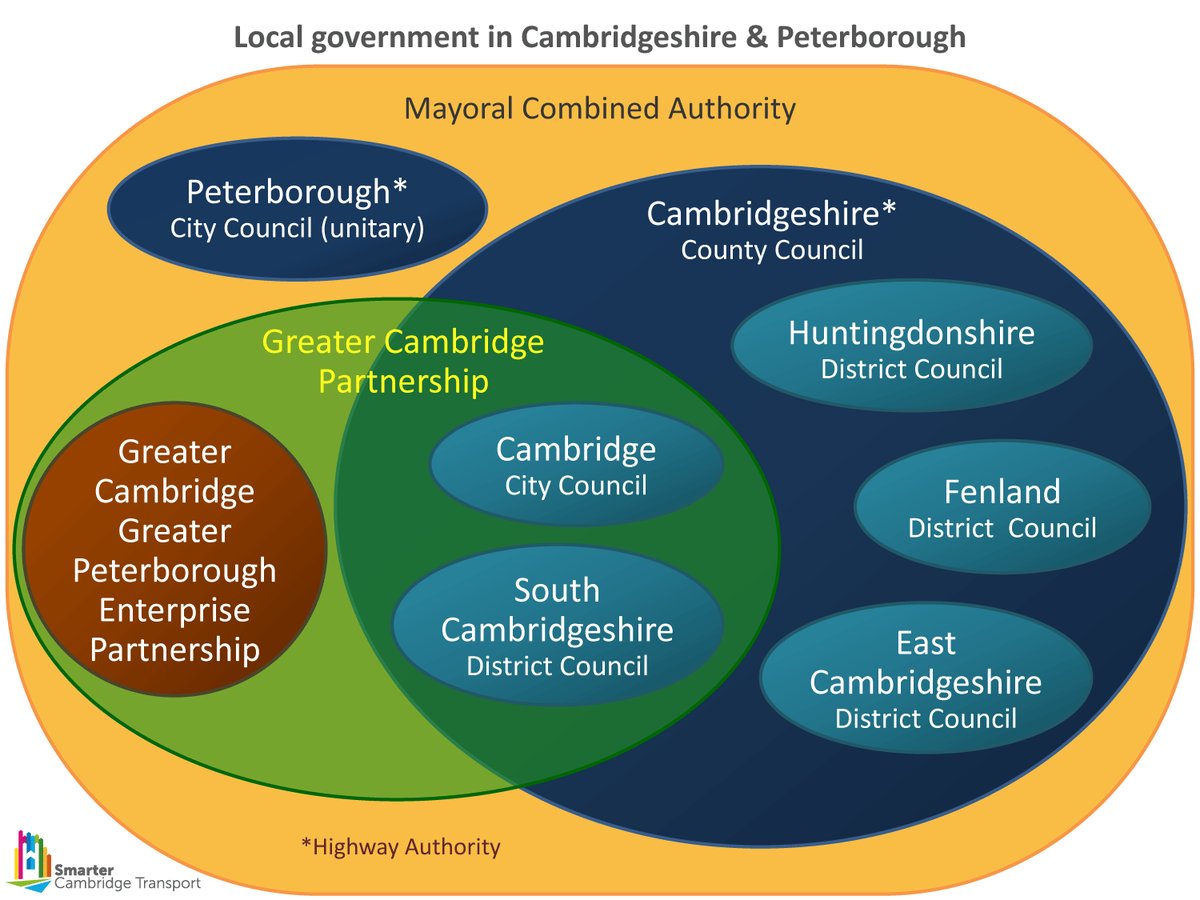
Cambridge Area Bus Users recognise that commercial bus companies cannot run services at a loss. Adding extra buses to maintain frequencies adds costs, without any certainty of increased farebox revenue. Unless our plethora of overlapping local governance bodies (see graphic, below) take radical action to tackle traffic congestion bus services will be in a spiral of decline: reduced speeds ➞ increased costs ➞ lower ridership ➞ reduced income ➞ service reductions ➞ lower ridership ➞ reduced income ➞ further service reductions.

Venn diagram giving visual representation to the overlapping responsibilities of district, unitary and county councils with Cambridgeshire and Peterborough Combined Authority and Greater Cambridge Partnership

In February 2024 sister organisation Cambridgeshire Sustainable Travel Alliance issued a press release – We will all lose out if the Greater Cambridge Partnership abandons large-scale projects to reduce congestion.

The current high motor traffic levels are hinted at as the reason for abandoning the road reclassification project. The Eastern Access project, Hills Road and Madingley Road schemes are also being watered down due to the need to accommodate large numbers of cars. It is highly inequitable that projects to encourage people to use sustainable transport and reduce car usage cannot go ahead or are compromised because there are currently too many people driving. Many people who drive would like to travel by sustainable means, but cannot. When GCP officers assessed the threats and opportunities of not proceeding with the Sustainable Travel Zone road charge last September, they did not mention that abandoning road charging would leave them unable to deliver other GCP projects. In hindsight, this is a significant omission.

CSTA press release as above

Silviya Barrett from national transport charity Campaign for Better Transport (a member organisation of the Cambridgeshire Sustaianble Travel Alliance) said: 

“The only way to tackle congestion is to reduce the number of cars on the roads. Traffic reduction measures, coupled with public transport improvements have been proven to cut congestion, reduce air pollution and make places more pleasant to work and live.”

Cambridge Area Bus Users has received multiple complaints about unreliable bus services; one member reported walking from the city centre to the Catholic Church faster than five buses crawling along in road congestion. The group cannot envisage significant improvements in bus reliability until congestion is tackled by reallocating road space away from private cars to buses and active travel.

We contacted David Boden, Business Development Director of Stagecoach East, Chair of the recently-formed Cambridgeshire and Peterborough Bus Alliance, who was kind enough to provide the following statement.

As people who run local buses, we tend to talk about two connected but different concepts: ‘reliability’ and ‘punctuality’. We are very willing to be held accountable for the aspects of reliability we can control – that is to say, providing a bus and a driver when we say we will. But, once the bus leaves the station or depot, its punctuality is overwhelmingly dictated by issues like congestion, parking enforcement and roadworks, none of which are in our power to change.

All this slows the bus down, increases journey times and the cost of service provision, and makes it really difficult to rebalance using the bus over car. There is no secret formula to all this, put simply, if you want a world-class bus network, you need a world-class road network and bus infrastructure.

Our local authorities work very hard to try to mitigate the negative effects of roadworks where they can, but there are sadly limits to their powers.  Now is the time for everyone, including the utility companies, Highways and other key stakeholders, to engage with bus operators directly in a meaningful and productive way.

Buses are a key lifeline for our region, and with a genuine desire from everyone to go that extra mile in minimising disruption to bus services, we can offer the residents of Cambridgeshire the excellent service that we all want them to have.

It is a burning issue. Bus services are not going to get any better – and will continue to get worse – until we have those conversations, and elected officials then are willing to make bold and difficult decisions. [Our emphasis]

I will say that, in recent times, we have seen some elements of progress. We recently praised the communication from UK Power Networks for their Mill Road works, for example. They gave us proper notice and this led to high-level discussions between the two companies, with potential ways to keep disruption to a minimum, floated.

We hope that this will set a template for all such interactions in the future, so it becomes ‘business as usual’ that utility companies talk with the major bus operators so we can all work together as best we can.

David Boden, Business Development Director of Stagecoach East, Chair of the Cambridgeshire and Peterborough Bus Alliance

Ian Lockwood, a recognized national leader in sustainable transportation policy (USA) and urban design (and witty cartoonist) sums up the situation, neatly.

Cartoon two parents and child in front of large car
THERE IS TOO MUCH TRAFFIC
FOR BILLY TO WALK TO SCHOOL:
SO WE DRIVE HIM.

Traffic Inducing Traffic

We recognise that funding for comprehensive, fast, frequent bus services cannot rely on farebox revenue alone. Support from the public purse is also essential. That public purse is not inexhaustible; plans for radical improvements to bus services envisaged by Cambridgeshire and Peterborough Combined Authority (our Transport Authority) could founder unless Cambridgeshire County Council (our Highway Authority) and the Greater Cambridge Partnership (holder of the ‘City Deal’ purse strings) “are willing to make bold and difficult decisions“.
Stagecoach changes from Sunday 1st September

Stagecoach are making changes to roughly half of their services operating in the Cambridge area with effect from Sunday 1st September – hence the length of this post. A fairly thorough description of these changes (as well as those further afield) can be found here (with links to the new timetables provided here) but you will find below a summary which might be useful (and which picks out a few changes not included in Stagecoach’s description). A number of the changes are linked to Cambridge’s persistent traffic congestion – which, with no remedy currently in view, is likely to get worse in the short term. Others benefit from support offered by the Combined Authority, through its Better Buses programme.

In some cases (the Busway and the 905 service) these will be the fourth timetables in operation since the beginning of 2024. However justified such frequent changes might be, they are certainly challenging for passengers to keep track of!

“Citi” branding seems to have been abandoned on Cambridge buses with the latest round of changes. But that’s not to say it couldn’t reappear at a later date…

Now to details of specific services:

1. Buses will cover Fulbourn in a single continuous loop, journeys from the city centre simply doing a clockwise look and then returning towards the city. This will impact departure times from Fulbourn village.

3. There are minor timetable adjustments. The last bus in both directions will operate a few minutes later, Monday-Saturday. Peak hour services will be calling at ARM on Fulbourn Road (eastbound journeys calling there in the morning, and citybound in the afternoon), but these calls are unlikely to appear in apps and other digital offerings.

4. This service reverts to its pre-pandemic frequency, with buses operating every 20 minutes, Monday-Saturday (excluding early morning and evening).

5. The whole of the Monday-Saturday timetable has been reorganised, resulting – amongst other things – in the first bus in both directions being 15 minutes earlier than previously. And the last buses are a full 35-40 minutes later, leading to a last bus from Emmanuel Street that departs at 2330. Service frequency is more or less unchanged, but fewer journeys will be operating to/from St Ives.

6. There’s to be a significant reduction in journeys on this route. Peak-hour journeys, Monday-Saturday, will now operate every 40 minutes (previously every 30) and off-peak every 70 (previously hourly). But there are minor exceptions to this, so be prepared. This sort of “staggered” frequency isn’t the easiest for passengers to get to grips with. Interpreting timetable departure sheets, where they exist, isn’t simple either (how useful is a statement saying “0945 and every 40 minutes” when you arrive at a stop at, say, 1235?). As a matter of historical record, it’s perhaps worth mentioning that less than 10 years ago there were three buses per hour along this route, even off-peak.

7. Changes to timings on this service include a number where longer journey times are allocated on schooldays to non-schooldays. Pampisford passengers will receive an earlier morning departure to Cambridge (Monday-Friday only) and two additional outbound services in the evening (Monday-Saturday). The last service out of Cambridge is 30 minutes later than at present (excluding Sundays). Conversely, the last bus into Cambridge from Sawston is half an hour earlier than in the current timetable.

X13. The main change to this service is the addition of five round trips (Monday-Friday only) between Addenbrookes and Linton (the first of which starts at Drummer Street Bus Station). There are also timing alterations – some journeys between the Haverhill and Cambridge bus stations are now scheduled to take over 90 minutes.

604 & 607. Timetables on both of these College services have been revised. Stagecoach are keen to point out that these services are open to everyone, and not just to students.

905. Some Monday-Friday departures have been retimed – mostly off-peak, but also a couple in the evening peak. Overall journey times haven’t changed (contrary to the impression given in Stagecoach’s announcement).

    Busway. Just 16 weeks after they were introduced, services H and R are being withdrawn! This is the result of improvements to the remaining Busway routes A and B (see below).

    A. Frequency on service A, Monday-Friday, is more or less doubled. Towards St Ives there will be services from Trumpington every 10 minutes until early evening. Services towards Trumpington mostly operate at the same 10-minute frequency, but there are a couple of 15-minute gaps to look out for. And the frequency declines after 1700. However… it’s important to note that half the trips begin/end at St Ives Park & Ride. Passengers to/from St Ives stops to the north of the Park & Ride retain the current service of three buses per hour (though not at the same times as at present). Sadly there is still no change to the dismal Sunday service (which remains at one per hour). Perhaps next time…?

    B. In the morning peak, Monday-Friday, all B services from Hinchingbrooke will continue to some part of the Biomedical Campus, including Long Road Sixth Form College. In the afternoon peak – through to early evening – services in both directions will be serving the Campus. Check the timetable for specific details of which stops are served when. All these journeys travel via Hills Road, and don’t serve the Railway Station or use the southern section of the Busway (because of the height restriction). As a consequence, there will be fewer journeys from Drummer Street to Hinchingbrooke first thing in the morning, Monday-Friday, than at present.

    PR1. An additional round trip on Saturday morning will operate, departing Madingley Road P&R at 0820 and Drummer Street at 0840.

    PR3. There are additional late afternoon journeys, maintaining a 10-minute frequency outbound to Trumpington until 1855, and inbound from Trumpington until 1840 (both Monday-Friday). Between 1100 and 1500, Monday-Friday, all stops along the route will in future be served (but only between these times).

    New Whippet service 18a from 2nd September

    Thanks to funding from the Combined Authority, Whippet will be launching service 18a on Monday 2nd September. As the numbering might suggest, this is a variant of Whippet’s existing service 18 (Cambridge-Comberton-Cambourne-St Neots).

    The 18a will add five journeys between Cambridge and Cambourne, and vice versa, although the first of the Cambridge-bound trips will start from St Neots, and operate only when schools are open.

    Some journeys are timed to serve Comberton Village College at key times.

    So what distinguishes service 18a from the existing service 18? The 18a doesn’t serve Grantchester and Kingston – for those villages you need to use the 18.

    Like the 18, the 18a doesn’t run on Sundays.

    The new timetable can be viewed and downloaded here