Stagecoach changes from Sunday 16th April

Stagecoach have announced changes to a number of services, taking effect from Sunday 16th April. They have published a summary of these changes, but this omits what could be important information, depending on your use of these services.

Citi 5. The timetable amendments are more significant than Stagecoach’s announcement might suggest. From 17th April Monday-Saturday services will commence earlier than at present – from Longstanton they will start up at 0510, and from Cambridge at 0615. Saturday evening services, which were withdrawn last October, have been reinstated. The last bus to Longstanton, Monday-Saturday, will leave at 2250, which is a significant improvement on the current time of 2210, although from Longstanton the last bus, excluding Sundays, will be at 2155, slightly earlier than at present. Times have changed throughout the day, Monday to Saturday. Unfortunately, the new daytime departure times from Cambridge – at 20 and 50 mins past the hour – means the Citi 5 mostly duplicates the Citi 6 between Emmanuel St and Girton Corner, as the latter already leaves at XX20 and (peak hours only) XX50. Sunday services are unchanged. The revised timetable mostly offers poor connectivity with the Citi 5 at Longstanton Park & Ride.

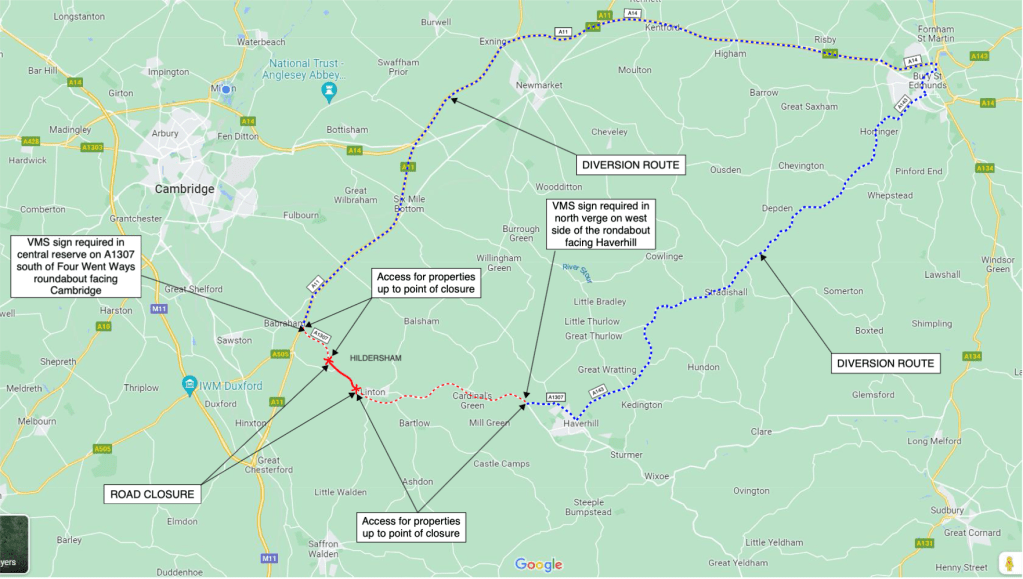
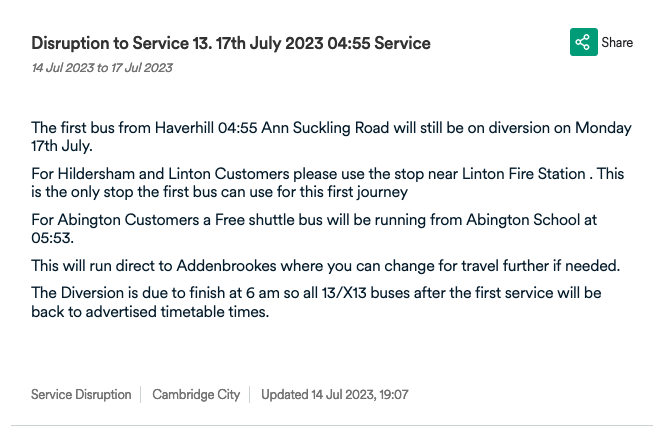
Citi 7, 9, 13 and 904: Minor timetable changes are being made (resulting, in most cases, in extended journey times overall). The additional 1815 departure on service 13 to Haverhill and Little Wratting referred to in the Stagecoach announcement operates only Monday-Friday. All departures from Peterborough on service 904 will operate 5 minutes later than at present.

Busway A: There are a number of potentially significant changes in addition to those outlined by Stagecoach. Overall journey times from St Ives are generally extended by 13 minutes (but there’s no change to journeys from Trumpington). Services from St Ives will now start at 0441 (Monday-Saturday). However, evening services will be operating to a revised pattern, one consequence of which is that the last bus to St Ives will be at 2300 (2200 Sundays), some 25 minutes earlier than at present. The last bus into Cambridge will leave St Ives at 2101 (2001 Sundays), which is a full 49 minutes earlier than on the current timetable. The afternoon Trumpington-Biomedical Campus peak-hour “shuttle” has been withdrawn, presumably to allow the operation of the increased frequency along the whole route that Stagecoach mention in their announcement.

Busway B: Overall journey times are generally extended by 12 or 13 minutes in both directions. As with service A, last buses will be departing earlier. On southbound journeys the last bus departs almost an hour earlier than at present, leaving Hinchingbrooke at 2055 (1955 on Sundays) rather than at 2151 (2051 on Sundays). The last bus from Cambridge will be 20 minutes earlier than is currently the case – at 2305 (2205 on Sundays). As the Stagecoach announcement makes clear, there are additional daytime services on Sundays between St Ives Bus Station and Drummer St.

Busway C: This is reduced from 4 services a day (Monday-Friday) to the 2 mentioned by Stagecoach. And no longer serves the Railway Station.

New timetables are available from the Stagecoach website. (except for the Busway, for which a revised version is expected after Easter).

Could a ‘Tourist Tax’ help fund bus services?

It’s complicated…

(Spoiler alert – it’s unlikely.)


Many will have seen or heard news reports about Manchester’s £1-a-night tourist tax 

From Saturday (1 April) tourists will have to pay a £1 tax to stay in Manchester – the first city in the UK to impose a tourist tax on visitors.

Overnight guests in city centre hotels or holiday apartments will be charged £1 a night, per room, as part of a new scheme which officials hope will raise £3m a year.

Manchester’s £1-a-night tourist tax comes into force | Nazia Parveen | The Guardian | Fri 31 Mar 2023

Manchester has become the first UK city to launch a “tourist tax” for visitors.

The City Visitor Charge will mean people face an extra £1 per room, per night, for their accommodation cost.

The money will be used to help to run large events, conferences, festivals, marketing campaigns and for street cleanliness.

Manchester City Council Chief Executive Joanne Roney said the “innovative initiative” would raise £3m a year to “enhance” visitors’ experience.

It would create “new events and activities for them to enjoy”, she said, adding that the money would be “invested directly into these activities, supporting Manchester’s accommodation sector to protect and create jobs and benefiting the city’s economy as a whole”.

Manchester becomes first UK city to impose ‘tourist tax’ | BBC News England Manchester | Sat 1 Apr 2023

This caused some excitement on Twitter

Councillor Sam Davies (@Sam_in_Cam) Tweeted a link to the Guardian article (above) on 31 March 2023.

Replies included:

  • Can Cambridge do this too? – Andrew Jones (@AJ99500818) on 31 March 2023.
  • Yes but councillors are reluctant to do it – Timothy Sykes (@timsykes3) on 1 April 2023.
  • From what I understand the council does [sic] currently have the legal power to introduce a tourist tax. Would require central legislation and also Cambridge BID. Ofc councillors could lobby for (or against) but do not have the powers as such (not sure if different in other cities) – Councillor Dr Alex Bulat (@alexandrabulat) on 1 April 2023. [Context suggests that Councillor Bullat intended to tweet “does NOT currently have the legal power”]
  • Exactly, it’s an obvious funding model. No doubt our overly tangled web of local authorities would all point the finger at each other and claim it’s their problem? – Andrew Jones (@AJ99500818) on 1 April 2023.

“Our overly tangled web of local authorities”? This 👇🏾

Complicated Venn diagram of the interrelationship of
Cambridge City Council
Peterborough City Council
Huntingdonshire District Council
Fenland District Council
East Cambridgeshire District Council
South Cambridgeshire District Council
Greater Cambridge Partnership
Cambridgeshire and Peterborough Combined Authority

In response, Wendy Blythe, Chair of Federation of Cambridge Residents’ Associations (@greenarteries) on 1 April 2023, tweeted a link to the Video report by ITV News Anglia’s Claire McGlasson, from January 2019.

Could Cambridge be the next council to ask for powers to introduce a tourist tax?
Clip from video report by ITV News Anglia's Claire McGlasson
Click the image to watch the video report by ITV News Anglia’s Claire McGlasson | Saturday 12 January 2019, 6:10pm

So what powers does Cambridge, or the Greater Cambridge Partnership, or even the Cambridgeshire and Peterborough Combined Authority, have?

Very few, according to this Centre for Cities blog …

View of Edinburgh
Click the image to read the full blogpost

After over a decade of austerity, local governments have seen their budgets shrink considerably but have very few fiscal tools to improve them. The main tool they have is council tax, and even the scope to increase this is limited by central government. Given this, is introducing a tourist tax a way to close some of the shortfall?

In Centre for Cities’ recent event in Manchester, Metro Mayor Andy Burnham raised the possibility of introducing a “tourist tax” in the city region.

The problem with this though, is that cities across the UK cannot introduce such a scheme without primary legislation, as local governments currently do not have the power of fiscal devolution to enact their own such taxes.

What could a tourism tax do for city budgets?Olivia Vera | Centre for Cities | 30 May 2022

Did Manchester Metro Mayor, Andy Burnham, obtain parliamentary legislation?

Er, no. It was, seemingly, a workaround.

[A]ccommodation providers voted to set up the Manchester Accommodation Business Improvement District (ABID).

Some 73 hotels and serviced apartments signed up to the levy scheme which has been introduced ahead of a planned expansion of the hotel and holiday let sector in the city.

Manchester becomes first UK city to impose ‘tourist tax’ | BBC News England Manchester | Sat 1 Apr 2023

Branded the City Visitor Charge, the fee is the first to be introduced in the UK and will help to fund the new Manchester Accommodation Business Improvement District (ABID), which aims to “improve the visitor experience” and “support future growth of the visitor economy” over the next five years.

Manchester’s £1-a-night tourist tax comes into force | Nazia Parveen | The Guardian | Fri 31 Mar 2023

So who are Manchester Accommodation Business Improvement District?

Manchester Accommodation Business Improvement District logo
Click the Manchester Accommodation Business Improvement District logo to visit their website

The Manchester Accommodation BID is a ground-breaking new initiative led by the city’s hotel and serviced apartment providers to help create new events and additional activities that will attract more people to visit and stay in Manchester and Salford. It will also contribute to the enhancement of overall guest experience and help to expand the city’s visitor economy by:

  • amplifying marketing campaigns that drive overnight stays;
  • securing large-scale events, conferences, and festivals in low-season months;
  • improving guest welcome and street cleanliness.

The above activities will be funded by the City Visitor Charge; a supplementary £1 Charge per room/unit per night for guests, added to the final accommodation bill. The statutory Charge will be collected from all paid accommodation establishments that fall into the Manchester Accommodation BID zone and will be applicable to all bookings from 1 April 2023.

Manchester Accommodation Business Improvement District website [Current, Accessed 2 April 2023]

Accommodation establishments across Manchester city centre and part of Salford have given resounding support for the establishment of a new Manchester Accommodation Business Improvement District (ABID), following a vote held last month.

The vote marks a significant moment for the city’s accommodation sector and will pave the way to create much-needed additional funding that will be used to improve the visitor experience and support the growth of the visitor economy across the city over the next five years.

Led by the Manchester Hoteliers’ Association in collaboration and partnership with Marketing Manchester, CityCo and both Manchester and Salford City Councils, the Manchester Accommodation BID is a direct response to significant challenges currently facing the accommodation sector in Manchester, including recovery from the pandemic and the impact that Brexit has had on the hospitality sector.

Manchester Accommodation Business Improvement District website [8 Dec 2022, Accessed 2 April 2023]

And in Cambridge (or Greater Cambridge)?

Cui bono?

It is important to recognise that the Manchester Accommodation Business Improvement District was established by, and for the benefit of, paid accommodation establishments in Manchester and Salford, albeit with the support of the local authorities. Moreover, what has been branded a ‘Tourist Tax’ is nothing of the sort; it is a City Visitor Charge. The money is collected by and is under the control of Manchester ABID.

In and around Cambridge, what would hoteliers, serviced apartment providers and the ‘Air BnB’ sector want the money spent on?

Probably not Cambridge’s new large concert hall so longed for by The Cambridge Town Owl (aka Antony Carpen).

Potholes? Cheaper buses? Also unlikely.

Events which could attract staying tourists (not day trippers) such as…?

Diversionary Schemes

A guest post from Nigel Pennick

There is a recurring problem with schemes to improve public transport. It is ‘mission creep’ caused by impracticable proposals that at first glance promise to serve every need, but in reality are poorly thought out and often mere proposals that have no practical substance in them.

Practical upgrading of bus systems is put on hold while untried systems are investigated at great expense by consultants – with taxpayers footing the bill.

There is a long history of novel and failed transport proposals involving monorails, tracked hovercraft, minitrams and now very light rail. Historically, these have all failed to materialise, except on test tracks, and often the companies promoting them have ended in administration. Such proposals have always diverted attention away from realistic improvements of existing bus systems.

These novel systems always have proprietary vehicles that are incompatible with existing transport modes. Looking ‘futuristic’ and promoted by slick marketing, these systems gain the attention of planners who lose sight of their function which is to improve public transport for the majority of people. As with tramways and metros – tried and tested modes that actually work – there is a limited application of tracked systems to specific routes in large cities. Elsewhere, buses serve the public well, if they are run properly. The danger of using novel systems, if they even get as far as being built, is that there will be no operational or maintenance support and no possibility of obtaining spare parts or new vehicles, if the companies making them go out of business or cease manufacturing the track and vehicles, as has happened with some schemes.

Unrealistic plans that have no chance of attracting the necessary funds for construction and operation seem to appear every few years. Cambridge’s planners spent millions in 1991 for a tram scheme that never materialised, in the last few years the Cambridge Autonomous Metro (CAM) was a money pit overseen by the Cambridgeshire and Peterborough Combined Authority, and now, in 2023 another tram scheme has been put forward. Both the abortive CAM and the 2023 tram plan require extensive tunnelling. Realistically, this will not happen as no public transport tunnels have been built in the UK outside London since the 1970s (Merseyrail and Tyne-Wear Metro).  

Promotional image of the now-abandoned Cambridge Autonomous Metro in an unsegregated Station Square, Cambridge, from which taxis appear to have been removed.

What all of these novel systems have in common is expensive infrastructure, often very intrusive, as in the case of overhead minitrams or monorails. In addition to their dubious utility, operating costs and reliability over the lifetime of a system is rarely considered.

The long planning process, disruption caused by protracted construction, and visual intrusion are further reasons why such systems rarely get past the planning stage. Sadly, the cost of planning eats away at funds that could better be spent on improving bus frequency and service reliability. But our planners insist on diverting attention away from practical solutions for spectacular vanity projects that look good in online promotional material.

I find it tiresome to see so much effort expended for so few results. Is it some sort of systemic failure among British transport planners to be fascinated with fanciful proposals whose proponents claim are the solution to all problems? It is time for public transport planners to pay attention to current needs.


Appendix: some examples of novel, untried and failed systems

Coventry Very Light Rail

The latest expensive experiment

Coventry Very Light Rail (indicative illustration) Click the image to visit the promotional website

Note how the now-cancelled Cambridge Autonomous Metro vehicle proposed in 2021 is similar to the very light rail vehicle (on rails) proposed for Coventry. See: TDI UNVEILS CAMBRIDGE AUTONOMOUS METRO CONCEPT 


Birmingham cable car

Birmingham city centre cable car (never built)

Read more on Birmingham’s aborted schemes: Five wacky travel schemes that never happened in Birmingham


Sheffield Minitram monorail system

Long before Supertram, Sheffield planned a Minitram monorail system. Back in the 1970s, Sheffield Metropolitan District Council explored methods to better connect various parts of the city centre.

The Sheffield Monorail going over the Hole in the Road roundabout – Concept

Read more on the Sheffield Guide blog…


Sydney Monorail (abandoned)

The Sydney Monorail is an example of a built system that was soon abandoned.

The decommissioned monorail station juts over Liverpool Street, Sydney. CREDIT: DOMINIC LORRIMER


Read more: ‘Rubbish in our sky’: Sydney monorail station left in limbo after seven years


One novel transport ‘solution’ that failed spectacularly…


Cambridge Area Bus Users never took a position of support, nor of opposition to CAM, nor other schemes. We have always made two pro-bus points:

  • if adequately funded, and properly co-ordinated, bus service improvements can give a quick win in serving public transport objectives, and
  • no tram, metro, light rail or heavy rail service can serve every town, every village, every neighbourhood; buses (like that beer) reach where other modes cannot.

Changes to all Whippet country services from Monday 20th March

Whippet are making changes to all of their country services (i.e., all Whippet routes except the U) from next Monday, 20th March.

In addition to timing changes, please note the following:

118 Cambridge-Grantchester: this is now incorporated into service 18 (Cambridge-Cambourne-St Neots) and will no longer operate as a separate service. As was the case in Stagecoach days.

61 Eaton Socon-St Neots-Eynesbury: this service is being withdrawn. We have no news yet from the Combined Authority about any replacement operator. The route is being taken over by Dews, and the timetable can be found here.

Revised timetables for the surviving services can be found on the Whippet website

Revised timetable on A2B service 75 from 27th February

A2B are introducing a revised timetable on service 75 (Cambridge-Orwell-Wrestlingworth) with effect from Monday 27th February. Most of the changes are minor, but it’s worth checking your intended journey as even a change of just a couple of minutes could result in you missing your bus!

The “School Days Only” service will in future be running as service X75.

The new timetable is included below for information as it currently isn’t on the A2B website. [Edited 23/2: timetable was subsequently posted to operator’s website]

Bus Strategy Survey

No, it’s not the Greater Cambridge Partnership (the body with the devolved government money) this time; it’s the Cambridgeshire and Peterborough Combined Authority (the body with the devolved powers).


The Cambridgeshire & Peterborough Combined Authority is asking regional residents to share their views on its bus strategy. Its vision is for a “comprehensive network of bus services across Cambridgeshire and Peterborough that people find convenient, easy to use, reliable and good value for money, that is inclusive and offers a viable alternative to the car.”

The Authority aims to more than double bus passenger journeys compared to 2019 levels, to around 60-75 million. Its strategy document does not contain details on specific bus routes or services but instead sets out the “strategic aims, objectives, and aspirations of the Combined Authority which will enable it to bid for further funding and shape the network to meet the needs of the people of the region.” 80% of those that responded to the Authoriy’s survey on buses wanted to see improvements (both bus users and non-bus users) and the Combined Authority believe better public transport will be essential to support the region’s other goals, for example tackling climate change, reducing inequality and delivering sustainable growth.


In collaboration with Cambridge Sustainable Travel Alliance on response advice, we encourage you to have your say. A detailed guide follows below. Share your views before the consultation closes on Friday 24 February through the Cambridgeshire and Peterborough Combined Authority Bus Strategy page.

Before submitting your comments, we recommend skim-reading the Bus Strategy Document (PDF). Click the image below to read/download the document.

Front page of the Bus Strategy Document
Click the image to read/download the document.

Guide to the Bus Strategy Survey

Respond as you see fit, but feel free to incorporate any of the suggested responses which are included in this guide.


Sections one and two

These sections of the survey (Q1-4) requires personal answers as they ask about age, location and how often you use a bus.


Section three: bus strategy vision

The vision is for a comprehensive network of bus services across Cambridgeshire and Peterborough that people find convenient, easy to use, reliable and good value for money, that is inclusive and offers a viable alternative to the car.

The Combined Authority wants to create a more connected region, which will encourage active and sustainable travel, improve health and wellbeing and reduce private vehicle journeys.

Success in achieving the vision will mean more travel by bus and less reliance on car travel. This in turn will help us maintain economic growth, care for the environment and improve quality of life.

To realise the vision, this Strategy seeks to achieve the following:

  • A comprehensive bus network, better connecting people to places across all parts of the region and beyond.
  • Buses are part of a fully integrated and planned transport system.
  • A more affordable network, with simplified fares and capping across the network
  • Transitioning to new, low emission vehicles, providing all the benefits of modern bus travel
  • A more understandable bus network, services and fares, with clear information and easy ticketing.
  • Faster and more reliable journeys by bus, delivered with more effective bus priority measures.
  • High quality passenger waiting facilities
  • Good quality services with high levels of satisfaction amongst customers.
  • A doubling of bus passengers (based on 2019/20 levels) by 2030.
  • Less traffic and congestion by attracting car users to buses.
  • Better bus infrastructure, including bus shelters and wider real time information coverage

Q 5 Asks: How much do you agree with the Vision of the Bus Strategy Vision?

Please explain why, if you wish, and add any other comments you may have.
See page 9 of the bus strategy document here.

Our suggested response: AGREE

Our reasoning:

We can not recommend a ‘Strongly agree’ response as the vision does not encompass everything we would expect to see in a comprehensive bus strategy.

Our comments:

This strategy should be more ambitious.

Doubling bus passengers by 2030 sounds unambitious given the recent cuts, the impacts of the pandemic and the reduction of car miles required by that date (15%).

In order for this vision to be achievable the Cambridgeshire and Peterborough Combined Authority will need to bring buses back under public control. This should be explicitly explained in the vision.

“Transitioning to new, low emission vehicles, providing all the benefits of modern bus travel” sounds weak compared to the strategies in other cities. For comparison, the vision for the West Midlands says: “A world-class integrated, reliable, zero emission transport system providing inclusive travel for all”. Cambridgeshire’s bus strategy should be at least as good as other places.

The strategy also fails to adequately integrate with other local travel strategies.

This vision should include everything listed as well as:

  • There must be safe, speedy and accessible pedestrian movement between bus stops and between buses and other transport modes e.g. trains. All stops should be connected to a footway which is suitable for use by passengers using wheelchairs or other mobility aids.
  • All stops should display printed timetable and key fare information and a location-named bus stop flag with the phrase ‘Towards [key destination(s)]’.
  • Wherever possible a shelter, with seating, lighting, and timetable and real-time bus information should be provided.
  • Key edge-of-town and edge-of-village locations should be developed as ‘travel hubs’ with secure cycle-parking facilities and interchange facilities with demand-responsive transport.
  • Reliable bus services that users can trust.

In addition the aspiration of “Buses are part of a fully integrated and planned transport system.” should explicitly mention cycling and walking including safe routes to bus stops and secure, accessible cycle parking.

Note for members/followers: For more detail on bringing buses back under public control, see our explainer Bus Franchising, Quality Partnerships, and other ways of Improving bus services.


Section four: Bus Strategy Aims

The aim of the Bus Strategy is to pave the way for a bus network that is convenient, attractive and easy to use, characterised by all of the following attributes:

CONVENIENT

  • Routes connecting to places and activities that people want to get to.
  • All areas are well served by bus.
  • Direct routes with little deviation.
  • Frequent services with limited waiting time in-between.
  • Services are available all day and into the evening, every day.
  • Range of tickets to meet different needs.

ATTRACTIVE

  • The network is simple and easy to understand.
  • Buses enjoy a great public image and everyone is happy to use them.
  • Services can be relied upon and run to time, without delay.
  • Cost of using a bus is considered good value for money, with targeted fares offers that incentivise some groups.
  • Buses run direct and quick.
  • Buses are clean, comfortable and pleasant to ride on.
  • Services are well marketed and there is plenty of clear information in a range of formats, available via different media.
  • Waiting environments are attractive, offer seating and information, and people feel safe using them.
  • Pleasant and helpful drivers, able to assist when needed.
  • Zero emission buses, offering a quiet and smooth ride.

EASY

  • A single understandable network that functions as one, with connecting services, branding and system-wide ticketing.
  • Ability for people to transfer between bus and other travel modes (walk, cycle, e-scooter, car, coach, train).
  • A clear service offer, backed by a Passenger Charter.
  • Buses run at regular time intervals and with consistent frequencies.
  • Stable services with minimal changes, removing uncertainty and confusion.
  • Simple fares with payment through a range of methods.
  • A system that is accessible and can be used by all.
  • Plenty of information is readily available.

Question 6 asks: How much do you agree with the Aims of the Bus Strategy?

Please explain why, if you wish, and add any other comments you may have.
See page 10 of the bus strategy document here.

Our suggested response: STRONGLY AGREE

Our reasoning:

We strongly agree however we think these aims are vague and very open to interpretation. There is no clarity about how success will be measured, which is vital if service providers are to be held to account. 

Suggested comments:

Convenient: 

The document refers to a table about frequency which is not present in the document. Without this inclusion we cannot express support for any frequency. ‘Frequent’ will inevitably mean different things on different services.

There needs to be a rationale for ‘range of tickets’. Having a ‘range’ should not be prioritised over simple ticketing that can be easily understood by all users.

There must be a clear definition of ‘evening’. It is essential that buses are available for hospitality and shift workers. Service hours must be specifically stated.

Rural routes should meet or exceed the aspirations of the Campaign to Protect Rural England’s ‘Every village, every hour’ campaign.

There should be a ‘no stranded passengers’ aim including avoiding overlong journeys owing to delays and missed connections.

The strategy states that “all areas are well served by bus”. Once again, this is a vague aim that is open to interpretation. a clear definition of “well served” must be provided.

Attractive:The aims the Combined Authority has stated here are by and large sensible. We believe the core elements for an attractive bus service are: 

  • Reliable, times and places
  • Staff are customer focussed
  • Buses are of a good and comfortable standard

When these standards are met the Authority will have the opportunity for authentic marketing of buses as an attractive travel choice.

Easy:

The strategy should view the concept of ‘easy’ from the perspective of a visitor to Cambridgeshire with no prior experience of our bus service. Would a visitor find it easy to find out how to use our buses, where and when our buses travel, and how ticketing works?

The point “Buses run at regular time intervals and with consistent frequencies,”  is crucial – people must be able to rely on the bus departing and arriving on time (with real time information if things go wrong.)

The point “Ability for people to transfer between bus and other travel modes (walk, cycle, e-scooter, car, coach, train)” should elaborate on what the transfer experience should be like. For example – transfer safely, easily and affordably. It should also elaborate on the impact that ticketing systems will have on transfers. There should be shared ticketing so that new tickets are not required when transferring across operators and transport modes. 

This section should also include the aim of simplicity. Passengers should be certain that they have the best/most suitable ticket and route without the complex comparison of options which is currently required.

Note for members/followers: For more detail on bringing buses back under public control, see our explainer Bus Franchising, Quality Partnerships, and other ways of Improving bus services.


Section five: Delivering the Bus Strategy

Four main principles underpin the Combined Authority’s approach to delivering the bus service improvements in this Strategy:

  1. Achieving a continuous cycle of passenger growth and service improvement 
  2. Using the best operational model of provision to achieve the necessary step change in the most effective way 
  3. Partnership 
  4. Integration

Question 7 asks: How much do you agree with the four main principles of delivering the Bus Strategy?

See pages 11-12 of the bus strategy document here.

Our suggested response: AGREE

Our reasoning:

We agree with the direction of the principles for delivery, however, once again, they are too vague – and jargon-ridden – to ensure accountability. It must be clear that successful delivery will require franchising and road space reallocation.

(Franchising – requiring operators to bid to run bus routes – offers the best way of re-regulating buses, gives the Cambridgeshire and Peterborough Combined Authority power to sets fares and timetables, and will also permit profitable routes to cross-subsidise routes which cannot cover costs from fare-box revenue. See our explainer Bus Franchising, Quality Partnerships, and other ways of Improving bus services.)

Suggested comments:

“Achieving a continuous cycle of passenger growth and service improvement” 

Growth in passenger numbers/journey numbers is essential to maintain the income to sustain the bus service. 

The strategy should be explicit that bus priority measures are about prioritising buses over motor vehicles so that there is road space for buses to flow. Investing in buses that will be constantly stuck in traffic will be pointless. 

Bus prioritisation strategies must be in line with the ‘hierarchy of road users’ – a concept that places those road users most at risk in the event of a collision at the top of the hierarchy – and be considered with other transport strategies like the Greater Cambridge Partnership’s proposed Sustainable Travel Zone. Bus priority must not be at the expense of active travel. 

“Using the best operational model of provision to achieve the necessary step change in the most effective way.”

This principle should be rewritten in language that is meaningful to bus users and free of corporate jargon. 

This strategy must be clear about how bus driver recruitment and retention will be improved. There should be more information about better conditions, pay, career progression and flexible working hours for bus drivers.

Consideration should be given to following the example of the West Yorkshire Combined Authority  which has appointed a training provider to run a ‘Route to Success’ programme, in partnership with local bus operators, designed to bolster the number of bus drivers in the region.

The operational model must also consider partnership and on this issue we strongly recommend franchising. 

Partnership

For bus services to be sustainable and this vision achievable there must be increases in passenger numbers. The strategy must be clear about how it will be delivered: the Cambridge Sustainable Travel Alliance’s view is that franchising will be required.

Integration

This principle must elaborate on improvements being made possible by integration with other transport strategies (e.g. Cambridge City Access). Buses can’t run at regular time intervals with consistent frequencies unless priority measures allow them to avoid traffic jams.


Section six: Combined Authority Strategies

Question 8 asks: How would you prioritise our strategies?

See page 13 of the bus strategy document here.

Please drag and drop the strategies into your preferred priority order, starting with your top priority first, or number them from 1 to 7 using the dropdown boxes, with number 1 being your top priority.

Cambridge Area Bus Users recommends the following order:

  1. Information and getting the message out
  2. Bus services for rural areas
  3. Value for money and simple, integrated ticketing
  4. An integrated coherent network linking people to the places they want to get to
  5. Getting to places quickly and on time
  6. Bus services that people want to get on
  7. Delighting customers

Our comments:

All of the above strategies are vital in persuading people to switch travel modes and ‘trust the bus’. Is it appropriate to rank them when all the aspects are needed to work with each other? All are required for a satisfactory bus experience and growth in buses. However…

  1. Bus information (fares, timetables, places served and stop locations) is currently very poor. ‘Information and getting the message out’ will be a quick, easy and cheap improvement.
  2. People unable to drive, or otherwise without a car, in rural areas, are cut off from employment, educational, cultural and social opportunities.
  3. There are, currently, a confusing range of tickets, mainly valid only on one operator’s services, whilst queries to the driver about ‘best value’ delay boarding and lengthen journey times. They also discourage bus travel.
  4. Major operators’ maps don’t show other operators’ services. There should be clear journey planning information with multi-operator ticketing and recognised interchange points.
  5. Getting to places quickly and on time seems dependent upon the points above.
  6. ‘Bus services that people want to get on’ are dependent upon the factors above..
  7. ‘Delighting customers’ is an outcome if all the strategies above are effective.

Section seven: And Finally

Q 9 Asks: Do you have any further comments on the Bus Strategy?

Our comments:

The strategy document and the consultation survey are poor quality with missing information and mismatched text between the strategy and survey. The survey fails to be accessible to many people, with the 

Bus Strategy Document having poor compatibility, in places, with screen-readers used by people with limited vision. The survey is, thereby, at a risk of not considering all user experiences when further developing the Combined Authority’s strategy. 

The strategy must be explicit about pursuing bus franchising as the crucial step to improving bus services. (See our explainer: Bus Franchising, Quality Partnerships, and other ways of Improving bus services.)

The strategy must go beyond the bus stop and include access to the bus stop (pavements etc) by connecting with wider strategies for pavements, pedestrians’ network, cycling infrastructure and cycle parking.

The strategy is disappointing in its lack of vision and of specific aims and strategy for ensuring that bus services are fully accessible to people living with disabilities. There must be a clear strategy about accessibility.

There are no references in the Bus Strategy document (whether in more or less acceptable terms) to ‘disabled/disability’, ‘hearing loss’, ‘deaf’, ‘visual disability’, ‘sight loss’, ’blind’, ‘reduced mobility’ or ‘mobility aids’. This suggests that the needs of a huge swathe of potential bus users have been disregarded.

While well-used buses run on fossil fuels are still better than private cars, and there are mentions of ‘zero emission electric buses’ there must be greater clarity on the strategy to move to zero emissions.


New weekday timetable on the U from 13th February

Whippet have introduced a revised timetable on the U service from today, Monday 13th February. There are changes to weekday services, partly to accommodate forthcoming roadworks, and partly to try to better match actual running times to the current Cambridge traffic. Another instance, then, of congestion on Cambridge’s roads adversely affecting bus operators and their passengers.

The revised timetable can be found here.

Changes to Stagecoach 13 and 905 in early 2023

Changes to a couple of Stagecoach services are being made in early January. Not for the first time they’re being implemented on different dates, which seems an unhelpful practice.

From January 1st, there are minor amendments on service 13 to the first two Cambridge-bound trips (leaving 10 minutes later from the first few stops). The revised timetable is available here.

From the following Sunday, January 8th, there are more substantial changes to the 905 service (Cambridge-St Neots-Bedford). This is an attempt to “combat congestion and improve reliability” as the Stagecoach press release puts it. It’s been quite common during November and December for trips in the weekday morning rush-hour, especially when schools are open, to be 30 or more minutes late arriving into Cambridge (and then departing for Bedford half an hour late as well). So expect trips to be scheduled to take longer. The new 905 timetable can be found here.

Making Connections

Image from Greater Cambridge Partnership's Making Connections webpage, showing:
image of two happy, young heterosexual couples, in a circle with imagine bubbles captioned "Imagine if We had £50Million a year to invest in public transport.
Also shown are the logos of Greater Cambridge Partnership and Cambridgeshire County Council.

The Greater Cambridge Partnership proposals

Better bus services and a Sustainable Travel Zone

Recent bus service withdrawals had people worrying how they would get to work or college. And it necessitated a breakneck scramble to find new operators by the Cambridgeshire and Peterborough Combined Authority.

Together with the continuing disruption caused by cancellations, this rather makes the case for democratic control over bus operators.

We need better reliability, more services, and more affordable fares.


The Greater Cambridge Partnership’s City Access proposals are riding to the rescue

If you want safe walking and cycling, reliable buses and a positive future for everyone, make your voice heard today!

The Greater Cambridge Partnership have promised £50 million annually for radically-improved bus services, funded by money from the city deal, signed with central government in 2014 and not from council tax or business rates.

But, longer-term, this money will run out and a sustainable revenue-stream will be required. Under national legislation, this will be legally ring-fenced for transport improvements.

And public money must be safeguarded: the benefits should be for bus passengers, not for bumper payouts to bus company shareholders (and foreign owners in some cases).

The GCP is working closely with the Cambridgeshire and Peterborough Combined Authority who can exercise powers (under the Bus Services Act 2017) to prevent bus operators ever again causing such disruption to people’s lives.


More about the Cambridgeshire and Peterborough Combined Authority’s potential powers

Image of single-deck bus overlaid with text:
Cambridge Area Buses
Under Public Control?

The Bus Services Act 2017 – passed under a Conservative government, with all-party support – provides Mayoral Combined Authorities (including the Cambridgeshire and Peterborough Combined Authority) with a number of options to improve bus services, including powers to implement bus franchising, akin to the system operated by Transport for London.

Full details and links to publications can be found here: Bus Franchising, Quality Partnerships, and other ways of Improving bus services


Making Connections Consultation

The Greater Cambridge Partnership has launched a City Access Public Consultation under the title Making Connections 2022.

How should Cambridge Area Bus Users members and supporters respond?

Take a look at this handy 5-minute Consultation response guide, compiled by the Cambridge Sustainable Travel Alliance.


Cambridge Sustainable Travel Alliance logo

Cambridge Area Bus Users’ secretary has been working closely with the other members of the Cambridge Sustainable Travel Alliance (mainly Camcycle and Cambridge Living Streets) to raise awareness of the Greater Cambridge Partnership proposals and to compile this Consultation response guide.

Bus Users group contributions to this Consultation response guide are taken from our Aims & Priorities document (PDF). In general, The GCP proposals are in line with what we set out in that 2019 document: more services, better frequencies, lower fares and improved reliability.

However, whilst that document called for operators and local authorities to co-operate on reliability (which implies tackling congestion) and for the GCP to generate funding for unprofitable routes, we have no existing policy on a congestion charge. It was, therefore, not possible to contribute a Cambridge Area Bus Users’ view on that aspect of the consultation. You will need to make up your own mind.


What are the Greater Cambridge Partnership proposing?

Image from Greater Cambridge Partnership's Making Connections brochure, showing:
image of two happy, young heterosexual couples, in a circle with imagine bubbles captioned "Imagine if We lived in a place that prioritised people over cars."
Also shown are the logos of Greater Cambridge Partnership and Cambridgeshire County Council, with the text: "MAKING CONNECTIONS
Have your say on proposals for faster, cheaper, more reliable bus services and safer cycling through the introduction of a Sustainable Travel Zone. A City Access Public Consultation."
  1. Transforming the bus network: From as early as mid-2023, The GCP are proposing to transform the bus network through more services to more locations, with cheaper fares set at £1 (city zone) and £2 (wider area).
  2. Investing in other sustainable travel schemes: Alongside the bus network, the GCP areproposing to invest in new sustainable travel schemes, such as better walking and cycling links.
  3. Creating a Sustainable Travel Zone: The GCP areproposing the introduction of a Sustainable Travel Zone in the form of a road user charge on behalf of Cambridgeshire County Council. Vehicles would be charged for driving within the Zone between 7am and 7pm on weekdays, and money raised would fund improvements to the bus network and other sustainable travel schemes. The Zone would be fully operational in 2027/28 but only once the first bus improvements are introduced.

The proposals will see:

  • Double the hours of service and miles covered of the pre-pandemic Greater Cambridge bus network
  • £1 flat fares for single journeys in the Cambridge bus zone, and £2 fares in the wider area
  • 50% expected reduction of traffic in Cambridge

Full details are in the Greater Cambridge Partnership Making Connections booklet (PDF).


How can you help?

It is important that as many bus users as possible give their views on the Greater Cambridge Partnership proposals, before the consultation closes on Friday 23 December 2022.

Complete it yourself and encourage your spouse/partner, your teenage children, your parents and your neighbours to give their views.

It’s easy:

You don’t need to live within the Greater Cambridge boundaries. If you and/or a member of your household uses buses to travel in and around Cambridge, the survey needs your views. 


Get involved in promoting sustainable travel!

Cambridge Sustainable Travel Alliance's If Not Now Then When? logo

Cambridge Sustainable Travel Alliance needs individual supporters who can help promote the campaign.
Contact Cambridge Sustainable Travel Alliance by email to find out more

  • Could you tell your story about how poor bus services have impacted on your life?
  • Could you tell people about how better bus services would improve your life?
  • The CSTA team need online stories, stories for press releases and stories for online videos.
  • Could you help distribute the IF NOT NOW THEN WHEN? leaflets around your streets, your village or join other members, leafleting in the city centre, or other locations?
Front of Cambridge Sustainable Travel Alliance's If Not Now Then When? leaflet with text:
If Not Now Then When? 
When the next bus is delayed? When the next service is cut?
Time is running out to improve transport in Cambridgeshire. Support the Sustainable Travel Zone package and help transform buses for the better for all who need them.
Rear of Cambridge Sustainable Travel Alliance's If Not Now Then When? leaflet with text:
 What is the Sustainable Travel Zone?
The Sustainable Travel Zone is a proposal to reduce traffic in Cambridge and create space and funding for better walking, cycling and buses.
A daily road charge would apply inside the zone from 7am to 7pm once sustainable alternatives are in place. If the plan goes ahead, it would:
● Transform the bus network, with cheaper fares set at £1 (within Cambridge) and £2 (for journeys outside Cambridge) and more services to more locations from 5am to 1am
● Deliver better walking and cycling routes, inside and outside the city
● Reduce car journeys to make walking and cycling safer, buses
more reliable and create space for people (e.g. seating, greenery).
Why do we think you should support it?
Cambridgeshire Sustainable Travel Alliance is a coalition formed by organisations working for sustainable transport including Cambridge Area Bus Users. We support the plans because we think they will:
● Make jobs, education and activities accessible to more people (not everyone can afford or use a car)
● Take back control of bus services so that decisions on routes, times and fares can be made for the benefit of all not just bus operators
● Tackle climate change & improve air quality and road safety.

Changes to Haverhill services 13 & 131 from 14th & 27th November

Stagecoach are making changes to the Cambridge-Haverhill service and the Haverhill town service. These are being implemented in two phases:

From Monday 14th November: There are two additional morning services on the 13 from Haverhill Bus Station to Cambridge, departing at 07.00 and 08.00. In the reverse direction there’s an additional service from Drummer St at 15.30 and one starting from Addenbrooke’s at 16.15. These services will operate Monday-Friday. There are no changes to the 131 Haverhill Town Service on this date.

From Sunday 27th November: The X13 “express” service is to be reinstated, with 3 morning journeys into Cambridge and 4 afternoon ones into Haverhill. An enhanced frequency on the 13 means that, combined with the X13, there will be buses every 15 minutes during the morning commute from Haverhill and the afternoon return from Cambridge. These changes will probably apply Monday-Friday only, bus this hasn’t been explicitly recorded yet.

A couple of morning services into Cambridge will divert via the Railway Station, as will all Haverhill-bound trips after 19.30.

In Haverhill, a new anti-clockwise service is being introduced (131A). There are also changes to the 131 to fit into this. Service 13 will divert in the evenings and on Sundays to serve Greenfields Way, North Avenue and Eastern Avenue.

A more detailed announcement and new timetables will be available from Stagecoach in due course, but at the time of writing (Nov 14 @ 10.15) they’ve not yet been added to the website.