Changes are being introduced to some services in the Ely area from 2nd January 2026.
Service 9 (Cambridge-Ely-Littleport). On part of this route, the number of daily journeys is being reduced – from six to five in both directions between Cambridge and Ely, and with a similar reduction on journeys from Littleport to Cambridge. But between Ely and Littleport (in both directions) there’s close to a 100% increase in journeys.
Ely Circular 9A and Little Downham 125. These services are being combined into a new service 10, which will also operate a modified route within Ely itself. This will bring a significant increase in journeys serving Little Downham.
Integrated daytime connections are promised at Ely Market Street between services 9 and 10 – they’re all being operated by the same operator (A2B), which helps in this regard.
For links to new timetables and more information on these and other changes, go to the Upcoming Bus Route Changes page on the Combined Authority website (although, strangely, this doesn’t alert passengers to any reduction in journeys, mentioning only increases).
In the south-east corner of the county, and running into Suffolk, service 19 provides a direct link from a number of villages to Haverhill. And, by changing buses at Linton, into Cambridge.
The service has had a number of operators in recent years – currently it’s operated by Flagfinders. But from Monday 22nd December there’s another change – Stephensons will be taking over the service from that date. And with the change of operator there are revisions to the timetable, although these are relatively minor (and very positive!). All journeys that currently run will continue to run, and to the present timetable. But, in addition, the first southbound service of the day from West Wickham will carry on beyond Linton to Haverhill. And there will be an additional service to Haverhill in the afternoon, leaving Burrough Green at 1506.
The revised timetable can be downloaded from Suffolkonboard.
(Thanks to Suffolk County Council for this information. An enquiry about the change to the CPCA, who provide financial support for this service, went unanswered.)
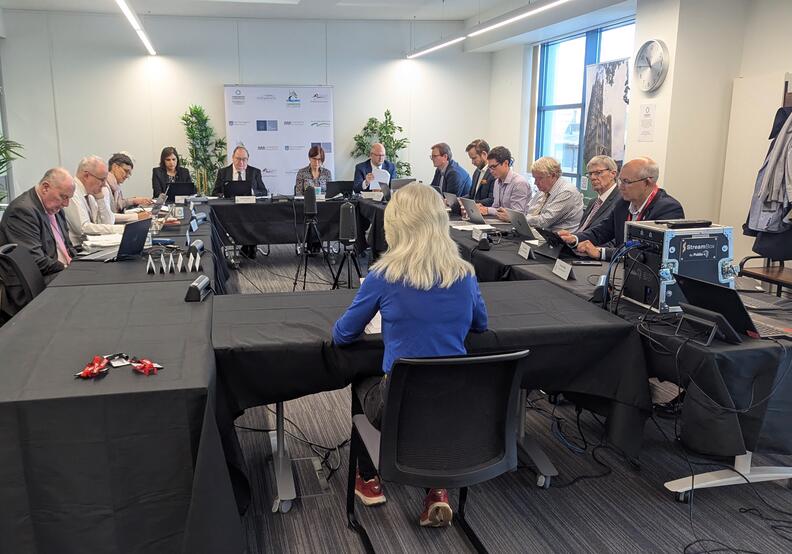
High up the ‘to-do’ list of the Cambridge Area Bus Users Executive Committee is to take steps to bring the needs of bus users to the attention of our local politicians. With this in mind, we have resolved to ask public questions at local council meetings when we believe an issue should be brought up the agenda.
Cambridge Area Bus Users was disappointed to learn that plans to franchise local bus services in Cambridgeshire and Peterborough have been delayed until at least 2028. This extended ‘limbo’ period prolongs uncertainty for bus operators and passengers alike. Commercial services are likely to deteriorate as bus operators need predictability to invest in route development and new vehicles, whilst the Combined Authority will continue to struggle to provide its patchwork of less-than-ideal supported services under the current deregulated model. The Bus Services Act 2025 requires the Combined Authority to identify, list and protect socially necessary local services. The papers for this meeting note: “The … current suite of interventions is not affordable in the long-term”. Delays to implementing franchising will exacerbate this problem.
The wholly contracted (aka franchised) model will remove current barriers to integrating self-supporting and supported routes as the Combined Authority takes control over investing public funds in an expanded, attractive, high-quality bus network which the business community is demanding, and our communities need.
Those who use the bus the most in Cambridgeshire and Peterborough, according to a report published in the papers for this meeting, are children, teenagers and young adults. This delay will adversely impact upon young people’s access to education, training and jobs they otherwise couldn’t take, jeopardising the Combined Authority’s ability to deliver targets on reducing the youth NEET (Not in Employment, Education or Training) count.
Under franchising, fare structures – including Tiger Pass fares, subject to restricted discussion at this meeting – will be the decision of the Combined Authority, with fare revenue accruing to the Authority, rather than commercial operators’ shareholders. It will then be for the Authority to decide if (for example) the revenue from 20 Tiger Pass £1 single fares are preferable to that from 5 young people paying £3 single fares.
What interim measures, ahead of the start of franchising, do the Combined Authority propose to implement, to bring stability for operators, to support bus users (particularly young people) the needs of the business community and to adapt the transport system to cope with regional growth?
Note: whilst there is a mention of the Tiger Pass, we have no wish to interfere with the restricted nature of the Committee’s discussions which will, inevitably, involve members discussing commercially sensitive information.
Cambridge Area Bus Users note that Mayor Bristow would like to boost high street retail trade in the Combined Authority area, starting with Peterborough. Would the mayor care to share with the Combined Authority Board, and the wider electorate, his business case for achieving this by subsidising free parking of private motor vehicles, compared with other uses of a similar amount of public funding by (for example) working with businesses to offer high street discount vouchers to Tiger Card users or, indeed, all bus and train passengers arriving in Peterborough and, over time, all of our cities and market towns?
Mayor Paul Bristow’s response to his question is not yet available on the Combined Authority’s website, but you can listen to it on the webcast.
Unusually, two of the three changes detailed here were implemented some weeks ago, but have only made it into the Traffic Commissioner’s weekly list of updates in the past few days. So apologies for the late arrival of this not-so-new news!
Stagecoach 5. Related to work (and new speed limits) on the Busway, the limited service to/from St Ives has been withdrawn. All services operate only between Longstanton Park & Ride and Cambridge City Centre. The new timetable can be found here.
Whippet T1. This is again related to work on the Busway, and involves changes to timings to take account of longer journey times. The new timetable can be found here.
And one upcoming change…
Stagecoach PR2F. From 9 December to 17 February – and only on weekday evenings when Cambridge United are playing at home – Stagecoach are operating two post-match services to Newmarket Road Park & Ride. These will leave from outside the Cledara Abbey Stadium at 2130 and 2200. It looks as though journeys will then have to operate via the East Road roundabout and back up the Newmarket Road, as there’s nowhere else to turn the bus round for its trip to the Park & Ride. There are also services in the opposite direction at 2120 and 2150. This timetable can be found here.
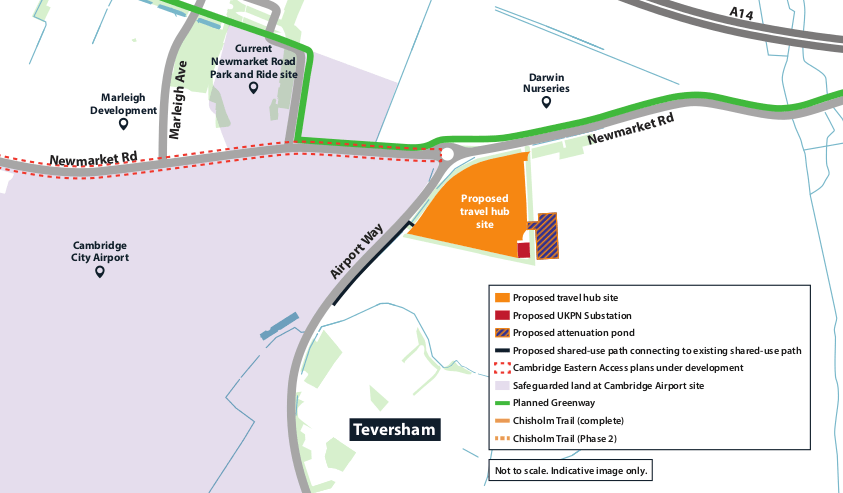
The Greater Cambridge Partnership are planning to move the Newmarket Road Park and Ride, as the lease on the current site will come to an end.
There’s a consultation online that readers may be interested in.
The proposals are hugely problematic, in a number of ways.
Instead of calling it a Park and Ride, it’s being labelled a Travel Hub, a concept originally championed by Smarter Cambridge Transport. This terminology is misleading and incorrect – we have already discussed the differences between Travel Hubs and Park and Ride and it’s abundantly clear that the proposal is purely a Park and Ride, with all the associated problems.
The proposal is to build a huge car park, doubling the current number of spaces, on a green field site well away from any local people. At a time when local councils have declared a Climate Emergency, and in South Cambridgeshire the transport sector is responsible for over 40% of the District’s carbon emissions, such a car-centric development is irresponsible.
One fundamental problem with a Park and Ride system is that it encourages people to drive, thereby abstracting ridership from local bus services, making them less viable to operators, leading to reductions in service and a vicious circle that forces more people to drive. Such a massive development as proposed here will reduce the potential ridership of rural bus services by about 1,000 passengers a day (the additional parking spaces), while increasing congestion by attracting another 1,000 cars a day (a 5 mile queue) onto Newmarket Road from Bottisham, The Swaffhams and the A14.
At this early stage, it appears that there are no concrete plans for what bus services might operate to take customers on their onward journeys, nor how the development works with other Newmarket Road improvements. It seems that the philosophy is “build it and services will come”. While the onset of franchising may lead to a more coherent set of services in the longer term, the proposal here shows no evidence of being part of such a larger plan.
In addition to such a purely car-centric design being harmful for rural bus services, the location is harmful for active travel. It would be silly for anyone to walk or cycle out from home closer to the centre of Cambridge towards the new site, as such users should have their needs met by services that call much closer to home. The correct location for a Travel Hub is in a population centre, where everyone is within a few minutes walk or cycle ride, and where lower density services bring together people from other local settlements onto a trunk service into the local population centres – Cambridge in this case. You can imagine Travel Hubs being placed in Bottisham and Burwell, for example, along an express route between Cambridge and Newmarket, with feeder services linking the smaller villages.
As the wrong design in the wrong place, the proposal is badly flawed, runs counter to its stated purpose, and needs to be rethought from the ground up.
With the recent introduction of significant speed restrictions along the whole of the Busway – due to last for around 15 months – and a rolling programme of closures, Stagecoach have published a revised timetable to come into effect from Sunday 26th October.
As might be expected – as passengers have already started to experience, even before a revised timetable was prepared – complete trips on both A and B services will take considerably longer. For example, a trip from Hinchingbrooke Hospital to Drummer St will take a minimum of 117 minutes to complete, compared to 105 before the changes. The fastest journey from St Ives Park & Ride to Addenbrooke’s Hospital is now timed at 65 minutes, when previously it was 59. And these are the fastest journeys (based on the Sunday morning timetable). Many journeys will take much longer than these!
The majority of departure times have changed, so please check the revised timetable.
Beyond actual timings, the greatest changes affect the Monday-Friday service, where the off-peak A between St Ives and Cambridge suffers a 50% reduction in frequency, returning to one journey every 20 minutes. Buses are being used to maintain the 10-minute frequency between Trumpington and Addenbrooke’s.
Similarly, the number of southbound trips on the Busway B that continue to Long Road Sixth Form College is being cut. There will be only three journeys to the College instead of six. And, as a result of the extended journey times, the last of these will leave Huntingdon Bus Station at 06.40.
Further information is available from the Stagecoach website (but please note that most of the content of that announcement is specific to the Monday-Friday service – the notice doesn’t explicitly state that).
And a reminder that the revised timetable can be found here!
Sometimes information just slips through the net. This is one of those cases.
Missing from the earlier post concerning changes from 31st August was any mention of a new timetable for A2B’s service 26 (Cambridge/Royston). But one was introduced at the same time as the new timetable for the 17.
There are changes only to the northbound timetable, and which should probably be considered in conjunction with the revised timetable for the 17.
If you want to download a copy of the new timetable, please go to Hertfordshire County Council’s Intalink site as it doesn’t – at time of writing – appear on the operator’s own website.
It’s unfortunate that a number of the area’s major visitor attractions are either difficult or impossible to access by public transport. Over the years a number of attempts have been made to address this, and here – for a limited period only at this stage – is another one.
The Welney Wetland Centre – thanks to a grant from Greater Anglia’s Customer and Community Improvement Fund – is providing two journeys a day from Ely railway station, operating on Tuesdays and Saturdays only until the end of November. Not only is the bus free to use, but the WWC is also offering a 10% discount in its shop and cafe to those who have arrived by bus.
Departures are at 11.00 and 12.00 from Ely, and visitors get just over 3 hours at the Centre before having to catch their return service.
Minibuses are provided by FACT Community Transport.
One CABU member who travelled on the 11.00 on its first day of operation earlier this week summed up the experience as “an excellent service leading to an enjoyable day out”. The period of operation should make it ideal for those wishing to catch migratory birds as they arrive at Welney – swans in particular, of course.
Bookings are advised – those who have booked in advance are guaranteed seats, whereas those who just turn up on the day may be disappointed.
A number of changes are being introduced to services in the Cambridge area from 31st August.
Withdrawn services
Stagecoach College services 604, 606 and 607 are being withdrawn. As is the X9 (Cambridge-Littleport direct).
Other changes, in service order (regardless of operator)
Stagecoach 1. The 0747 Saturday journey from Fulbourn Tesco to Arbury is withdrawn.
Stagecoach 7. Following the cancellation of service 607, on schooldays the 0730 from Drummer Street and the 1503 from Pampisford will call additionally at Sawston Village College.
Stagecoach 8A. Frequency on this route is being reduced to hourly, providing just 12 trips a day against the current 24. The first inbound and last outbound trips will operate from/to Rampton. These provide a faster journey time than the Rampton journeys on service 8, and will operate in Histon via the B1049 (providing Mill Lane and Orchard Road with their first buses in some time), and in Cottenham via the village green and Rampton Road.
A2B/Stagecoach 9. Stagecoach are withdrawing from the Cambridge-Ely-Littleport service. A2B will be the sole operator on this route, but the timetable is largely unchanged – except that the first departure from Cambridge will be at 0825 and run only as far as Ely, and the last departure on Saturdays, whilst leaving Cambridge at the same time as at present, runs faster. So if you need to board at an intermediate stop, please check the timetable carefully.
A2B 9A (Ely City). The first and last journeys will both be 35 minutes later than at present, and the 1145 departure wil cease to operate.
Stagecoach 13/13A/X13. Peak-hour journeys will serve the Babraham Institute in both directions. This means that departure times at subsequent stops will be 2 minutes later than at present.
A2B 17. Hertfordshire County Council report that there will be minor changes to this service, partly in response to a request from Melbourn Village College and partly as a result of long-term roadworks and increased traffic. At the time of writing no further information is available about these.
Revised timetables:
For Stagecoach services 1, 7, 8A and 13/13A/X13 revised timetables are available for download from the Stagecoach website. The new timetable for the 9 to/from Ely and Littleport is available at bustimes.org. The revised timetable for the 9A is also available at bustimes.org. The revised timetable for A2B’s service 17 doesn’t seem to be available at time of writing.
A new service connecting Waterbeach with central Cambridge begins operation on Monday 7th July. Operated by Central Connect, and numbered 100, buses start at the Cambridge Research Park, travel via Waterbeach, Horningsea and Fen Ditton, then along Newmarket Road and East Road to Drummer Street Bus Station. Outbound journeys will call at the Grafton Centre.
The service operates 7 days a week. There are 30 return journeys on weekdays from early morning to late evening. The Saturday service has 28 return journeys, and on Sundays there’s what is essentially an hourly service (with slight variations at the beginning and end of the day).
Further information about the service and fares, with links to both a timetable and a route map, is available from the Central Connect website.
 Cambridge Area Bus Users