Beehive Centre Planning Update

Note that this planning application includes a number of bus service enhancement proposals.
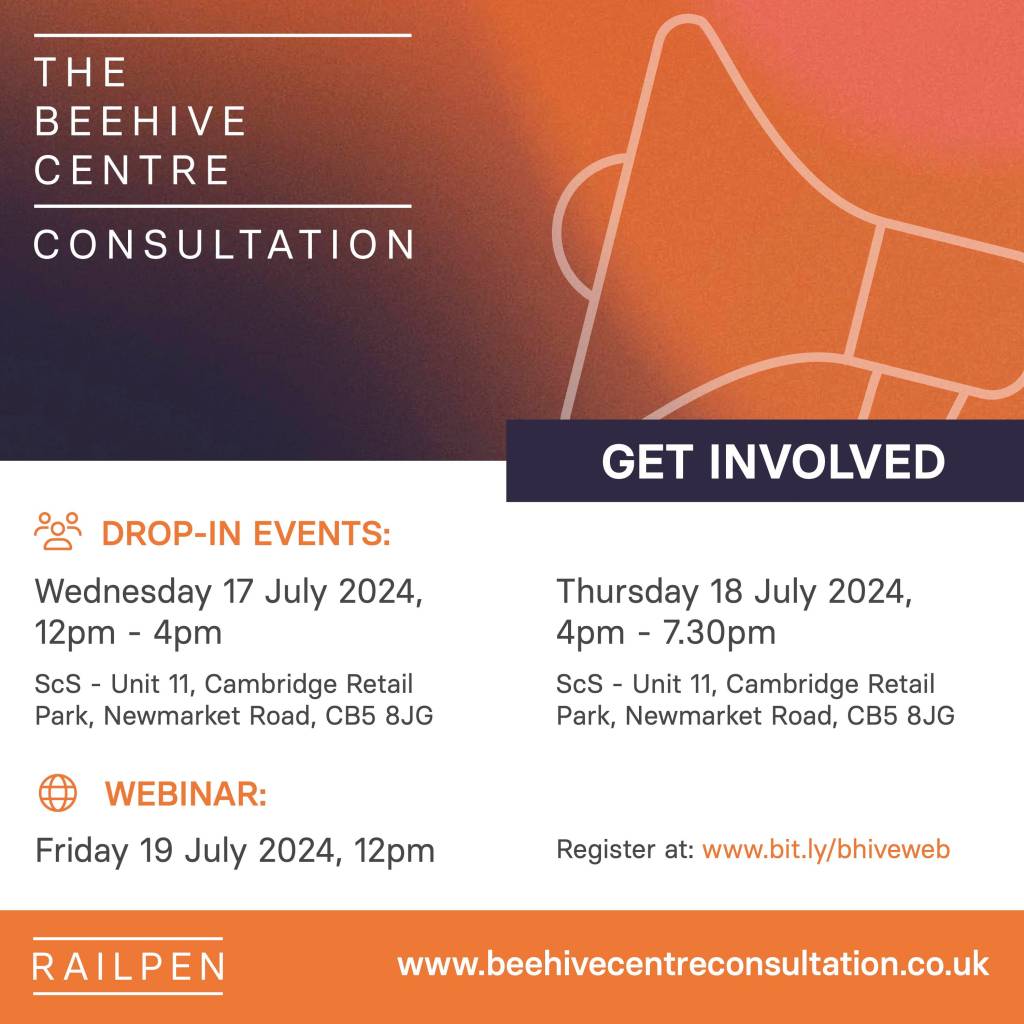
poster text as accompanying text in this post
Click the image to download a printable PDF

Nick Vose​​​​, Director, Marengo Communication, writes:

We are pleased to provide you with an update on Railpen’s proposals for the Beehive Centre.

As you will be aware, we first submitted plans last year, including proposals for new retail, leisure, and community space, as well as laboratory, workspace, and green public space.

However, following feedback on the plans we decided to come back to you with revised designs.

The key uses proposed for the site remain the same, but we have reduced the height and massing of a number of buildings and adjusted building footprints and locations to increase separation distances between buildings and our neighbours.

A new park roughly the same size as St Matthew’s Piece has been introduced and we will plant even more trees (275 in total).

There is also a new direct cycle/pedestrian route through the site and Coldham’s Lane Roundabout will be upgraded to a four-way signalised junction, creating safer connections for pedestrians and cyclists.

Around 20 new shops and leisure facilities, including a small supermarket and gym are included on the ground floor. This is in addition to our plan to invest in Cambridge Retail Park which is also moving forward and will support the re-location of several retailers from the Beehive Centre. The development will also fund an additional 15 public buses per hour with a service extension to the train station, a new service to Milton Park & Ride, as well as new direct services to Cambourne and St Neots, Huntington and St Ives, Ely and Waterbeach. More than 4,200 cycle parking spaces will be created, and 460 car parking spaces – a third of which will provide electric vehicle (EV) charging.

Finally, in response to earlier feedback, we are also looking carefully at how our proposals can help reduce urban temperatures. We know that green spaces, trees, green roofs and vegetation are all very helpful as natural cooling measures and we are planning to replace large areas of concrete with new landscaping, 275 new trees, rain gardens, permeable surfaces and green roofs. In addition, we have committed to undertaking an Urban Greening Factor assessment to evaluate the quality and quantity of green space provided. More commonly used in London this voluntary assessment will demonstrate how green infrastructure has been integral in the design of the development.  Several other design choices will also be taken, including carefully selected materials with a higher albedo, which is the metric for how much incoming sun is reflected by a material surface.

We are still listening and are now inviting residents and stakeholders to comment on these revised plans before we submit an amended planning application.

You can find out more about our updated plans on the 17, 18 and 19 July.

Wednesday 17th July 2024, 12pm – 4pm
ScS – Unit 11 (next to Nando’s), Cambridge Retail Park, Newmarket Road, CB5 8JG

Thursday 18th July 2024, 4pm – 7.30pm
ScS – Unit 11 (next to Nando’s), Cambridge Retail Park, Newmarket Road, CB5 8JG

Friday 19 July 2024, 12 noon
Online webinar: Register here: Beehive Centre Update – Online Webinar Registration

We are also holding a further event for adjacent neighbours on Wednesday 17 July between 6pm and 7.30pm. This event will also be held in the ScS and a separate letter has been sent via the Royal Mail.

Further details of our events are enclosed in the attached community flyer – which has been sent this week to over 6,000 local residents – and we have prepared a social media friendly graphic, also attached, which we are asking stakeholders to share via their own social media channels. 

We look forward to talking you through the latest proposals.

Best regards,
Nick
For and on behalf of Railpen

Bus Lanes – New DfT Guidance

Mark Harper, Secretary of State for Transport has recently issued new guidance on, amongst other things, bus lanes’ the hours of operation. Bus lanes, he asserts, should only operate when needed. Furthermore, ‘surplus funds’ from enforcement should be restricted, Harper believes.

Read the excerpts, quoted below (click the hyperlinks for fuller information, if you’re keen) and see if you can see a logical inconsistency…

At the moment, restrictions on bus lane use are too rigid, creating delays and causing regular fines for drivers. New guidance on bus lanes has also been issued today, to make sure they only operate when it makes sense, like when traffic is heavy enough to delay buses. This will prevent drivers being hit with unfair fines.

News story – Crackdown on anti-driver road schemes and blanket 20mph limits to put local consent first, DfT and The Rt Hon Mark Harper MP, Published 17 March 2024

While this guidance focuses on improving bus services, it is important to recognise the possible impacts on other road users. The Plan for Drivers, published in October 2023, includes a range of measures to ensure smoother journeys. This guidance delivers the commitment to strengthen guidance to make sure bus lanes help rather than hinder traffic.

As set out in the 2024 BSIP guidance, the NBS states that to increase bus use, buses must become attractive to far more people. The key to doing this is making them faster and more reliable. The NBS therefore expects plans for bus priority on roads where there is a frequent bus service, traffic congestion, and the physical space to install it. Bus lanes should be as continuous as they need to be, and have the hours of operation they need to have, to insulate buses from delays caused by traffic congestion and parked vehicles. The Plan for Drivers confirms that this means bus lanes should be provided only where they are needed and should operate only when buses are running or when traffic is heavy enough to cause delays to buses. Bus priority measures should be developed with full consideration of the impacts on other road users. [Our emphasis]

Local Transport Note 1/24: Bus User Priority, Dft, March 2024

Harper has issued, through the DfT, an Open call for evidence – Restricting the generation of surplus funds from traffic contraventions.

On closer inspection the guidance on the hours of operation of bus lanes might seem somewhat illogical.

  • When general motor traffic is light, the existence of a parallel bus lane will make no difference to the progress of general motor traffic.
  • When general motor traffic is heavy, the existence of the bus lane will impede the progress of general motor traffic, but allow buses to continue on their journeys, unimpeded and speedier than a private car.
  • If the aim of bus lane ANPR cameras were to maximise revenue for the relevant highway/transport authority, rather than to deter misuse of the bus lane, having variable hours of operation of bus lanes, not only across the country, but within the same local authority would achieve this end.
  • to achieve consistency of respect for bus lanes when they are needed, 24/7 operation may be desirable. This would also achieve the aim of minimising penalty charges for infractions.

Some roads on which buses operate 24/7 might carry heavy traffic from a city centre to a motorway or an airport, day and night. Other roads may only be busy at office commuting and school-run times, whilst the peak commuting hours on some routes might overlap with shopping journeys. In some areas, Saturday and Sunday tourist visitors might cause more congestion than weekday traffic.

Imagine the close attention to the minutiae of bus lane signage, and to the clock, required of the diligent private car driver wishing to comply with the regulations and to avoid penalties around these (hypothetical) streets:

  • Dover Street – 24/7 operation
  • Folkestone Road – Mon-Fri 7am-10 am, 4pm-7pm
  • Newhaven Boulevard – Mon-Sat 7 am-9am
  • Portsmouth Road – Daily 7am-7pm
  • Southampton Avenue – Mon-Fri 8am-6pm; Sat 9am-7pm
  • Poole Road – Mon-Fri 7am-9:30am, 3:30pm-5pm; Sat 10am-6pm: Sun 10:30am-5:30pm
  • Plymouth Avenue – (Sign faded, try guessing)

Unfortunately, the current obsession with resisting the (non-existent) ‘war on motorists’ potentially delivers this kind of illogical nonsense.

See: The war on motorists: the secret history of a myth as old as cars themselves, Peter Walker, The Guardian, Thu 28 Sep 2023

Your comments are welcome.

Southern Busway – Planned Reopening

From Stagecoach map annotated by Roger French

Members and others will no doubt have seen reports in the local media about work on the Southern Busway between Hills Road bridge and the Addenbrooke’s Spur Junction, based on this press release –  Guided Busway works begin to allow closure to be lifted, 06 February 2024 – from Cambridgeshire County Council.

Since February 2022, a section of the Guided Busway in one direction has been closed between Cambridge Railway Station and the Cambridge Biomedical Campus. The inbound only track (closest to the maintenance track) was closed to allow for a temporary fence to be installed without reducing the width of the path used by pedestrians and cyclists. This measure has severely impacted the busway service and connections to key employment and health facilities.

The temporary fence was installed whilst we waited for an independent safety review and following ongoing communications with the Health and Safety Executive (HSE) and as part of our continuous review of safety on the busway.

Guided Busway works begin to allow closure to be lifted, Cambridgeshire County Council, 06 February 2024
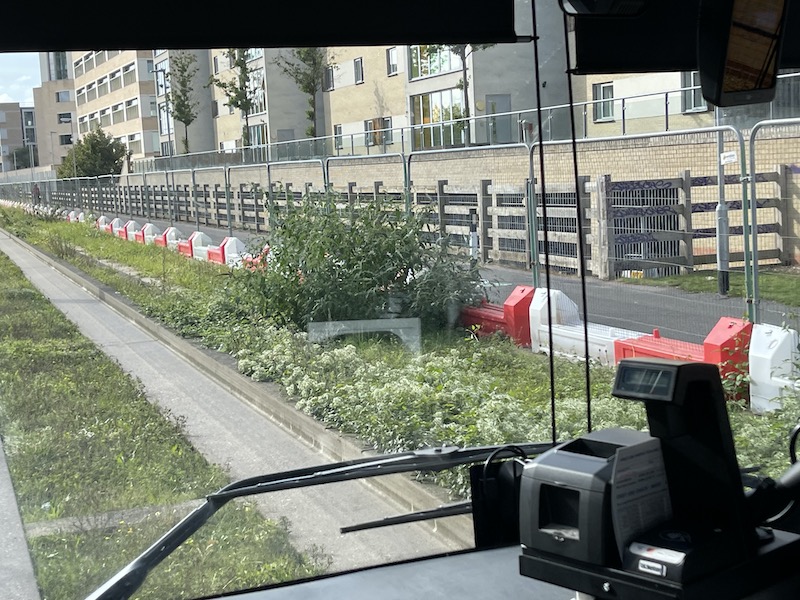
Photo from bus, showing overgrown northbound track
Photo courtesy of BusAndTrainUser

The busway and the maintenance track (foot and cycle track) are currently programmed to re-open on Saturday 30 March.

The questions, and responses from a Cambridgeshire County Council Highways officer are shown below.

  • What northbound speed limit is proposed on the guideway?

The proposed speed limit will be the 30 mph restriction that was in place before the installation of the safety barrier, and which is in place on all of the operational parts of the southern section

  • Will this be mandated by the HSE, or at the discretion of Cambridgeshire County Council?

There has been no reference made by the HSE as to a required speed limit. As mentioned previously, the pre-existing speed limit will be in place when the closed guideway re-opens. 

  • What is the justification for the 15mph limit on northbound buses leaving the guideway towards Station Place?

The speed limit was lowered to 15 mph several years ago, due to the increasing numbers of pedestrians, cyclists and other non-motorised traffic in this area. There is a transition area directly at the northern end of the Cambridge-bound guideway where cyclists cross between the carriageway and the maintenance track in both directions, and where there is more interaction with pedestrians using the maintenance track and the footpath towards Station Place. In addition, there is subsidiary traffic entering and leaving the same are via the access from the Obsidian development adjacent to the Busway.

  • Could this be raised to a 30mph limit? 

While it would be possible to raise the speed limit to any required level, the Council would not wish to exponentially increase the risk of a collision with non-Busway traffic, and the increased likelihood of major injury or death arising from such an increase. The current speed limit allows bus drivers more time to react to what can be unpredictable movement by non-Busway users.

  • What is the justification for the 30mph limit on the southbound guideway to the Addenbrooke’s spur junction?

The speed limit across the entire southern section was reduced to a blanket level of 30 mph some years ago, largely in response to the increased numbers of pedestrians, cyclists and other non-motorised traffic arising from the construction of new housing developments, and the expansion of the Biomedical Campus at Addenbrooke’s Hospital. The speed limit is also in keeping with those in place on the road network around the Busway corridor.

  • Can the southbound guideway – separated from the cycleway/footway/maintenance track by the northbound guideway, and the new fence – revert to the original 56mph limit?

Whilst it would be possible to raise the pre-existing speed limit to the original speed limit of 56 mph, there is no compelling case to do so. The maximum theoretical transit time gained through increasing the speed limit to 56 mph over this limited distance would be approximately 62 seconds, assuming that a bus entered and left this section of guideway at that speed. However, as the speed limits at either end of the section would be lower, there would be a period on entry where a bus would need to accelerate to the maximum permitted speed, and subsequently a period where the bus would need to decelerate before exiting the guideway to match the speed limit in place at the end of the guideway. These actions would reduce the gains in transit time well below the theoretical maximum.

In addition, and possibly of a greater impact , all buses that use the southern section have their speeds regulated by on-bus control systems using GPS-based geo-fencing. The accuracy of these systems does not have sufficient accuracy to allow for differing speeds on the guideway tracks that are immediately adjacent to each other.

  • If the 30mph limit is mandated by the HSE, will the County Council and Combined Authority press the HSE to allow the limit to be raised?

As stated above, the HSE have not made reference to any required speed limit in the southern section. The rationale for the 30 mph has already been addressed in my response regarding your question on the 30 mph limit on the southbound guideway. As I have already stated, there is no compelling case to increase the speed limit, and the technology in use to regulate bus speeds currently in use would preclude a separate speed limit for one section of guideway in this section.

  • Whilst a 15mph limit is required for southbound buses at the point of entry to the southbound guideway, why does this apply from the junction with Station Place?

The reasons are the same as stated above, in response to your question regarding the 15 mph speed limit for buses leaving the northbound guideway.

  • Could this apply only from the overhead hanging height limit warning signs before the Hills Road bridge, with the 30mph limit applicable in Station Place continuing up to this point?

As outlined above, given the levels of non-Busway traffic using the area, there would be little to gain by doubling the speed limit for buses over such a short distance, and any gains in transit time would be negligible. The area between Station Place and the height restriction barrier is where large numbers of pedestrians cross the roadway from the station side to reach the path that eventually joins the maintenance track adjacent to the guideway south of Hills Road bridge, and an increase in the speed limit would increase the likelihood and severity of a collision between buses and non-Busway traffic.


We look forward to the re-opening and, even with the lower speed limits in both directions, buses will, once again be able to avoid the traffic congestion on Hills Road (which the Greater Cambridge Partnership and others seems reluctant to tackle).

Photo courtesy of BusAndTrainUser

The images displayed here are from BusAndTrainUser the retirement activity for Roger French OBE DL MA, former MD of Brighton&Hove Bus Cº, a blogging site which we are pleased to promote.

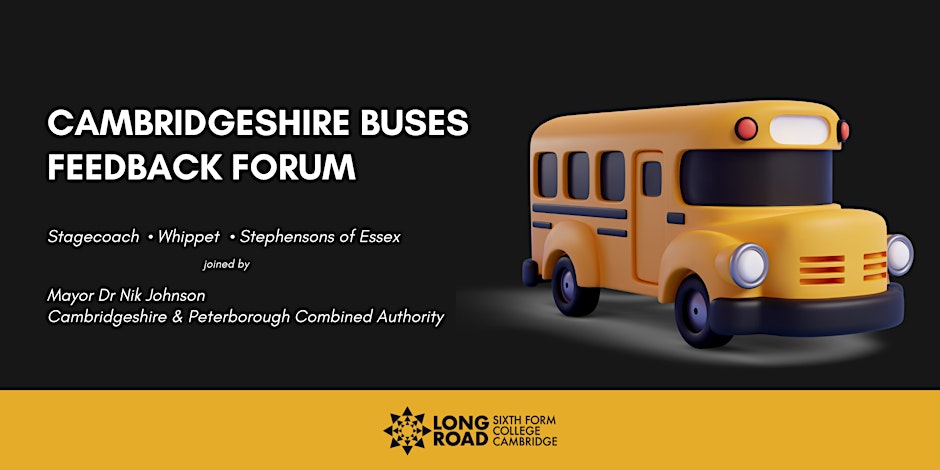
Cambridgeshire Buses Feedback Forum

image of toy bus
text as per subsequent paragraphs
Click the image to book a place

Long Road Sixth Form College are running an event regarding bus services across Cambridgeshire and surrounding areas, on Tuesday 5th March 2024 5:30pm – 7:00pm.

Pre-booking is required. Click here to book, and for full information. Booking closes at 4pm on Tuesday 5th March.

Since the changes to bus routes in October 2022, many local communities have found their bus service to be less than satisfactory; an issue that is particularly impacting young people accessing a variety of educational, work and social opportunities. We want this to change. 

Share your questions and feedback with Mayor Dr Nik Johnson of Cambridgeshire and Peterborough Combined Authority (our Transport Authority) who are raising additional Council Tax to fund more bus services, and representatives of bus companies Stagecoach, Whippet and Stephensons of Essex, who will be able to talk about any of their bus services; giving young people and their families the opportunity to share their feedback and get their questions answered.

Important information for attendees:

  • You must book 1 ticket for each person attending the event, including parents/carers.
  • On-campus parking is available. Please use public transport or car-share where possible.
  • Long Road Sixth Form College will be taking photos for use in their marketing materials and social media. If you would not like to be photographed please alert their photographer(s) when you see them, or move out of shot.

Revised University/Whippet U service from Monday 2nd October

Significant changes to the University’s “Universal” (or “U”) service are taking place on Monday 2nd October.

Two distinct services are being created, to be known as “U1” and “U2”.

U1 is essentially the same as the extended version of the current service – the one that calls at Girton Corner (but only a very few times a day at present). Throughout most of the day alternate services will extend to/from Girton Corner, but otherwise follow the existing route (except that journeys towards Girton Corner call adjacent to Eddington Sainsbury’s and not across the road).

U2 takes a different route between Grange Road and Queen’s College, serving the whole of Grange Road and Barton and Newnham Roads between Grange Road and Silver Street. Omitting, therefore, West Road. Some U2 journeys extend to/from Girton Corner.

One other significant change is that weekend services will again serve the Biomedical Campus (as happened during the Covid pandemic).

Overall frequency remains unchanged. Services from the Biomedical Campus continue to serve Homerton College (and Hills Road more generally) whilst the northbound lane of the southern section of the Busway remains closed to buses.

The service is operated by Whippet on behalf of the University of Cambridge.

The new timetable – and a handy route map for those unfamiliar with the area – is available from the Whippet website.

Making Connections

Image from Greater Cambridge Partnership's Making Connections webpage, showing:
image of two happy, young heterosexual couples, in a circle with imagine bubbles captioned "Imagine if We had £50Million a year to invest in public transport.
Also shown are the logos of Greater Cambridge Partnership and Cambridgeshire County Council.

The Greater Cambridge Partnership proposals

Better bus services and a Sustainable Travel Zone

Recent bus service withdrawals had people worrying how they would get to work or college. And it necessitated a breakneck scramble to find new operators by the Cambridgeshire and Peterborough Combined Authority.

Together with the continuing disruption caused by cancellations, this rather makes the case for democratic control over bus operators.

We need better reliability, more services, and more affordable fares.


The Greater Cambridge Partnership’s City Access proposals are riding to the rescue

If you want safe walking and cycling, reliable buses and a positive future for everyone, make your voice heard today!

The Greater Cambridge Partnership have promised £50 million annually for radically-improved bus services, funded by money from the city deal, signed with central government in 2014 and not from council tax or business rates.

But, longer-term, this money will run out and a sustainable revenue-stream will be required. Under national legislation, this will be legally ring-fenced for transport improvements.

And public money must be safeguarded: the benefits should be for bus passengers, not for bumper payouts to bus company shareholders (and foreign owners in some cases).

The GCP is working closely with the Cambridgeshire and Peterborough Combined Authority who can exercise powers (under the Bus Services Act 2017) to prevent bus operators ever again causing such disruption to people’s lives.


More about the Cambridgeshire and Peterborough Combined Authority’s potential powers

Image of single-deck bus overlaid with text:
Cambridge Area Buses
Under Public Control?

The Bus Services Act 2017 – passed under a Conservative government, with all-party support – provides Mayoral Combined Authorities (including the Cambridgeshire and Peterborough Combined Authority) with a number of options to improve bus services, including powers to implement bus franchising, akin to the system operated by Transport for London.

Full details and links to publications can be found here: Bus Franchising, Quality Partnerships, and other ways of Improving bus services


Making Connections Consultation

The Greater Cambridge Partnership has launched a City Access Public Consultation under the title Making Connections 2022.

How should Cambridge Area Bus Users members and supporters respond?

Take a look at this handy 5-minute Consultation response guide, compiled by the Cambridge Sustainable Travel Alliance.


Cambridge Sustainable Travel Alliance logo

Cambridge Area Bus Users’ secretary has been working closely with the other members of the Cambridge Sustainable Travel Alliance (mainly Camcycle and Cambridge Living Streets) to raise awareness of the Greater Cambridge Partnership proposals and to compile this Consultation response guide.

Bus Users group contributions to this Consultation response guide are taken from our Aims & Priorities document (PDF). In general, The GCP proposals are in line with what we set out in that 2019 document: more services, better frequencies, lower fares and improved reliability.

However, whilst that document called for operators and local authorities to co-operate on reliability (which implies tackling congestion) and for the GCP to generate funding for unprofitable routes, we have no existing policy on a congestion charge. It was, therefore, not possible to contribute a Cambridge Area Bus Users’ view on that aspect of the consultation. You will need to make up your own mind.


What are the Greater Cambridge Partnership proposing?

Image from Greater Cambridge Partnership's Making Connections brochure, showing:
image of two happy, young heterosexual couples, in a circle with imagine bubbles captioned "Imagine if We lived in a place that prioritised people over cars."
Also shown are the logos of Greater Cambridge Partnership and Cambridgeshire County Council, with the text: "MAKING CONNECTIONS
Have your say on proposals for faster, cheaper, more reliable bus services and safer cycling through the introduction of a Sustainable Travel Zone. A City Access Public Consultation."
  1. Transforming the bus network: From as early as mid-2023, The GCP are proposing to transform the bus network through more services to more locations, with cheaper fares set at £1 (city zone) and £2 (wider area).
  2. Investing in other sustainable travel schemes: Alongside the bus network, the GCP areproposing to invest in new sustainable travel schemes, such as better walking and cycling links.
  3. Creating a Sustainable Travel Zone: The GCP areproposing the introduction of a Sustainable Travel Zone in the form of a road user charge on behalf of Cambridgeshire County Council. Vehicles would be charged for driving within the Zone between 7am and 7pm on weekdays, and money raised would fund improvements to the bus network and other sustainable travel schemes. The Zone would be fully operational in 2027/28 but only once the first bus improvements are introduced.

The proposals will see:

  • Double the hours of service and miles covered of the pre-pandemic Greater Cambridge bus network
  • £1 flat fares for single journeys in the Cambridge bus zone, and £2 fares in the wider area
  • 50% expected reduction of traffic in Cambridge

Full details are in the Greater Cambridge Partnership Making Connections booklet (PDF).


How can you help?

It is important that as many bus users as possible give their views on the Greater Cambridge Partnership proposals, before the consultation closes on Friday 23 December 2022.

Complete it yourself and encourage your spouse/partner, your teenage children, your parents and your neighbours to give their views.

It’s easy:

You don’t need to live within the Greater Cambridge boundaries. If you and/or a member of your household uses buses to travel in and around Cambridge, the survey needs your views. 


Get involved in promoting sustainable travel!

Cambridge Sustainable Travel Alliance's If Not Now Then When? logo

Cambridge Sustainable Travel Alliance needs individual supporters who can help promote the campaign.
Contact Cambridge Sustainable Travel Alliance by email to find out more

  • Could you tell your story about how poor bus services have impacted on your life?
  • Could you tell people about how better bus services would improve your life?
  • The CSTA team need online stories, stories for press releases and stories for online videos.
  • Could you help distribute the IF NOT NOW THEN WHEN? leaflets around your streets, your village or join other members, leafleting in the city centre, or other locations?
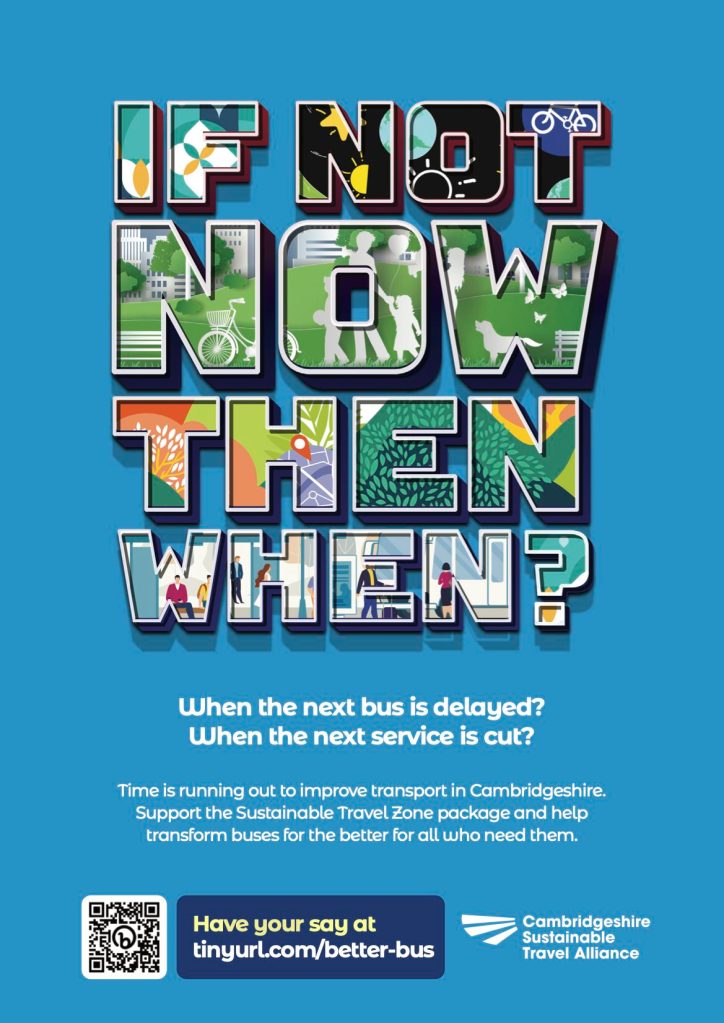
Front of Cambridge Sustainable Travel Alliance's If Not Now Then When? leaflet with text:
If Not Now Then When? 
When the next bus is delayed? When the next service is cut?
Time is running out to improve transport in Cambridgeshire. Support the Sustainable Travel Zone package and help transform buses for the better for all who need them.
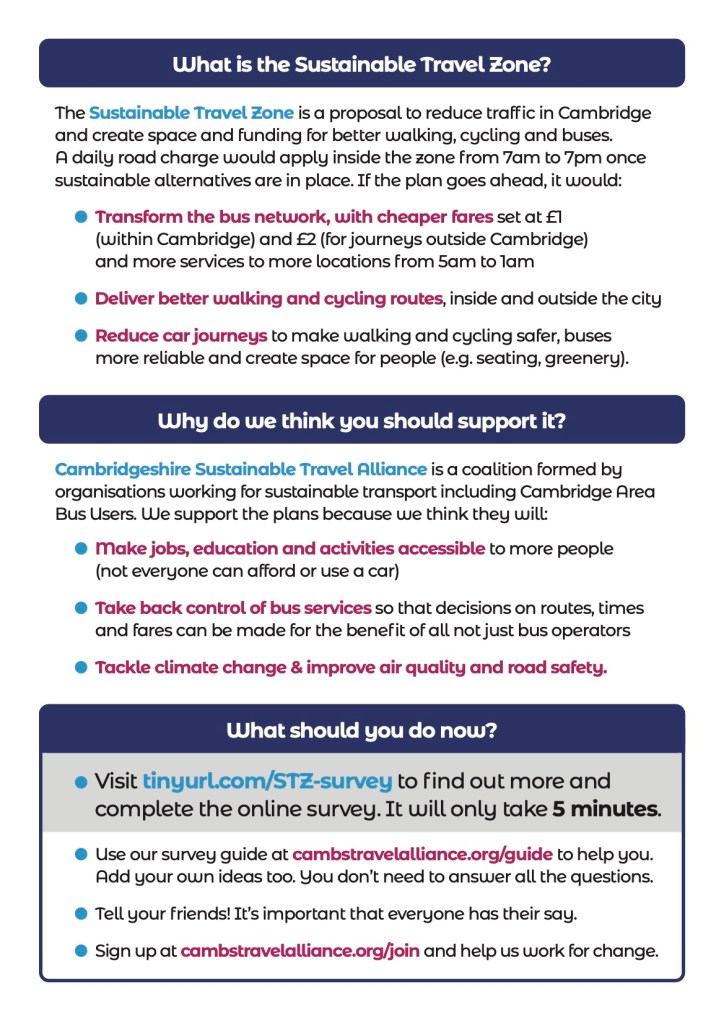
Rear of Cambridge Sustainable Travel Alliance's If Not Now Then When? leaflet with text:
 What is the Sustainable Travel Zone?
The Sustainable Travel Zone is a proposal to reduce traffic in Cambridge and create space and funding for better walking, cycling and buses.
A daily road charge would apply inside the zone from 7am to 7pm once sustainable alternatives are in place. If the plan goes ahead, it would:
● Transform the bus network, with cheaper fares set at £1 (within Cambridge) and £2 (for journeys outside Cambridge) and more services to more locations from 5am to 1am
● Deliver better walking and cycling routes, inside and outside the city
● Reduce car journeys to make walking and cycling safer, buses
more reliable and create space for people (e.g. seating, greenery).
Why do we think you should support it?
Cambridgeshire Sustainable Travel Alliance is a coalition formed by organisations working for sustainable transport including Cambridge Area Bus Users. We support the plans because we think they will:
● Make jobs, education and activities accessible to more people (not everyone can afford or use a car)
● Take back control of bus services so that decisions on routes, times and fares can be made for the benefit of all not just bus operators
● Tackle climate change & improve air quality and road safety.

It’s a Ting Thing

Demand responsive bus service for West Hunts

Although, arguably, West Huntingdonshire is a little outside the Cambridge Area Bus Users area of interest, we are featuring this service as there appears to be considerable support for demand responsive bus services (DRT) at central government (DfT) level. The opportunity to increase bus ridership through DRT has been discussed for some time in the Cambridgeshire and Peterborough Combined Authority – with Cambridge Area Bus Users stating our view that DRT should supplement, rather than replace existing supported fixed-route services. We are pleased to note that this is the view of the Combined Authority.

The Ting branded fleet of four Optare solo, single deck vehicles, two of which appeared at the event launch, will provide an overlay service, and operate in addition to the existing bus services currently running across the area. It isn’t a replacement of [existing] services.

Cambridgeshire and Peterborough Combined Authority
Image as caption
Two of the four Optare Solo vehicles to be used by the service Photo: Stagecoach East Website

The Ting service is run by four Optare Solo, single-deck, wheelchair-accessible buses powered by Euro VI engines, which have lower PM10, PM2.5 and NOx emissions than a single diesel taxi. They are a cleaner and more environmentally friendly way of journeying throughout West Huntingdonshire.


Depending upon the success of the West Hunts six-month Ting DRT trial – initiated by the Combined Authority and operated by Stagecoach East – we may well see an expansion of DRT services into those parts of the Combined Authority which are hard to reach with conventional bus services. One thinks of many areas of rural East Cambridgeshire and of Fenland.

The outcome of this trial will be used to help decide whether demand responsive bus services can become a valuable addition to our public transport service across Cambridgeshire and Peterborough in the future.

Dr Nik Johnson, Mayor of Cambridgeshire and Peterborough

The Ting service goes live on 25th October 2021.

To read the full Ting press release on the Cambridgeshire and Peterborough Combined Authority website, click here.


Stagecoach East are excited to be partnering with the Cambridgeshire & Peterborough Combined Authority to launch our brand new on-demand, responsive bus service – ‘Ting’. Ting will transform how customers use our services and will help to break down the barriers to bus travel, that some people experience, by allowing customers to facilitate on-demand, tailor-made bus trips that are not restricted by timetables.

Darren Roe, Managing Director of Stagecoach East

Ting is a great new way to get about by bus in West Huntingdonshire, without having to rely on a car. Simply download the Ting app, book your trip and your bus will pick you up at your chosen time. Plus, you can travel anywhere within the service zone for just £2 each way!

Stagecoach East

The Ting service will be available 7am-7pm on Mondays-Fridays and 8am-4pm on Saturdays. Ting will not operate on Sundays or Bank Holidays. Any one-way ride within the service zone costs £2 for all adults and children. Concessionary Bus Pass holders can travel for free on the service, subject to ENCTS terms and conditions.

Ting service area map. Click the image to view/download a PDF map from the Stagecoach East website

To discover the full details of Ting services, fares, add-on fares for linked services, the Ting app and more, on the Stagecoach East website, click here.


Feedback

Cambridge Area Bus Users would welcome your views on, and your experiences of, this new service. This post is open for comments. You can also tweet your views to us @cbgbususers, to Stagecoach East @Stagecoach_East, and Cambridgeshire and Peterborough Combined Authority @CambsPboroCA.