
Members and others will no doubt have seen reports in the local media about work on the Southern Busway between Hills Road bridge and the Addenbrooke’s Spur Junction, based on this press release – Guided Busway works begin to allow closure to be lifted, 06 February 2024 – from Cambridgeshire County Council.
Since February 2022, a section of the Guided Busway in one direction has been closed between Cambridge Railway Station and the Cambridge Biomedical Campus. The inbound only track (closest to the maintenance track) was closed to allow for a temporary fence to be installed without reducing the width of the path used by pedestrians and cyclists. This measure has severely impacted the busway service and connections to key employment and health facilities.
The temporary fence was installed whilst we waited for an independent safety review and following ongoing communications with the Health and Safety Executive (HSE) and as part of our continuous review of safety on the busway.
Guided Busway works begin to allow closure to be lifted, Cambridgeshire County Council, 06 February 2024
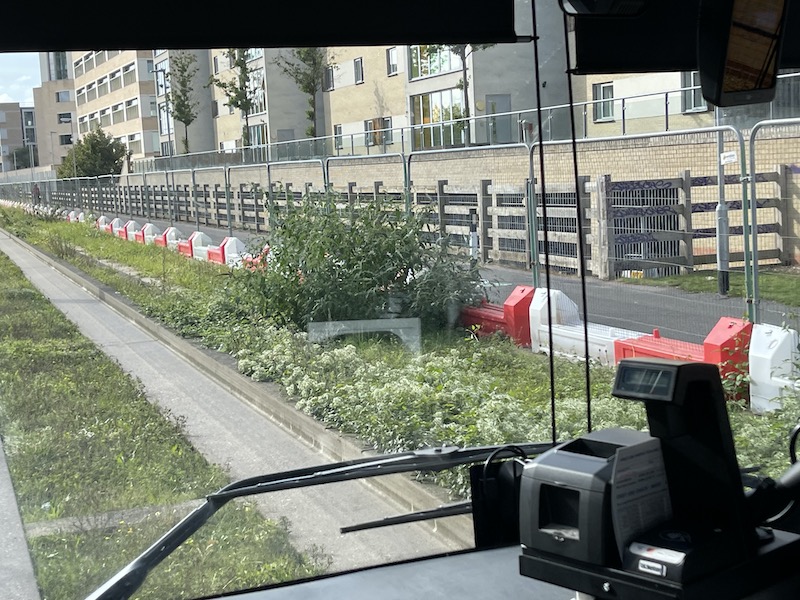
The busway and the maintenance track (foot and cycle track) are currently programmed to re-open on Saturday 30 March.
Cambridge Area Bus Users wondered about speed limits, and asked some questions
The questions, and responses from a Cambridgeshire County Council Highways officer are shown below.
- What northbound speed limit is proposed on the guideway?
The proposed speed limit will be the 30 mph restriction that was in place before the installation of the safety barrier, and which is in place on all of the operational parts of the southern section
- Will this be mandated by the HSE, or at the discretion of Cambridgeshire County Council?
There has been no reference made by the HSE as to a required speed limit. As mentioned previously, the pre-existing speed limit will be in place when the closed guideway re-opens.
- What is the justification for the 15mph limit on northbound buses leaving the guideway towards Station Place?
The speed limit was lowered to 15 mph several years ago, due to the increasing numbers of pedestrians, cyclists and other non-motorised traffic in this area. There is a transition area directly at the northern end of the Cambridge-bound guideway where cyclists cross between the carriageway and the maintenance track in both directions, and where there is more interaction with pedestrians using the maintenance track and the footpath towards Station Place. In addition, there is subsidiary traffic entering and leaving the same are via the access from the Obsidian development adjacent to the Busway.
- Could this be raised to a 30mph limit?
While it would be possible to raise the speed limit to any required level, the Council would not wish to exponentially increase the risk of a collision with non-Busway traffic, and the increased likelihood of major injury or death arising from such an increase. The current speed limit allows bus drivers more time to react to what can be unpredictable movement by non-Busway users.
- What is the justification for the 30mph limit on the southbound guideway to the Addenbrooke’s spur junction?
The speed limit across the entire southern section was reduced to a blanket level of 30 mph some years ago, largely in response to the increased numbers of pedestrians, cyclists and other non-motorised traffic arising from the construction of new housing developments, and the expansion of the Biomedical Campus at Addenbrooke’s Hospital. The speed limit is also in keeping with those in place on the road network around the Busway corridor.
- Can the southbound guideway – separated from the cycleway/footway/maintenance track by the northbound guideway, and the new fence – revert to the original 56mph limit?
Whilst it would be possible to raise the pre-existing speed limit to the original speed limit of 56 mph, there is no compelling case to do so. The maximum theoretical transit time gained through increasing the speed limit to 56 mph over this limited distance would be approximately 62 seconds, assuming that a bus entered and left this section of guideway at that speed. However, as the speed limits at either end of the section would be lower, there would be a period on entry where a bus would need to accelerate to the maximum permitted speed, and subsequently a period where the bus would need to decelerate before exiting the guideway to match the speed limit in place at the end of the guideway. These actions would reduce the gains in transit time well below the theoretical maximum.
In addition, and possibly of a greater impact , all buses that use the southern section have their speeds regulated by on-bus control systems using GPS-based geo-fencing. The accuracy of these systems does not have sufficient accuracy to allow for differing speeds on the guideway tracks that are immediately adjacent to each other.
- If the 30mph limit is mandated by the HSE, will the County Council and Combined Authority press the HSE to allow the limit to be raised?
As stated above, the HSE have not made reference to any required speed limit in the southern section. The rationale for the 30 mph has already been addressed in my response regarding your question on the 30 mph limit on the southbound guideway. As I have already stated, there is no compelling case to increase the speed limit, and the technology in use to regulate bus speeds currently in use would preclude a separate speed limit for one section of guideway in this section.
- Whilst a 15mph limit is required for southbound buses at the point of entry to the southbound guideway, why does this apply from the junction with Station Place?
The reasons are the same as stated above, in response to your question regarding the 15 mph speed limit for buses leaving the northbound guideway.
- Could this apply only from the overhead hanging height limit warning signs before the Hills Road bridge, with the 30mph limit applicable in Station Place continuing up to this point?
As outlined above, given the levels of non-Busway traffic using the area, there would be little to gain by doubling the speed limit for buses over such a short distance, and any gains in transit time would be negligible. The area between Station Place and the height restriction barrier is where large numbers of pedestrians cross the roadway from the station side to reach the path that eventually joins the maintenance track adjacent to the guideway south of Hills Road bridge, and an increase in the speed limit would increase the likelihood and severity of a collision between buses and non-Busway traffic.
We look forward to the re-opening and, even with the lower speed limits in both directions, buses will, once again be able to avoid the traffic congestion on Hills Road (which the Greater Cambridge Partnership and others seems reluctant to tackle).

The images displayed here are from BusAndTrainUser the retirement activity for Roger French OBE DL MA, former MD of Brighton&Hove Bus Cº, a blogging site which we are pleased to promote.
 Cambridge Area Bus Users