As readers might have guessed, this is not the Daily Mail headline, which read…
EXCLUSIVE Britain’s e-bus ticking timebomb: How nearly TWO THOUSAND electric buses worth £800m face urgent recall over fears they could see burst into flames
If you really wish to read the inaccurate, misleading nonsense from Darren Boyle (2 March 2024) in the Daily Mail click here.
… a hysterical report in the Daily Mail claiming uncited fears that affected buses “could see [sic] burst into flames.” … The Mail also quoted FairFuelUK founder and Reform UK candidate for the London mayoral election Howard Cox as claiming that taxpayers will “have to fund these expensive buses being taken off the road.”
op cit, routeone Team, March 6, 2024
And the facts?
Alexander Dennis has issued a safety bulletin to operators of BYD ADL Enviro200EV and Enviro400EV battery-electric buses in relation to a potential recall issue around the heating, ventilation and air-conditioning (HVAC) systems in some of those vehicles. … An under-development permanent fix will be introduced to deal with the problem. DVSA’s recall listing service shows that it affects 1,758 buses produced by the BYD Alexander Dennis partnership. In the meantime, operators have been advised to ensure that the Hispacold HVAC system is switched off when those vehicles are left unattended.
ibid
So which of Cambridge’s e-buses are affected?
Not these nine…
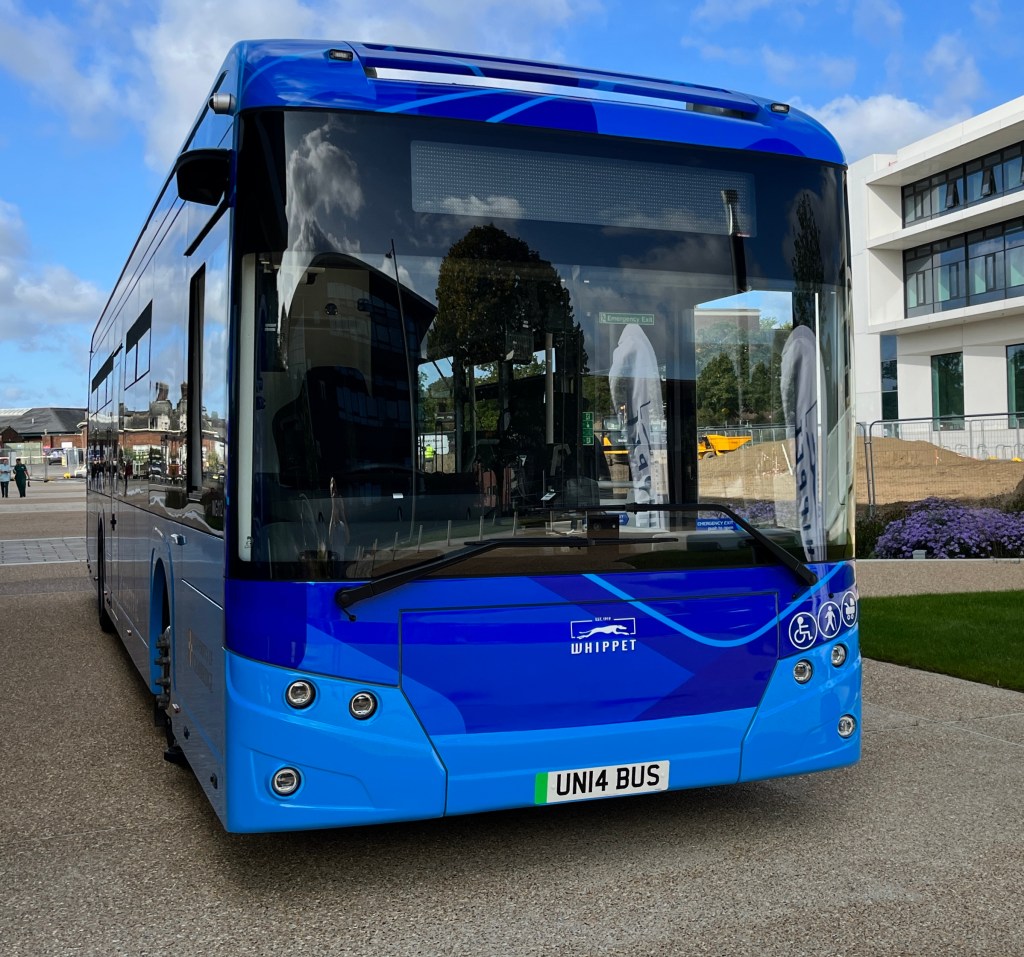
No. None of the nine Mellor Sigma 12 buses serving Whippet’s U1/U2 routes
Nor these thirty…
No, Not the Volvo electric buses allocated to the P&R routes and the citi2
So, which? And how many?
Just these two…
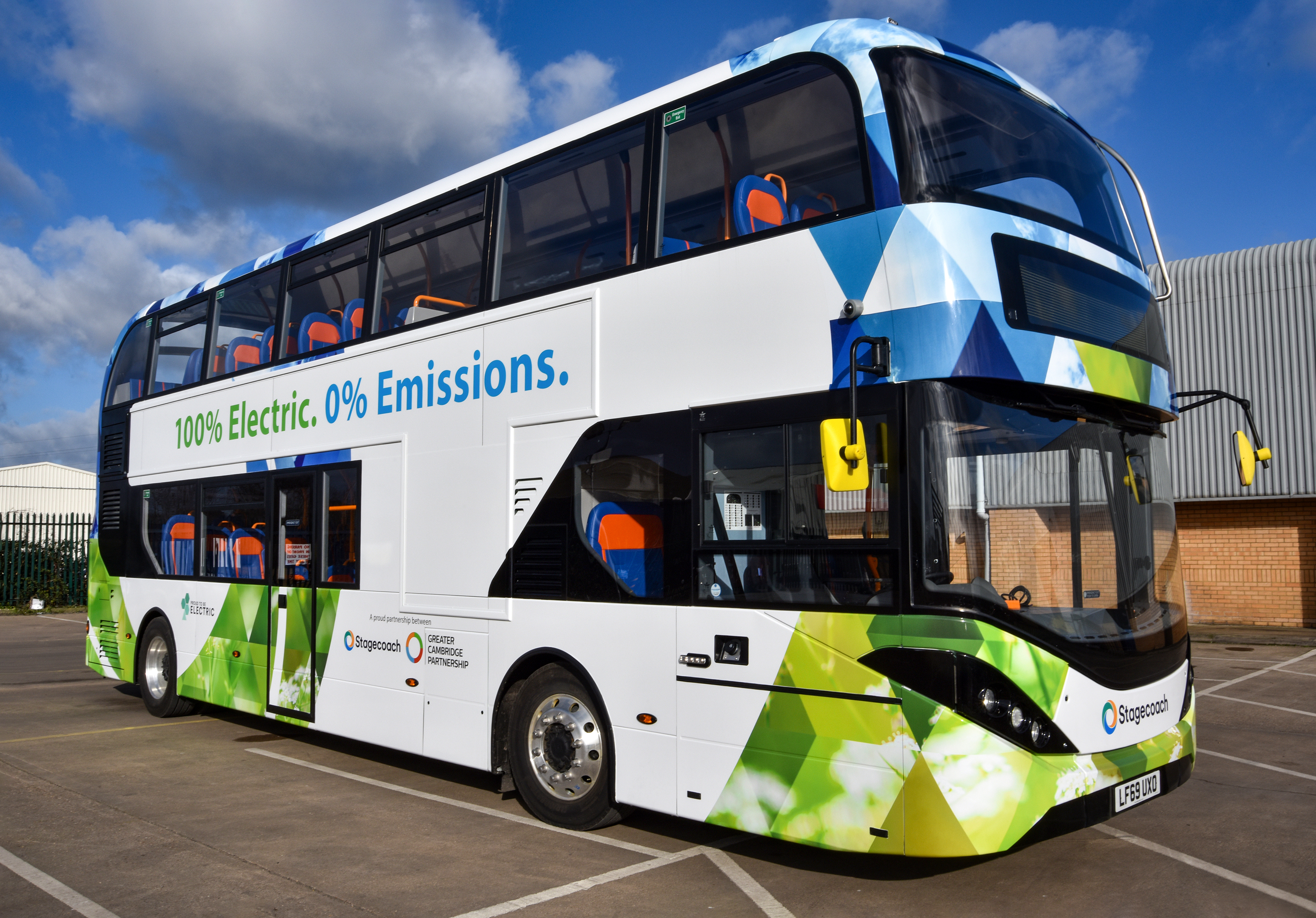
BYD ADL Enviro400EV
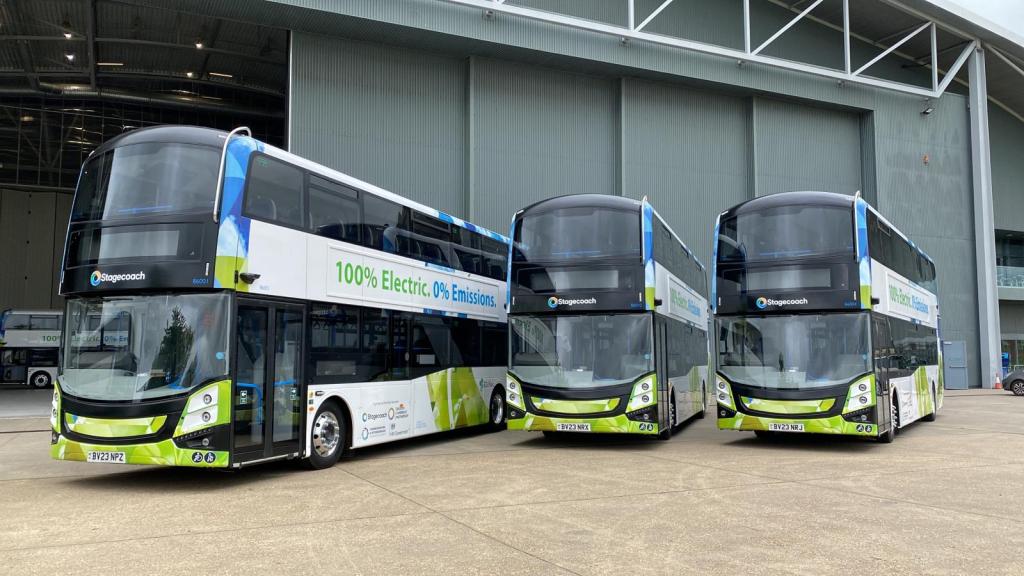
Just these two. ⬆︎ The Alexander Dennis electric double deckers supplied to Stagecoach East for a project between the operator and the Greater Cambridge Partnership, supporting an improvement in air quality in the city centre of Cambridge and giving the opportunity to inform potential future investment in a zero emission bus fleet.
So, these two EXPENSIVE BUSES bought with PUBLIC MONEY are going to be off the road over fears they could burst into flames?
Err… No. Stagecoach drivers and mechanics will ensure that the Hispacold HVAC system is switched off when these vehicles are left unattended, pending a permanent fix from manufacturers ADL.
This puts us in mind of…
There was no wrecks and nobody drownded ‘Fact, nothin’ to laugh at at all!
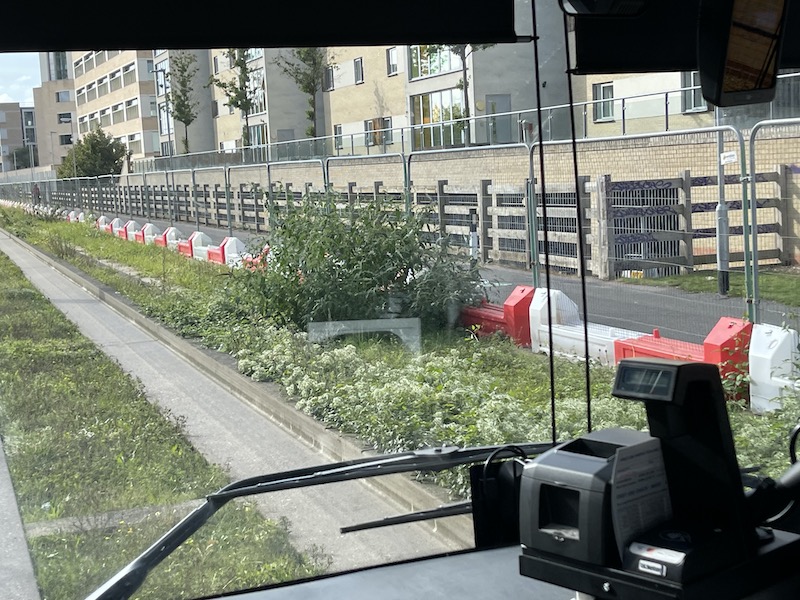
Members and others will no doubt have seen reports in the local media about work on the Southern Busway between Hills Road bridge and the Addenbrooke’s Spur Junction, based on this press release – Guided Busway works begin to allow closure to be lifted, 06 February 2024 – from Cambridgeshire County Council.
Since February 2022, a section of the Guided Busway in one direction has been closed between Cambridge Railway Station and the Cambridge Biomedical Campus. The inbound only track (closest to the maintenance track) was closed to allow for a temporary fence to be installed without reducing the width of the path used by pedestrians and cyclists. This measure has severely impacted the busway service and connections to key employment and health facilities.
The temporary fence was installed whilst we waited for an independent safety review and following ongoing communications with the Health and Safety Executive (HSE) and as part of our continuous review of safety on the busway.
The busway and the maintenance track (foot and cycle track) are currently programmed to re-open on Saturday 30 March.
Cambridge Area Bus Users wondered about speed limits, and asked some questions
The questions, and responses from a Cambridgeshire County Council Highways officer are shown below.
What northbound speed limit is proposed on the guideway?
The proposed speed limit will be the 30 mph restriction that was in place before the installation of the safety barrier, and which is in place on all of the operational parts of the southern section
Will this be mandated by the HSE, or at the discretion of Cambridgeshire County Council?
There has been no reference made by the HSE as to a required speed limit. As mentioned previously, the pre-existing speed limit will be in place when the closed guideway re-opens.
What is the justification for the 15mph limit on northbound buses leaving the guideway towards Station Place?
The speed limit was lowered to 15 mph several years ago, due to the increasing numbers of pedestrians, cyclists and other non-motorised traffic in this area. There is a transition area directly at the northern end of the Cambridge-bound guideway where cyclists cross between the carriageway and the maintenance track in both directions, and where there is more interaction with pedestrians using the maintenance track and the footpath towards Station Place. In addition, there is subsidiary traffic entering and leaving the same are via the access from the Obsidian development adjacent to the Busway.
Could this be raised to a 30mph limit?
While it would be possible to raise the speed limit to any required level, the Council would not wish to exponentially increase the risk of a collision with non-Busway traffic, and the increased likelihood of major injury or death arising from such an increase. The current speed limit allows bus drivers more time to react to what can be unpredictable movement by non-Busway users.
What is the justification for the 30mph limit on the southbound guideway to the Addenbrooke’s spur junction?
The speed limit across the entire southern section was reduced to a blanket level of 30 mph some years ago, largely in response to the increased numbers of pedestrians, cyclists and other non-motorised traffic arising from the construction of new housing developments, and the expansion of the Biomedical Campus at Addenbrooke’s Hospital. The speed limit is also in keeping with those in place on the road network around the Busway corridor.
Can the southbound guideway – separated from the cycleway/footway/maintenance track by the northbound guideway, and the new fence – revert to the original 56mph limit?
Whilst it would be possible to raise the pre-existing speed limit to the original speed limit of 56 mph, there is no compelling case to do so. The maximum theoretical transit time gained through increasing the speed limit to 56 mph over this limited distance would be approximately 62 seconds, assuming that a bus entered and left this section of guideway at that speed. However, as the speed limits at either end of the section would be lower, there would be a period on entry where a bus would need to accelerate to the maximum permitted speed, and subsequently a period where the bus would need to decelerate before exiting the guideway to match the speed limit in place at the end of the guideway. These actions would reduce the gains in transit time well below the theoretical maximum.
In addition, and possibly of a greater impact , all buses that use the southern section have their speeds regulated by on-bus control systems using GPS-based geo-fencing. The accuracy of these systems does not have sufficient accuracy to allow for differing speeds on the guideway tracks that are immediately adjacent to each other.
If the 30mph limit is mandated by the HSE, will the County Council and Combined Authority press the HSE to allow the limit to be raised?
As stated above, the HSE have not made reference to any required speed limit in the southern section. The rationale for the 30 mph has already been addressed in my response regarding your question on the 30 mph limit on the southbound guideway. As I have already stated, there is no compelling case to increase the speed limit, and the technology in use to regulate bus speeds currently in use would preclude a separate speed limit for one section of guideway in this section.
Whilst a 15mph limit is required for southbound buses at the point of entry to the southbound guideway, why does this apply from the junction with Station Place?
The reasons are the same as stated above, in response to your question regarding the 15 mph speed limit for buses leaving the northbound guideway.
Could this apply only from the overhead hanging height limit warning signs before the Hills Road bridge, with the 30mph limit applicable in Station Place continuing up to this point?
As outlined above, given the levels of non-Busway traffic using the area, there would be little to gain by doubling the speed limit for buses over such a short distance, and any gains in transit time would be negligible. The area between Station Place and the height restriction barrier is where large numbers of pedestrians cross the roadway from the station side to reach the path that eventually joins the maintenance track adjacent to the guideway south of Hills Road bridge, and an increase in the speed limit would increase the likelihood and severity of a collision between buses and non-Busway traffic.
We look forward to the re-opening and, even with the lower speed limits in both directions, buses will, once again be able to avoid the traffic congestion on Hills Road (which the Greater Cambridge Partnership and others seems reluctant to tackle).
The images displayed here are from BusAndTrainUser the retirement activity for Roger French OBE DL MA, former MD of Brighton&Hove Bus Cº, a blogging site which we are pleased to promote.
Long Road Sixth Form College are running an event regarding bus services across Cambridgeshire and surrounding areas, on Tuesday 5th March 2024 5:30pm – 7:00pm.
Since the changes to bus routes in October 2022, many local communities have found their bus service to be less than satisfactory; an issue that is particularly impacting young people accessing a variety of educational, work and social opportunities. We want this to change.
Share your questions and feedback with Mayor Dr Nik Johnson of Cambridgeshire and Peterborough Combined Authority (our Transport Authority) who are raising additional Council Tax to fund more bus services, and representatives of bus companies Stagecoach, Whippet and Stephensons of Essex, who will be able to talk about any of their bus services; giving young people and their families the opportunity to share their feedback and get their questions answered.
Important information for attendees:
You must book 1 ticket for each person attending the event, including parents/carers.
On-campus parking is available. Please use public transport or car-share where possible.
Long Road Sixth Form College will be taking photos for use in their marketing materials and social media. If you would not like to be photographed please alert their photographer(s) when you see them, or move out of shot.
Here are some details from the launch event at West Hub, JJ Thomson Avenue, Cambridge, CB3 0US, on Friday 29th September 2023.
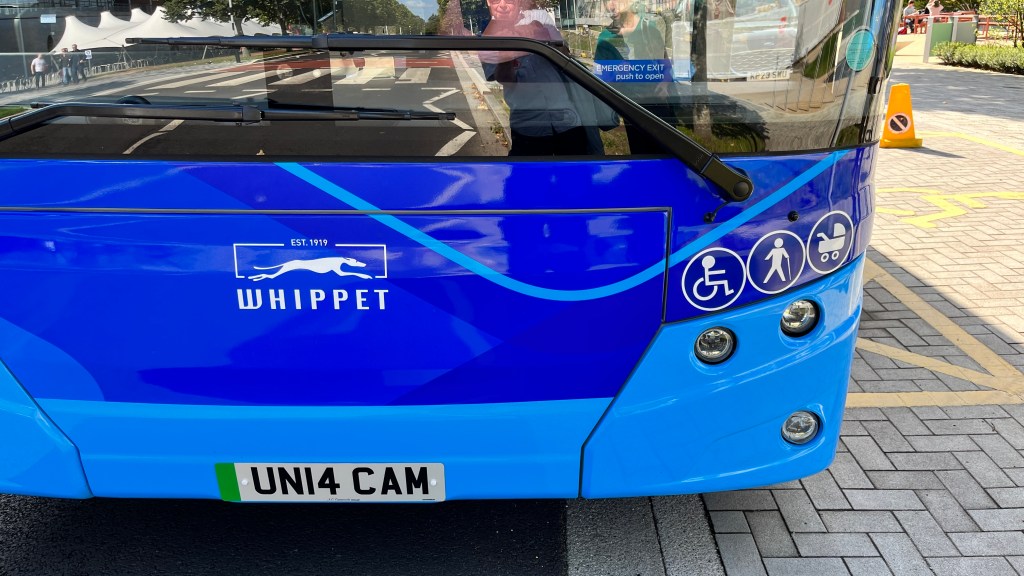
One of the nine Mellor Sigma 12 buses serving the U1/U2 routes This is one of two with personalised registration marks Note the cameras which replace traditional exterior mirrors
We don’t intend to duplicate reports from elsewhere, but add a few details about the vehicles and the attention to detail which has gone into the new vehicles and the re-imagined routes.
Reports from the University and the news media, give the overview and key details of the new U1/U2 7-day/week service from Girton Corner to the Cambridge Biomedical Campus. (Yes, the Biomedical Campus is served on Sundays, and Newnham gains a Sunday bus service to the rail station and the Biomedical Campus.)
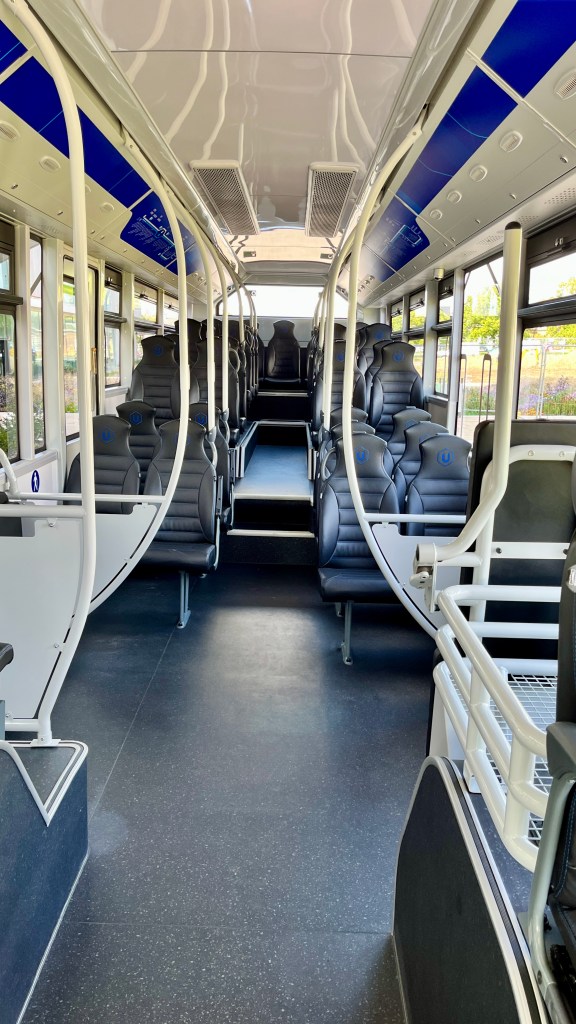
The nine Mellor Sigma 12 buses – designed, engineered and fitted out in the UK – have two wheelchair/buggy bays (each with three tip-up seats for when not fully occupied by wheelchairs or child buggies) and ten highly-accessible, fixed, high-back seats on the low-floor section, forward of the raised area to the rear, under which some of the batteries are housed.
Interior of one of the Mellor Sigma 12 vehicles showing ten highly-accessible, fixed, high-back seats on the low-floor section, forward of the raised area
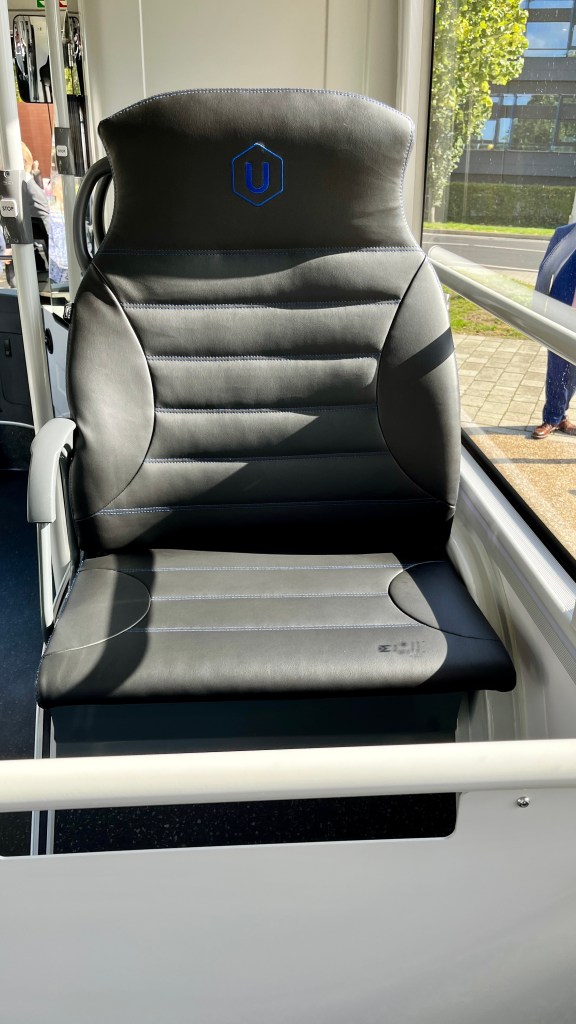
Above the front wheel arches are three slightly-wider single seats designed to accommodate a parent with a small child.
One of the three slightly-wider single seats designed to accommodate a parent with a small child
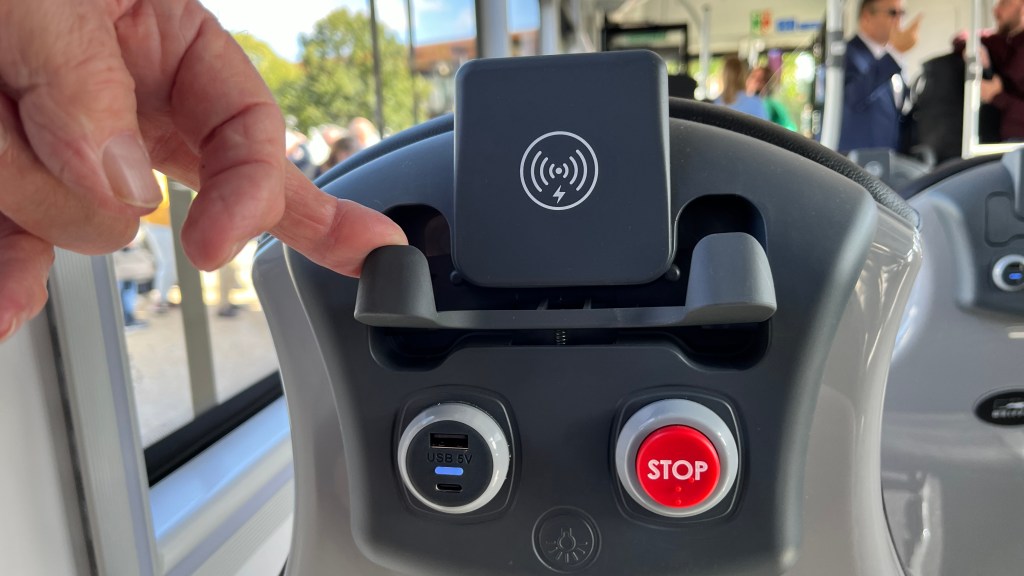
Smartphone getting low on its charge? The University, Whippet and Mellor have the solution…
You can charge up wirelessly, or with your USB-A or USB-C cable Note, also, the STOP button on the seat-back and the button for the reading lamp
Passengers benefit from clear audio-visual announcements for the direction of travel (eg ‘Towards Girton Corner’) and the next stop, comfortable high-backed seats (ten of which are accessible on the low-floor section), two wheelchair/buggy bays, multi-way phone charging, a STOP button on every seat-back, and even a reading-lamp to help decipher those all-important marginalia.
Drivers have the benefits of external cameras at the front (replacing traditional mirrors) and at the rear, an AI-assisted hazard detection system, fully adjustable driving-seat, steering wheel and a dashboard which adjusts with the wheel.
The enhanced audio-visual announcements mentioned above are only part of the mission to remove anxiety from bus travel. The installation of seat-back STOP buttons in addition to more traditionally-located buttons help those with hidden disabilities. But these features are only part of the integrated mission.
West Hub bus stop, towards Cambridge Biomedical Campus
All stops have been updated with a printed timetable in a weatherproof case, and a bus stop flag which shows the direction of travel. Wherever possible, bus stops have many more passenger-friendly features.
The West Hub bus stop shown in the foregoing photograph, has a shelter with integrated seating, good hard-standing, a printed timetable in a weatherproof case, e-paper real-time passenger information, and gives easy access to the bus for wheelchair users. The bus stop flag reads ‘towards city centre, rail station & Biomedical Campus’.
This stop fulfils all of the criteria for quality Bus stop infrastructure in our joint briefing paper with Living Streets, Cambridge.
A feature to give a smile
The other of the two vehicles with personalised registration marks
Recently, Roger French OBE DL MA, BusAndTrainUser, visited Whippet as part of his fortnightly A to Z of bus and train companies. Read the blogpost here: W is for Whippet.
Significant changes to the University’s “Universal” (or “U”) service are taking place on Monday 2nd October.
Two distinct services are being created, to be known as “U1” and “U2”.
U1 is essentially the same as the extended version of the current service – the one that calls at Girton Corner (but only a very few times a day at present). Throughout most of the day alternate services will extend to/from Girton Corner, but otherwise follow the existing route (except that journeys towards Girton Corner call adjacent to Eddington Sainsbury’s and not across the road).
U2 takes a different route between Grange Road and Queen’s College, serving the whole of Grange Road and Barton and Newnham Roads between Grange Road and Silver Street. Omitting, therefore, West Road. Some U2 journeys extend to/from Girton Corner.
One other significant change is that weekend services will again serve the Biomedical Campus (as happened during the Covid pandemic).
Overall frequency remains unchanged. Services from the Biomedical Campus continue to serve Homerton College (and Hills Road more generally) whilst the northbound lane of the southern section of the Busway remains closed to buses.
The service is operated by Whippet on behalf of the University of Cambridge.
The new timetable – and a handy route map for those unfamiliar with the area – is available from the Whippet website.
Recent bus service withdrawals had people worrying how they would get to work or college. And it necessitated a breakneck scramble to find new operators by the Cambridgeshire and Peterborough Combined Authority.
Together with the continuing disruption caused by cancellations, this rather makes the case for democratic control over bus operators.
We need better reliability, more services, and more affordable fares.
The Greater Cambridge Partnership’s City Access proposals are riding to the rescue
If you want safe walking and cycling, reliable buses and a positive future for everyone, make your voice heard today!
The Greater Cambridge Partnership have promised £50 million annually for radically-improved bus services, funded by money from the city deal, signed with central government in 2014 and not from council tax or business rates.
But, longer-term, this money will run out and a sustainable revenue-stream will be required. Under national legislation, this will be legally ring-fenced for transport improvements.
And public money must be safeguarded: the benefits should be for bus passengers, not for bumper payouts to bus company shareholders (and foreign owners in some cases).
The GCP is working closely with the Cambridgeshire and Peterborough Combined Authority who can exercise powers (under the Bus Services Act 2017) to prevent bus operators ever again causing such disruption to people’s lives.
More about the Cambridgeshire and Peterborough Combined Authority’s potential powers
The Bus Services Act 2017 – passed under a Conservative government, with all-party support – provides Mayoral Combined Authorities (including the Cambridgeshire and Peterborough Combined Authority) with a number of options to improve bus services, including powers to implement bus franchising, akin to the system operated by Transport for London.
Bus Users group contributions to this Consultation response guide are taken from our Aims & Priorities document (PDF). In general, The GCP proposals are in line with what we set out in that 2019 document: more services, better frequencies, lower fares and improved reliability.
However, whilst that document called for operators and local authorities to co-operate on reliability (which implies tackling congestion) and for the GCP to generate funding for unprofitable routes, we have no existing policy on a congestion charge. It was, therefore, not possible to contribute a Cambridge Area Bus Users’ view on that aspect of the consultation. You will need to make up your own mind.
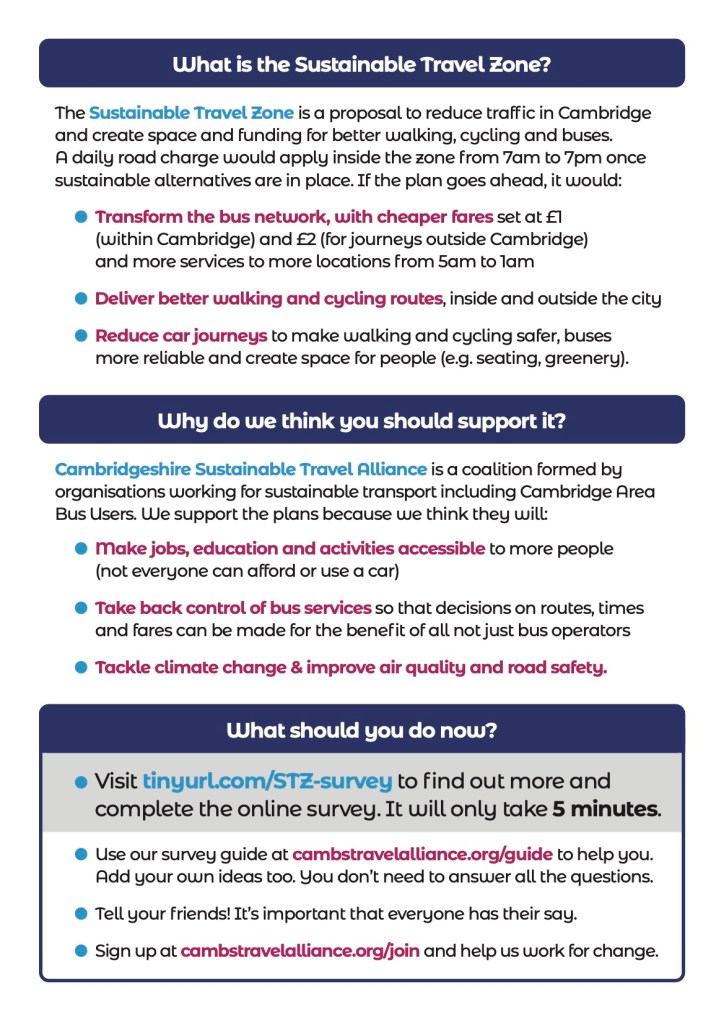
What are the Greater Cambridge Partnership proposing?
Transforming the bus network: From as early as mid-2023, The GCP are proposing to transform the bus network through more services to more locations, with cheaper fares set at £1 (city zone) and £2 (wider area).
Investing in other sustainable travel schemes: Alongside the bus network, the GCP areproposing to invest in new sustainable travel schemes, such as better walking and cycling links.
Creating a Sustainable Travel Zone: The GCP areproposing the introduction of a Sustainable Travel Zone in the form of a road user charge on behalf of Cambridgeshire County Council. Vehicles would be charged for driving within the Zone between 7am and 7pm on weekdays, and money raised would fund improvements to the bus network and other sustainable travel schemes. The Zone would be fully operational in 2027/28 but only once the first bus improvements are introduced.
The proposals will see:
Double the hours of service and miles covered of the pre-pandemic Greater Cambridge bus network
£1 flat fares for single journeys in the Cambridge bus zone, and £2 fares in the wider area
It is important that as many bus users as possible give their views on the Greater Cambridge Partnership proposals, before the consultation closes on Friday 23 December 2022.
Complete it yourself and encourage your spouse/partner, your teenage children, your parents and your neighbours to give their views.
You don’t need to live within the Greater Cambridge boundaries. If you and/or a member of your household uses buses to travel in and around Cambridge, the survey needs your views.
Could you tell your story about how poor bus services have impacted on your life?
Could you tell people about how better bus services would improve your life?
The CSTA team need online stories, stories for press releases and stories for online videos.
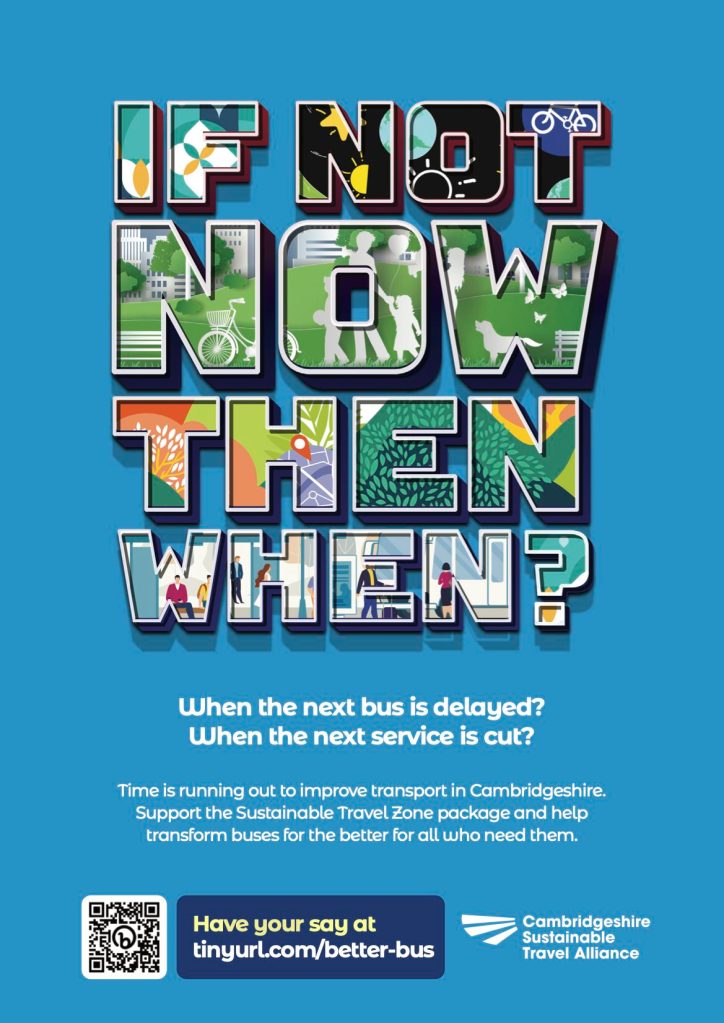
Could you help distribute the IF NOT NOW THEN WHEN? leaflets around your streets, your village or join other members, leafleting in the city centre, or other locations?






 Cambridge Area Bus Users