Two steps forward; one step back?
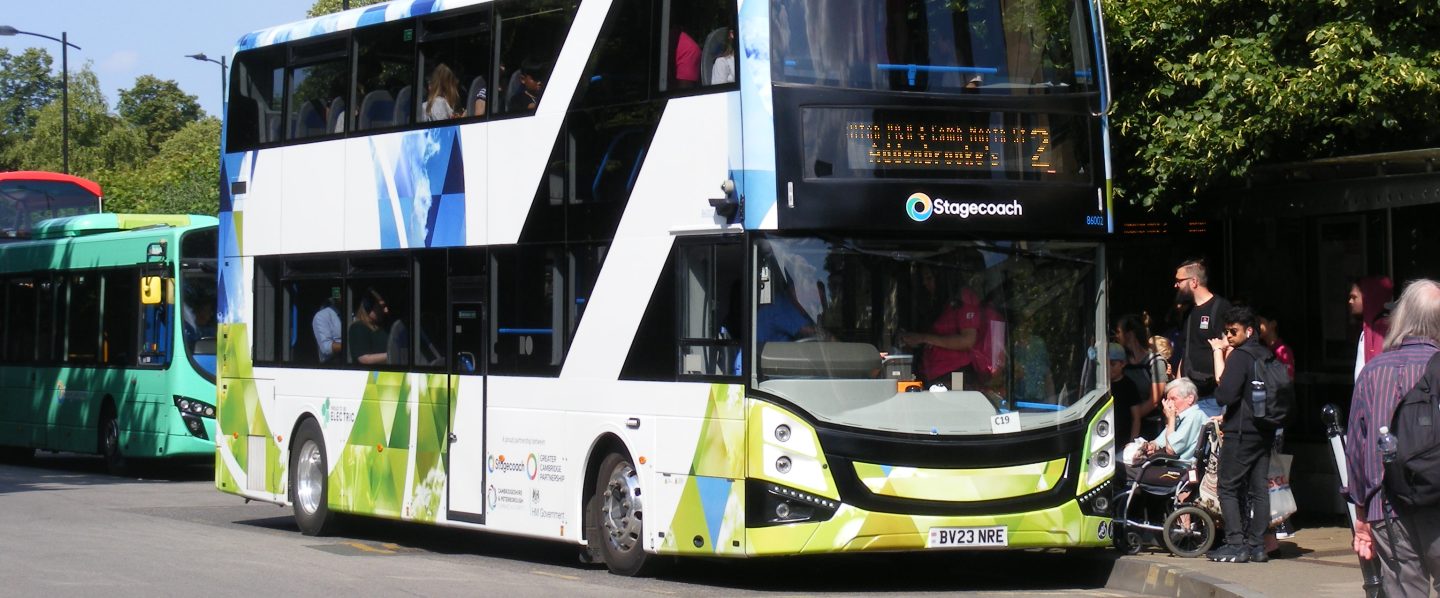
There is much to welcome in the September changes to bus services in and around Cambridge announced by Stagecoach and Whippet – Stagecoach changes from Sunday 1st September, New Whippet service 18a from 2nd September – with increasing funding from Cambridgeshire and Peterborough Combined Authority.
However…
Some services are being ‘rationalised’ (Stagecoach’s citi1 in Fulbourn) others have longer journey times (citi7) or reduced frequency (citi6) whilst others have, currently, no prospect of returning to pre-Covid frequency levels (citi2 every 20 mins, 10 mins pre-Covid).
And the elephant in the room (or on the streets)? Traffic congestion
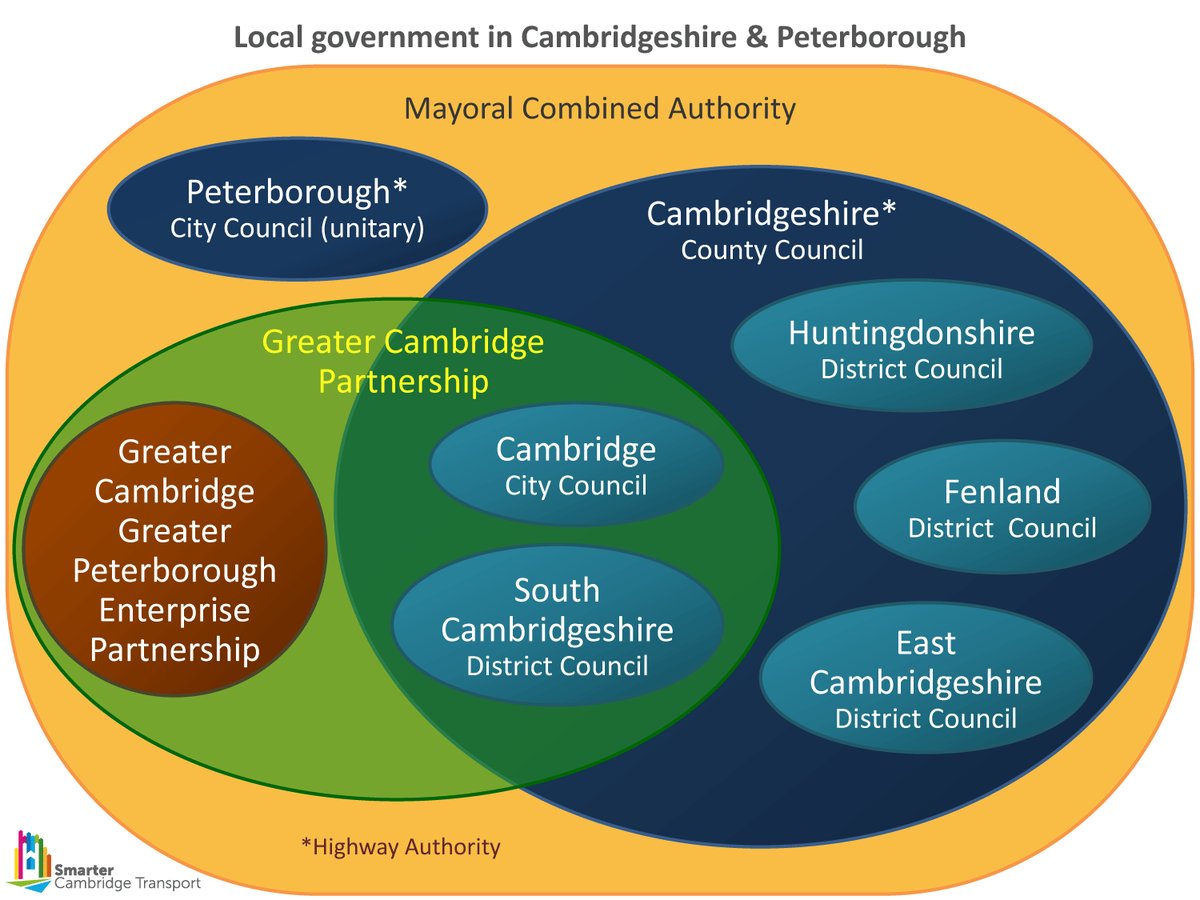
Cambridge Area Bus Users recognise that commercial bus companies cannot run services at a loss. Adding extra buses to maintain frequencies adds costs, without any certainty of increased farebox revenue. Unless our plethora of overlapping local governance bodies (see graphic, below) take radical action to tackle traffic congestion bus services will be in a spiral of decline: reduced speeds ➞ increased costs ➞ lower ridership ➞ reduced income ➞ service reductions ➞ lower ridership ➞ reduced income ➞ further service reductions.
Tackling traffic congestion: the need for bold action
In February 2024 sister organisation Cambridgeshire Sustainable Travel Alliance issued a press release – We will all lose out if the Greater Cambridge Partnership abandons large-scale projects to reduce congestion.
The current high motor traffic levels are hinted at as the reason for abandoning the road reclassification project. The Eastern Access project, Hills Road and Madingley Road schemes are also being watered down due to the need to accommodate large numbers of cars. It is highly inequitable that projects to encourage people to use sustainable transport and reduce car usage cannot go ahead or are compromised because there are currently too many people driving. Many people who drive would like to travel by sustainable means, but cannot. When GCP officers assessed the threats and opportunities of not proceeding with the Sustainable Travel Zone road charge last September, they did not mention that abandoning road charging would leave them unable to deliver other GCP projects. In hindsight, this is a significant omission.
CSTA press release as above
Silviya Barrett from national transport charity Campaign for Better Transport (a member organisation of the Cambridgeshire Sustaianble Travel Alliance) said:
“The only way to tackle congestion is to reduce the number of cars on the roads. Traffic reduction measures, coupled with public transport improvements have been proven to cut congestion, reduce air pollution and make places more pleasant to work and live.”
Cambridge Area Bus Users has received multiple complaints about unreliable bus services; one member reported walking from the city centre to the Catholic Church faster than five buses crawling along in road congestion. The group cannot envisage significant improvements in bus reliability until congestion is tackled by reallocating road space away from private cars to buses and active travel.
And the bus operators’ view?
We contacted David Boden, Business Development Director of Stagecoach East, Chair of the recently-formed Cambridgeshire and Peterborough Bus Alliance, who was kind enough to provide the following statement.
As people who run local buses, we tend to talk about two connected but different concepts: ‘reliability’ and ‘punctuality’. We are very willing to be held accountable for the aspects of reliability we can control – that is to say, providing a bus and a driver when we say we will. But, once the bus leaves the station or depot, its punctuality is overwhelmingly dictated by issues like congestion, parking enforcement and roadworks, none of which are in our power to change.
All this slows the bus down, increases journey times and the cost of service provision, and makes it really difficult to rebalance using the bus over car. There is no secret formula to all this, put simply, if you want a world-class bus network, you need a world-class road network and bus infrastructure.
Our local authorities work very hard to try to mitigate the negative effects of roadworks where they can, but there are sadly limits to their powers. Now is the time for everyone, including the utility companies, Highways and other key stakeholders, to engage with bus operators directly in a meaningful and productive way.
Buses are a key lifeline for our region, and with a genuine desire from everyone to go that extra mile in minimising disruption to bus services, we can offer the residents of Cambridgeshire the excellent service that we all want them to have.
It is a burning issue. Bus services are not going to get any better – and will continue to get worse – until we have those conversations, and elected officials then are willing to make bold and difficult decisions. [Our emphasis]
I will say that, in recent times, we have seen some elements of progress. We recently praised the communication from UK Power Networks for their Mill Road works, for example. They gave us proper notice and this led to high-level discussions between the two companies, with potential ways to keep disruption to a minimum, floated.
We hope that this will set a template for all such interactions in the future, so it becomes ‘business as usual’ that utility companies talk with the major bus operators so we can all work together as best we can.
David Boden, Business Development Director of Stagecoach East, Chair of the Cambridgeshire and Peterborough Bus Alliance
Ian Lockwood, a recognized national leader in sustainable transportation policy (USA) and urban design (and witty cartoonist) sums up the situation, neatly.

We recognise that funding for comprehensive, fast, frequent bus services cannot rely on farebox revenue alone. Support from the public purse is also essential. That public purse is not inexhaustible; plans for radical improvements to bus services envisaged by Cambridgeshire and Peterborough Combined Authority (our Transport Authority) could founder unless Cambridgeshire County Council (our Highway Authority) and the Greater Cambridge Partnership (holder of the ‘City Deal’ purse strings) “are willing to make bold and difficult decisions“.

 Cambridge Area Bus Users
You ask, Martin, “When are CAPCA going to stand up to the Roads Lobby, and are they afraid of doing so?”
Cambridgeshire and Peterborough Combined Authority is not the Highway Authority in Cambridge/Cambridgeshire; that is Cambridgeshire County Council. Recently abandoned plans for a Sustainable Travel Zone came from the Greater Cambridge Partnership (holder of the City Deal purse-strings). If implemented, this would have required the exercise of Cambridgeshire County Council’s powers (with Greater Cambridge Partnership funding).
You ask, Martin, “… the recent announcement that trams are likely to be coming to Cambridge within the next few years is a game changer.”
We are aware of the recent publicity drive by Cambridge Connect, and the associated plea for feasibility/business-case funding. A well-planned tramway scheme would be of benefit to the Greater Cambridge travel-to-work area, but is far from shovel-ready, and even further away from operation. In the meantime, improved bus services (frequency, times of operation, geographical coverage) will be essential. Buses will also help to expand/prove the market for public transport in general. If/when a tram/metro comes into operation, buses will be needed to link areas that a tracked system will never be able to serve.
You ask, Martin, “Whilst we are on the subject of buses, when are CAPCA going to provide funding for the reintroduction of Evening and Sunday buses on routes radiating from Drummer Street Bus Station?”
Cambridgeshire and Peterborough Combined Authority’s mayor, Dr Nik Johnson, can speak for himself, but could we urge you to read the consultation documents on the way forward for buses? Look out for a forthcoming Cambridge Area Bus Users post on this.) These compare the benefits of a statutory ‘Enhanced Partnership’ and ‘Franchising’ under the Bus Services Act 2017. Considerable levels of funding are proposed, as are the introduction of addition routes, times of operation and fare capping. Currently the Mayor’s powers do not permit him to establish new routes which might be considered to compete with commercial services. Under ‘Franchising’ the Mayor would specify all routes, fares, times and days of operation. Under an ‘Enhanced Partnership’ improved routes, fares, times and days of operation, could be negotiated with operators.
You write, Martin, “I have seen no sign of Stagecoach East restoring the Service 9 frequency to its pre-coronavirus levels.”
As commercially-operated de-regulated route, Stagecoach have no obligation to run it at any frequency, or at all, only the obligation to pre-register changes with the Traffic Commissioner and to pre-notify the Cambridgeshire and Peterborough Combined Authority (as Traffic Authority)to enable the Combined Authority to find an alternative operator. In the case of route 9 the Combined Authority has engages A2B to run some of the withdrawn services.
You write, Martin, “I don’t buy the idea that the route was running at a loss.”
Route 9 is outcompeted by faster, more frequent railway services from Littleport and Ely to Waterbeach, Cambridge North and Cambridge Adult return fares are comparable. It is surprising that Stagecoach kept the route running at the previous frequency for so long. Admittedly, closure of their Ely depôt as an operating centre did not help, but that decision was entirely theirs to make as a commercial company, seeking to restrain costs.
You write, Martin, “If it isn’t reinstated ASAP, I will be seeking a FoI request to see the passenger usage data. If they still refuse, I will be seeking Legal Advice.”
Route 9’s frequency has been partially restored through the intervention of the Combined Authority’s contract with A2B. Stagecoach is not a public body; you cannot submit an FoI request for their commercially-sensitive information.
LikeLike
Whilst former Stagecoach East Managing Director, Andy Campbell, claimed that 20mph zones slowed his buses, no proper study has been undertaken to verify this. Given the close proximity of stops and the levels of traffic congestion, over the Cambridge city/citi network, this is a moot point.
On the 1/7/13 route southward on Hills Road, Cambridge, the stop opposite Hills Rd 6th Form College (NaPTAN 0500CCITY060) is around 450 yds (410m) ahead of Cambridge Blinco Grove (near) (NaPTAN 0500CCITY036). If no passengers board or alight at either stop, and there are no turning vehicles, or other potential obstructions to safe running, the time taken will be about 30 sec at 30mph -v- 45 sec at 20mph.
If, however, passengers wish to board or alight, both of these times will be extended by the need to accelerate (gently) away from 0500CCITY060 and to brake (gently) before 0500CCITY036. Under such conditions, a top speed of 30mph, if attained at all, would be for the very briefest of time – maybe 10 sec – with negligible time advantage.
LikeLike
When are CAPCA going to stand up to the Roads Lobby, and are they afraid of doing so?
As things stand, Public Transport in Cambridge is no better than that of a Third World country at present. However, the recent announcement that trams are likely to be coming to Cambridge within the next few years is a game changer. Once built and in operation, then a London-style ULEZ scheme for the City Centre could be brought into use.
Whilst we are on the subject of buses, when are CAPCA going to provide funding for the reintroduction of Evening and Sunday buses on routes radiating from Drummer Street Bus Station? Last night, myself and a friend of mine caught the last service 11 bus from the Bus Station to Swaffham Bulbeck at 7-15pm. It was standing room only, so it proved that the demand is there. Such a reintroduction, particularly on Friday and Saturday nights and during School Holidays, would help to reduce the carnage on our roads caused by drunk drivers.
Finally, I have seen no sign of Stagecoach East restoring the Service 9 frequency to its pre-coronavirus levels. What have they got to hide (I don’t buy the idea that the route was running at a loss)? If it isn’t reinstated ASAP, I will be seeking a FoI request to see the passenger usage data. If they still refuse, I will be seeking Legal Advice.
Martin Thorne, Vice Chairman Cambridge Connect/Cambridge Street Tramways Corporation.
LikeLike
There are suggestions in Cambridge that 20 mph zones should be extended further. Long sections of road at 20 increase the running times of buses, and the Milton service was for a while cut back to the Science Park as the bus company was unable or unwilling to add more buses to the route. I have heard that some bus routes in Wales were cut for the same reason. The unintended consequences of slowing everything down seem not to be understood by those in control of us.
LikeLike