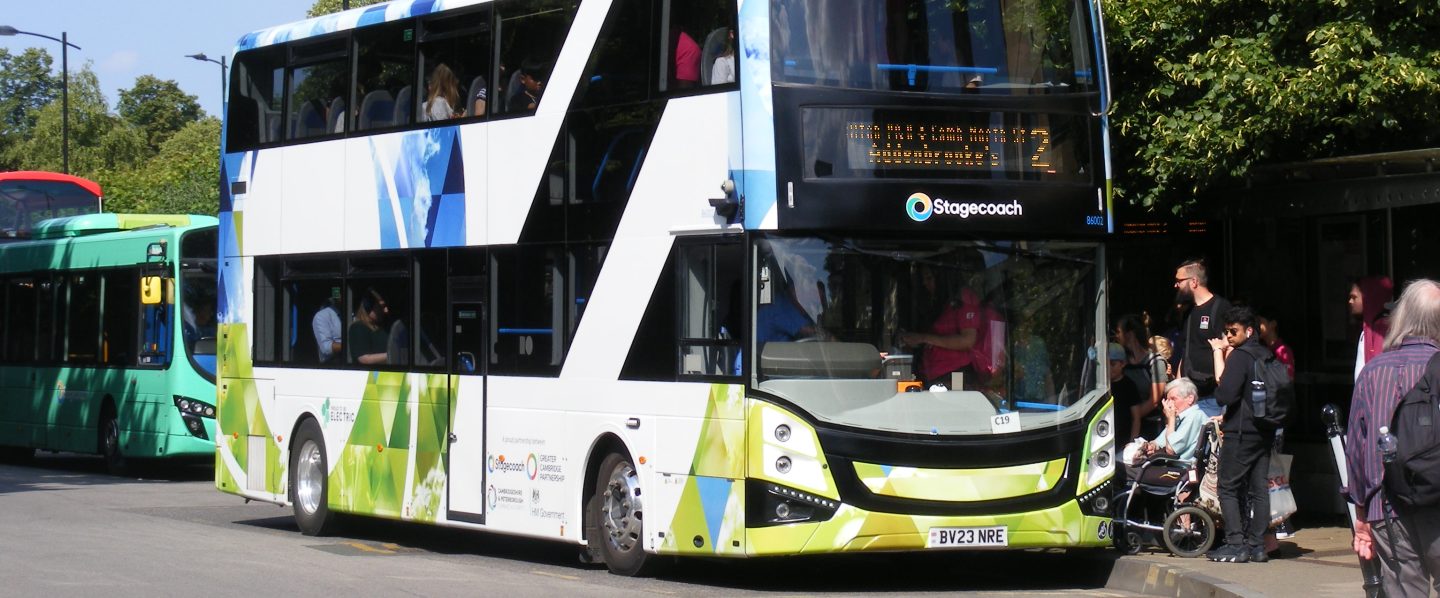
Greater Cambridge Growth: Planning for Bus Services

Cambridge Area Bus Users was particularly concerned about Policy I/ST – Sustainable Transport and connectivity. In our view this policy is ineffective in ensuring that new developments are highly permeable by buses.


(Note: Greater Cambridge Shared Plannning is the Shared Planning Service between Cambridge City Council and South Cambridgeshire District Council. It is not the same body as Greater Cambridge Partnership which is the delivery body for the devolved City Deal signed in 2014)


Our PDF – New Developments – street layout for efficient bus operation – is based on our response to the Greater Cambridge Local Plan. It draws heavily on advice contained in two publications:

Below are some excerpts from our supporting evidence.


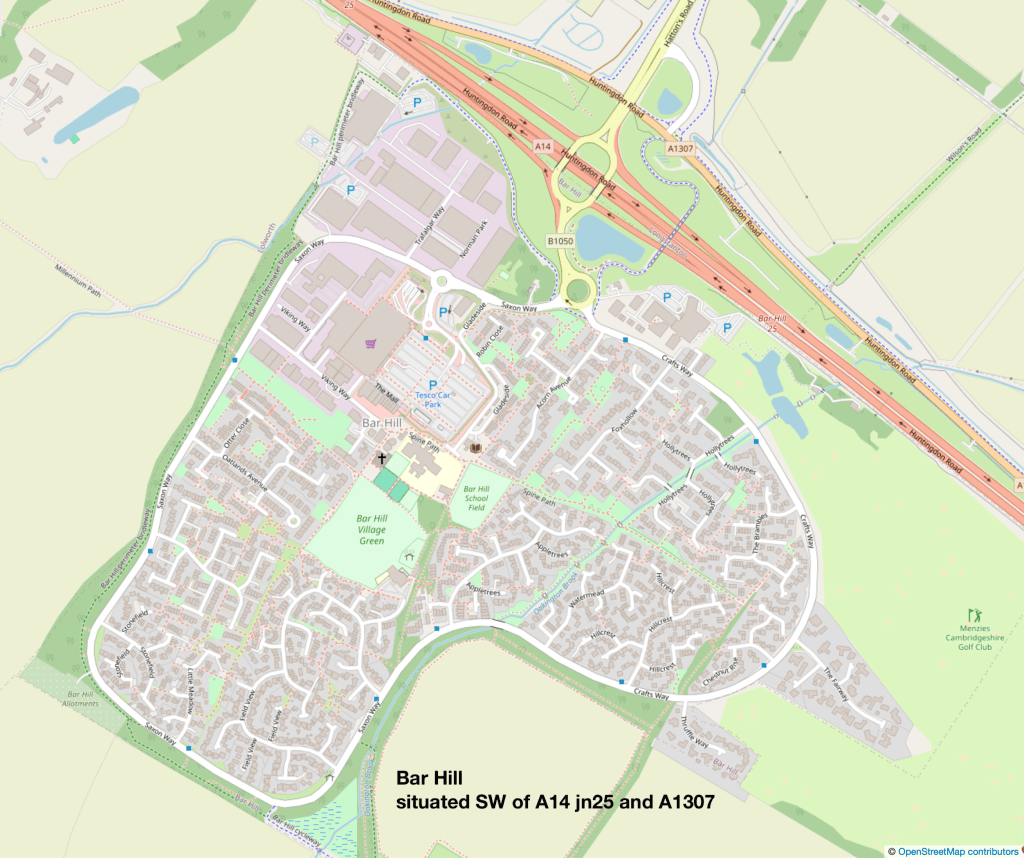
Map of Bar Hill

Bar Hill, established in the 1960s, SW of what was, at the time, the A604 Cambridge – Huntingdon road was a missed opportunity for bus permeability. In particular the possibility of being served by attractive, fast, Cambridge – Bar Hill – Huntingdon services, was lost as a result of the car-centric layout of an orbital distributor road with residential culs-de-sacs. This imposes an unattractive, loop service on the bus operator, with a time penalty of around 10 minutes to access, loop and exit the settlement. Albeit there is a network of footways throughout the village, to encourage active travel, the highway layout is fundamentally flawed in failing to plan for attractive bus services.

Construction of Cambourne, situated south of the A428 and east of the A1198, began in June 1998, with the first house occupied in August 1999. The road layout exemplifies the gratuitous curves and tight bends with poor visibility which should be avoided in planning for bus permeability in new developments.
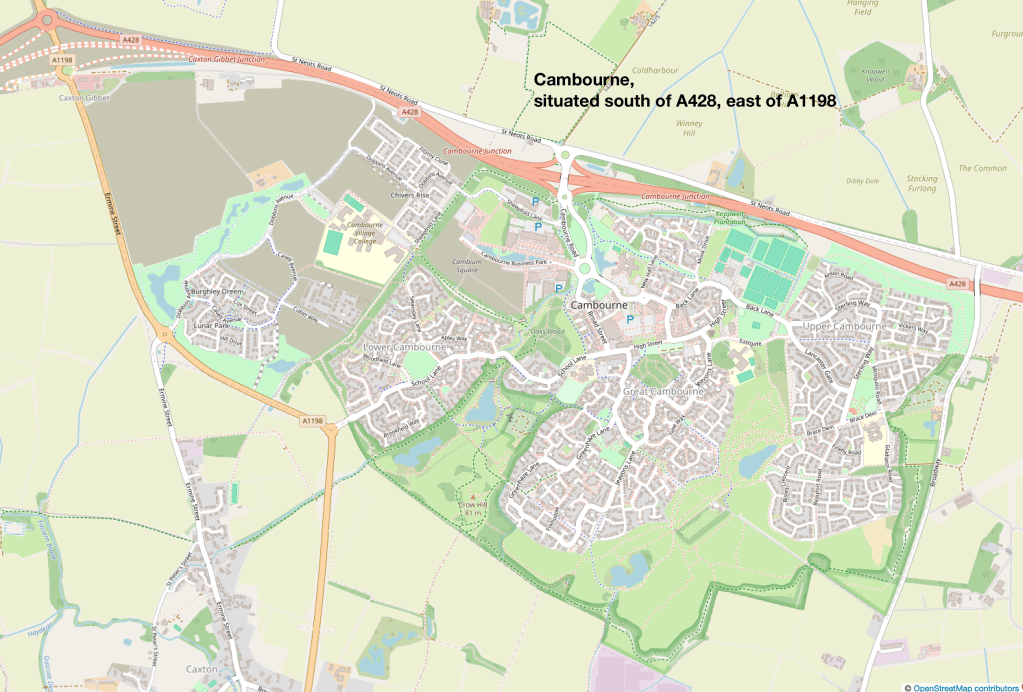
Map of Cambourne

With only northern (A428) and western (A1198) entry/egress to the ‘super village’, Stagecoach East’s service 4 must follow a difficult and indirect pair of loops, to serve Great Cambourne and Upper Cambourne, as shown on the route map, below.
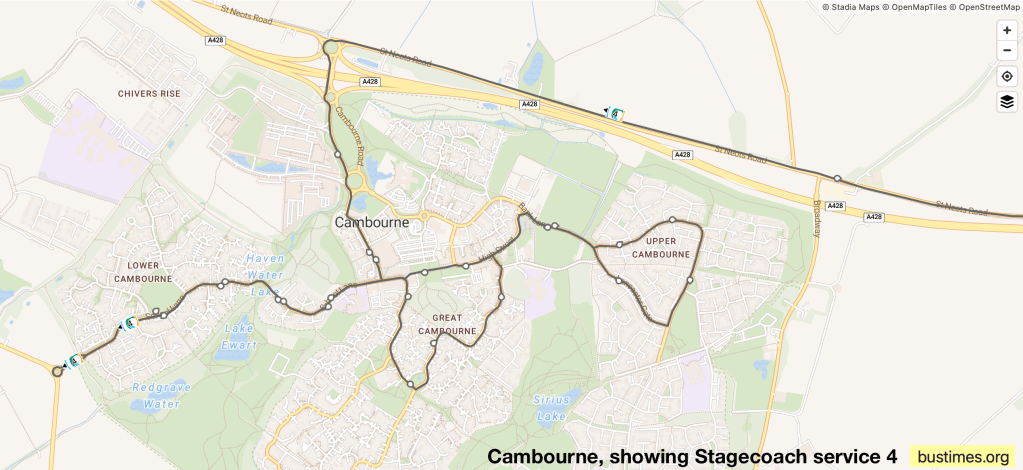
Map of Cambourne, showing route of Stagecoach citi 4

Passengers travelling to/from Cambridge thus have much slower services because of the lack of planning for any direct, east-west bus priority route through the settlement. The time penalty disadvantage of the sub-optimal nature of bus route 4 further imposes costs on the bus operator, threatening the sustainability of the service. Furthermore, the southernmost parts of the settlement are not served by buses, leaving residences in Jeavons Lane and Whittle Way some considerable distance (600m – 800m) from the nearest bus stop.

Additionally, the smooth operation of Stagecoach’s route 4 and the two through services – Whippet’s routes 18 and X3 – are hampered by the gratuitous curves, tight bends and poorly regulated car parking on the shared section along School Lane and Broad Street.


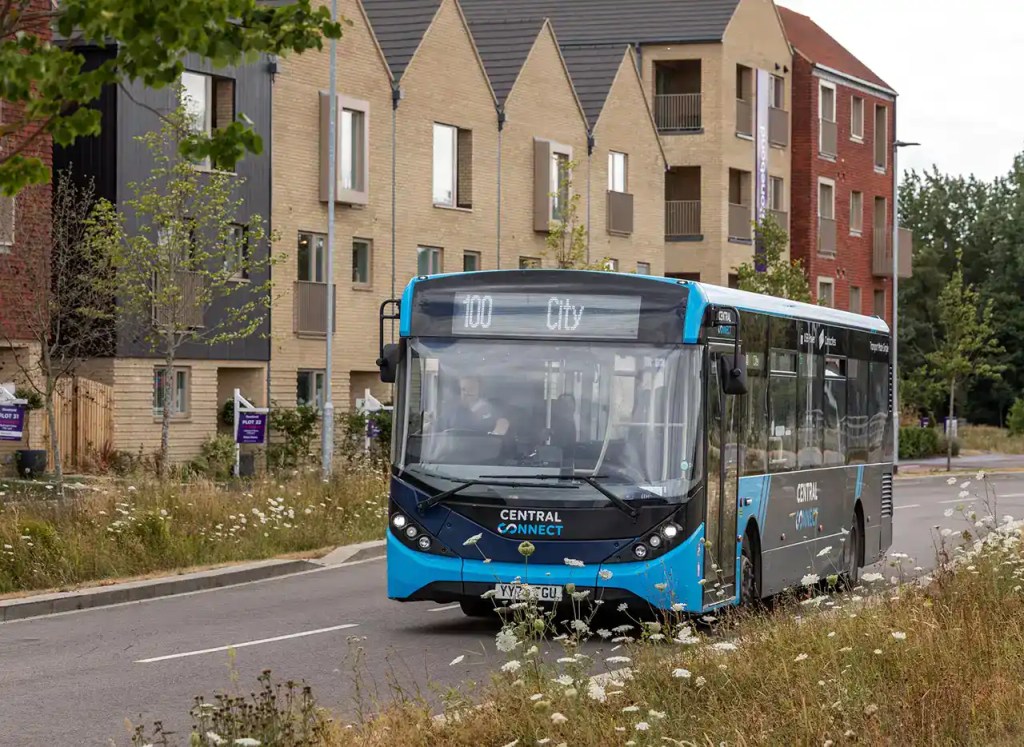
central-connect-bus-service-waterbeach

The Waterbeach new town development of around 11,000 homes, being built on the site of the former Waterbeach Barracks and Airfield, has been designed to prioritise active travel and public transport from the start. The western sector of the development is led by Urban&Civic as the master developer and has included a Sustainable Travel Hub, installed ready for the arrival of the first residents, and an initially half-hourly shuttle bus service connecting to Waterbeach Station, the Science Park, and Cambridge city centre [Waterbeach website: Connections]. Phase 2 will include a “bus only main link” through the site, connecting destinations including schools, a health facility and a new town centre [Waterbeach website, news blog, 19 May 2026].


For the full details of our submission see – New Developments – street layout for efficient bus operation – which is based on our response to the Greater Cambridge Local Plan.

For more on the Cambridgeshire Sustainable Travel Alliance’s objections see: Travel Alliance’s objections to the Local Plan.
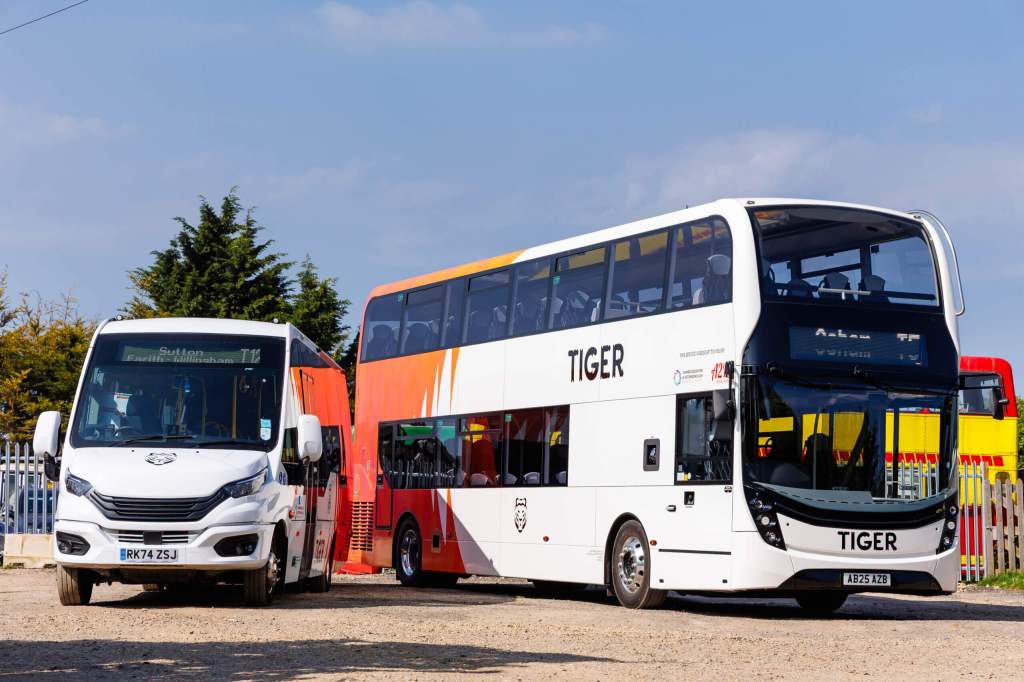
Combined Authority Must Invest in Improved Bus Services


Cambridgeshire and Peterborough Combined Authority is holding an additional bus franchising consultation. Changes to how buses would be brought under local control are proposed, in large part as a consequence of Mayor Paul Bristow’s decision to freeze the Mayoral precept (the portion of council tax the Mayor levies). The Travel Alliance urges you to respond to the consultation questionnaire calling for increased investment by the Combined Authority in buses and an expanded public transport network.

Image from Cambridgeshire and Peterborough Combined Authority of two buses in the 'Tiger' colours.

The Mayor’s decision to freeze the Mayoral Council Tax Precept has led to a significant change in the financial assumptions underlying the original franchising business case. The previously planned Mayoral Precept increase for an average Band D household from the current 10p/day to 16.5p/day by 2032 and 20p/day in 30 years time is much lower than the amount of Council Tax currently levied by the Police and Crime Commissioner (86p/day), and by the Fire Authority (25p/day). It is also lower (in some cases much lower) than many parish precepts: South Cambridgeshire’s parish precepts, for example, are currently as much as 53.5p/day (Great Shelford) with a South Cambridgeshire average of 26.5/day.


Cambridge Area Bus Users collaborated with Cambridgeshire Sustainable Travel Alliance to produce a guide to the Combined Authority’s Bus Franchising Supplementary Consultation

The full guide can be found on the Travel Alliance website: Consultation guide – Don’t miss your chance to call for more investment in buses.

How many stops before I get off?

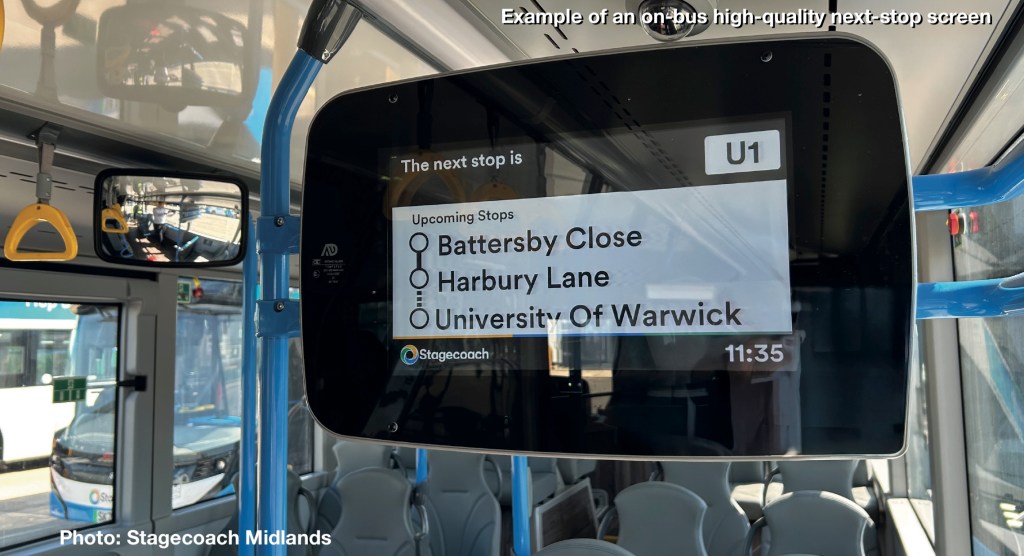
If you’ve been travelling by bus in and around Cambridge recently, you should have noticed more buses announcing and displaying the next stop.


Under the Public Service Vehicles (Accessible Information) Regulations 2023, bus operators across Great Britain are now legally required to provide both audible and visible next-stop and route information on all local buses. This is a win for accessibility, making bus travel in the Cambridge area more reassuring for visually or hearing-impaired passengers, tourists, and everyday commuters alike.

Example of an on-bus high-quality next-stop screen displaying
Route: U1
Upcoming Stops
Battersby Close
Harbury Lane
University Of Warwick
Time: 11:35
Photo credit: Stagecoach Midlands
Not all screens will be as good as this!

  • The regulations do not apply to demand-responsive transport services, such as Tiger-On-Demand, because it is impractical when the route and stopping places are not pre-defined.
  • Services operated by minibuses (vehicles designed to carry 16 or fewer passengers) are exempt from providing accessible information.

Here is Cambridge Area Bus Users‘ focus:

Although the law is now in full effect, equipment isn’t helpful if it’s muted, switched off, or glitching. We will be actively monitoring services across local bus operators. If you’ve travelled on a bus with faulty or inactive audiovisual announcements, please report it to the bus operator. See our Information: Operators page for contact details. Whenever possible email the operator and copy us in to the email on contact.cabu@gmail.com.

As Greater Cambridge heads toward a franchised bus network, basic next-stop announcements should only be the starting point. We want to see rich, contextual passenger information – especially at key hubs. Imagine hearing:

Next Stop: Addenbrooke’s Hospital. Interchange here for Route 13 towards Linton/Haverhill and Route 7 towards Sawston.

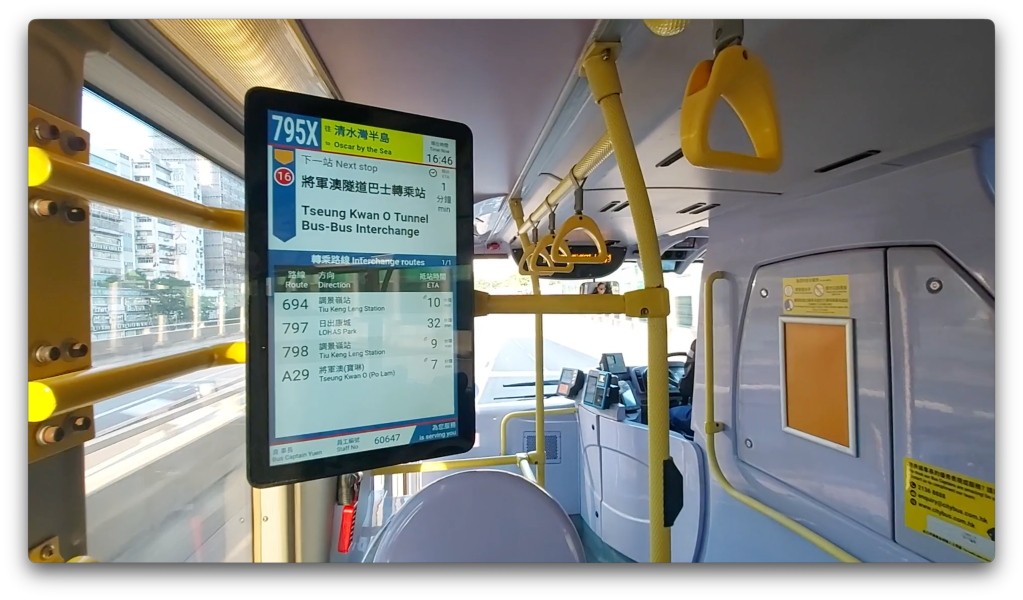
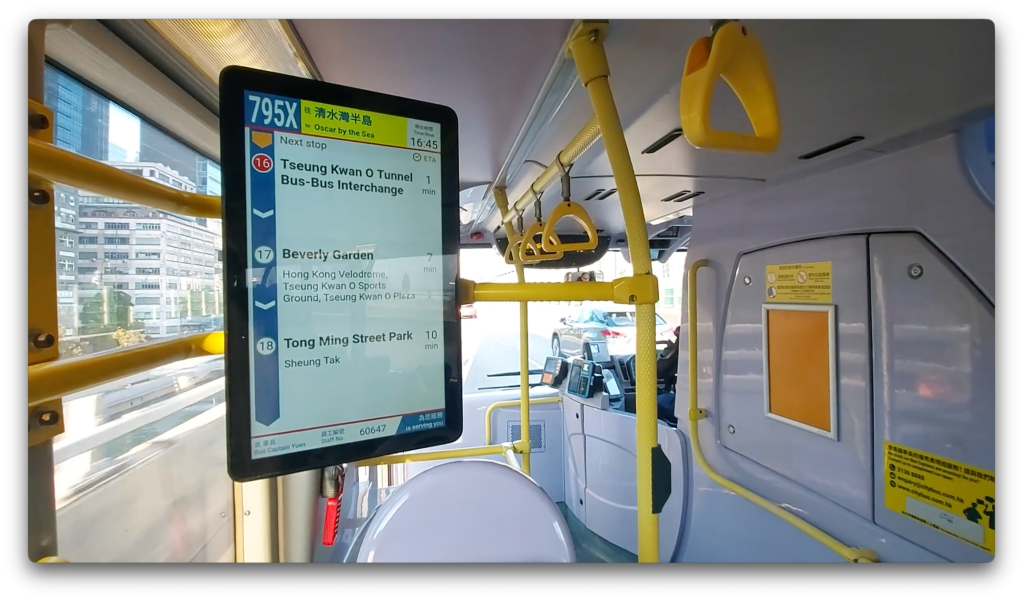
Why stop at static announcements? Some systems around the world are starting to adopt dynamic onboard displays that show live real-time arrival countdowns for connecting services at upcoming interchanges. (See this slideshow from Hong Kong.) We believe the Cambridge area – world renowned for its technological expertise – deserves similar forward-thinking changes as part of the Cambridgeshire and Peterborough Combined Authority’s bus franchising vision.


Have they been working well, or are there routes where compliance is falling short?

You are welcome to help us compile data to monitor compliance, using this email link: Bus AV Announcement Compliance. Note, however, that we cannot take up complaints on your behalf. For more information, see our Making a Complaint about Bus Services page.


September Bus Changes

There is much to welcome in the September changes to bus services in and around Cambridge announced by Stagecoach and Whippet – Stagecoach changes from Sunday 1st September, New Whippet service 18a from 2nd September – with increasing funding from Cambridgeshire and Peterborough Combined Authority.

Some services are being ‘rationalised’ (Stagecoach’s citi1 in Fulbourn) others have longer journey times (citi7) or reduced frequency (citi6) whilst others have, currently, no prospect of returning to pre-Covid frequency levels (citi2 every 20 mins, 10 mins pre-Covid).

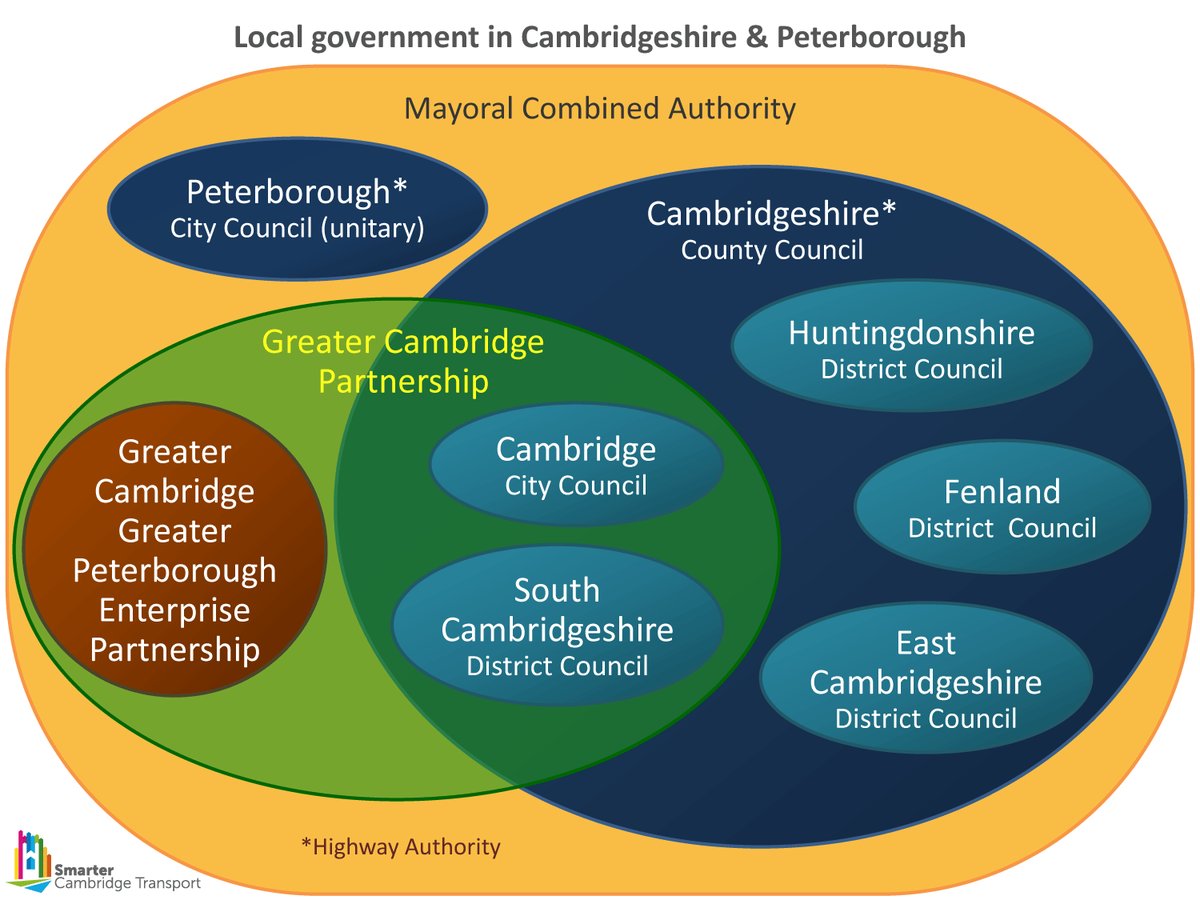
Cambridge Area Bus Users recognise that commercial bus companies cannot run services at a loss. Adding extra buses to maintain frequencies adds costs, without any certainty of increased farebox revenue. Unless our plethora of overlapping local governance bodies (see graphic, below) take radical action to tackle traffic congestion bus services will be in a spiral of decline: reduced speeds ➞ increased costs ➞ lower ridership ➞ reduced income ➞ service reductions ➞ lower ridership ➞ reduced income ➞ further service reductions.

Venn diagram giving visual representation to the overlapping responsibilities of district, unitary and county councils with Cambridgeshire and Peterborough Combined Authority and Greater Cambridge Partnership

In February 2024 sister organisation Cambridgeshire Sustainable Travel Alliance issued a press release – We will all lose out if the Greater Cambridge Partnership abandons large-scale projects to reduce congestion.

The current high motor traffic levels are hinted at as the reason for abandoning the road reclassification project. The Eastern Access project, Hills Road and Madingley Road schemes are also being watered down due to the need to accommodate large numbers of cars. It is highly inequitable that projects to encourage people to use sustainable transport and reduce car usage cannot go ahead or are compromised because there are currently too many people driving. Many people who drive would like to travel by sustainable means, but cannot. When GCP officers assessed the threats and opportunities of not proceeding with the Sustainable Travel Zone road charge last September, they did not mention that abandoning road charging would leave them unable to deliver other GCP projects. In hindsight, this is a significant omission.

CSTA press release as above

Silviya Barrett from national transport charity Campaign for Better Transport (a member organisation of the Cambridgeshire Sustaianble Travel Alliance) said: 

“The only way to tackle congestion is to reduce the number of cars on the roads. Traffic reduction measures, coupled with public transport improvements have been proven to cut congestion, reduce air pollution and make places more pleasant to work and live.”

Cambridge Area Bus Users has received multiple complaints about unreliable bus services; one member reported walking from the city centre to the Catholic Church faster than five buses crawling along in road congestion. The group cannot envisage significant improvements in bus reliability until congestion is tackled by reallocating road space away from private cars to buses and active travel.

We contacted David Boden, Business Development Director of Stagecoach East, Chair of the recently-formed Cambridgeshire and Peterborough Bus Alliance, who was kind enough to provide the following statement.

As people who run local buses, we tend to talk about two connected but different concepts: ‘reliability’ and ‘punctuality’. We are very willing to be held accountable for the aspects of reliability we can control – that is to say, providing a bus and a driver when we say we will. But, once the bus leaves the station or depot, its punctuality is overwhelmingly dictated by issues like congestion, parking enforcement and roadworks, none of which are in our power to change.

All this slows the bus down, increases journey times and the cost of service provision, and makes it really difficult to rebalance using the bus over car. There is no secret formula to all this, put simply, if you want a world-class bus network, you need a world-class road network and bus infrastructure.

Our local authorities work very hard to try to mitigate the negative effects of roadworks where they can, but there are sadly limits to their powers.  Now is the time for everyone, including the utility companies, Highways and other key stakeholders, to engage with bus operators directly in a meaningful and productive way.

Buses are a key lifeline for our region, and with a genuine desire from everyone to go that extra mile in minimising disruption to bus services, we can offer the residents of Cambridgeshire the excellent service that we all want them to have.

It is a burning issue. Bus services are not going to get any better – and will continue to get worse – until we have those conversations, and elected officials then are willing to make bold and difficult decisions. [Our emphasis]

I will say that, in recent times, we have seen some elements of progress. We recently praised the communication from UK Power Networks for their Mill Road works, for example. They gave us proper notice and this led to high-level discussions between the two companies, with potential ways to keep disruption to a minimum, floated.

We hope that this will set a template for all such interactions in the future, so it becomes ‘business as usual’ that utility companies talk with the major bus operators so we can all work together as best we can.

David Boden, Business Development Director of Stagecoach East, Chair of the Cambridgeshire and Peterborough Bus Alliance

Ian Lockwood, a recognized national leader in sustainable transportation policy (USA) and urban design (and witty cartoonist) sums up the situation, neatly.

Cartoon two parents and child in front of large car
THERE IS TOO MUCH TRAFFIC
FOR BILLY TO WALK TO SCHOOL:
SO WE DRIVE HIM.

Traffic Inducing Traffic

We recognise that funding for comprehensive, fast, frequent bus services cannot rely on farebox revenue alone. Support from the public purse is also essential. That public purse is not inexhaustible; plans for radical improvements to bus services envisaged by Cambridgeshire and Peterborough Combined Authority (our Transport Authority) could founder unless Cambridgeshire County Council (our Highway Authority) and the Greater Cambridge Partnership (holder of the ‘City Deal’ purse strings) “are willing to make bold and difficult decisions“.

Queen Edith’s Roadworks: Bus Diversions 8 July – 9 August

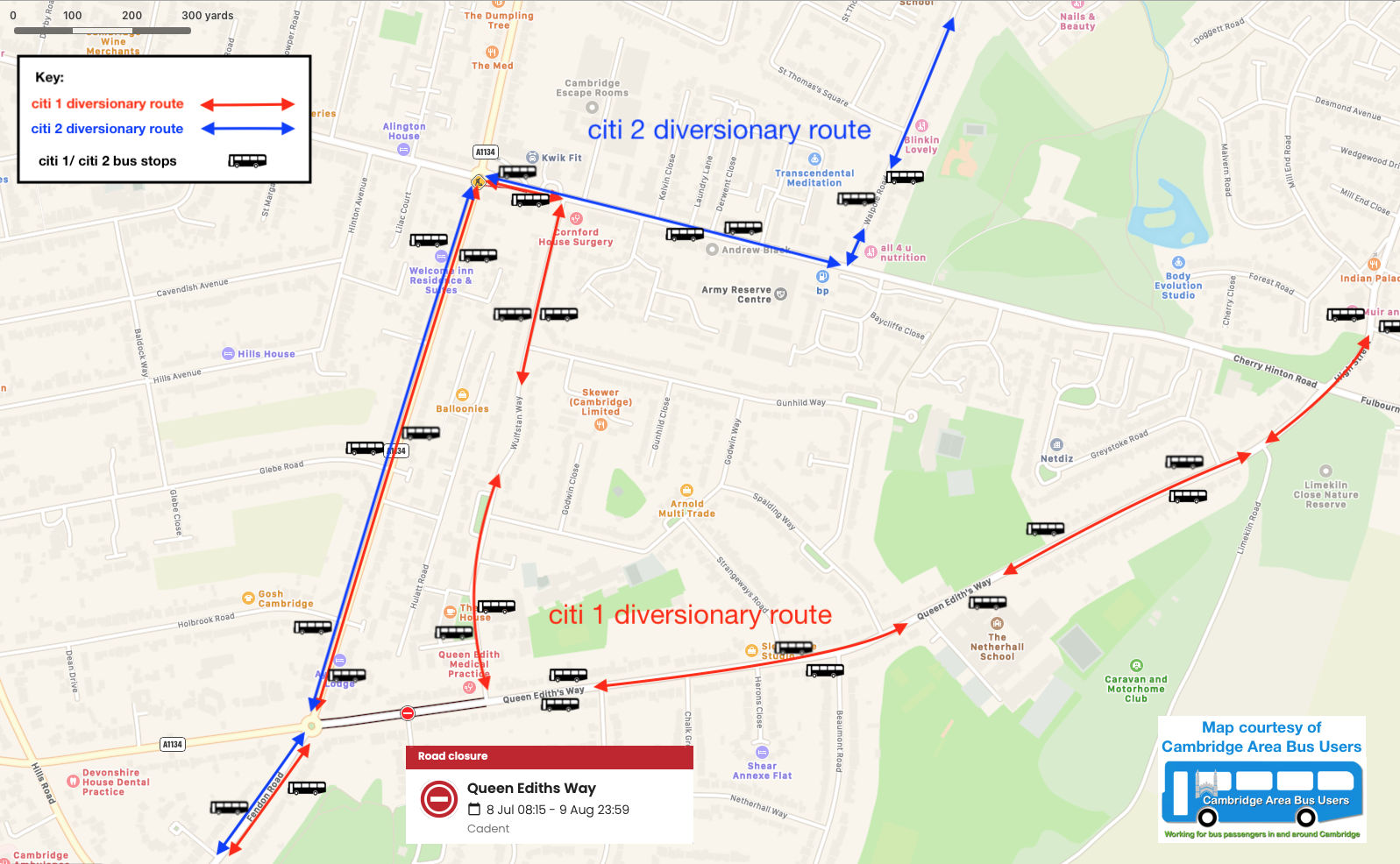
Cambridge Area Bus Users note, from Causeway one.network, that a road closure has been granted for Cadent Gas from Mon 08/07/24 on Queen Edith’s Way, Cambridge between the Fendon Road roundabout and Wulfstan Way. As a result Stagecoach’s citi1/citi2 will be on diversionary routes.

map showing road closure from Fendon Road roundabout to Wulfstan Way
Closure from Fendon Road roundabout to Wulfstan Way

Stagecoach have posted a service update. Following contact with their Cowley Road staff, we can conform these diversionary routes:

  • citi 1 be using Mowbray Road (A1134), Cherry Hinton Road, Wulfstan Road and Queen Edith’s Way between Fendon Road and Cherry Hinton High Street (Robin Hood junction)
  • citi 2 will be using Mowbray Road (A1134) and Cherry Hinton Road between Fendon Road and Walpole Road

The map, below, should help make these diversions clearer.

Non-interactive map showing diversions as described above.
Click the image to view a larger version in a new tab

Electric buses in Cambridge are quite safe, actually…

As readers might have guessed, this is not the Daily Mail headline, which read…

EXCLUSIVE Britain’s e-bus ticking timebomb: How nearly TWO THOUSAND electric buses worth £800m face urgent recall over fears they could see burst into flames

If you really wish to read the inaccurate, misleading nonsense from Darren Boyle (2 March 2024) in the Daily Mail click here.

If you’d rather check out facts, then click through to this on-line government publication: Investigation into bus fires reported to DVSA from 2020 to 2022, DVSA, 20 July 2023

RouteOne a trade publication, gave a balanced report Fix for potential BYD ADL battery-electric bus recall ‘in hand’ in which they remarked upon…

 … a hysterical report in the Daily Mail claiming uncited fears that affected buses “could see [sic] burst into flames.”
…
The Mail also quoted FairFuelUK founder and Reform UK candidate for the London mayoral election Howard Cox as claiming that taxpayers will “have to fund these expensive buses being taken off the road.”

op cit, routeone Team, March 6, 2024

Alexander Dennis has issued a safety bulletin to operators of BYD ADL Enviro200EV and Enviro400EV battery-electric buses in relation to a potential recall issue around the heating, ventilation and air-conditioning (HVAC) systems in some of those vehicles.
…
An under-development permanent fix will be introduced to deal with the problem. DVSA’s recall listing service shows that it affects 1,758 buses produced by the BYD Alexander Dennis partnership. In the meantime, operators have been advised to ensure that the Hispacold HVAC system is switched off when those vehicles are left unattended.

ibid

Not these nine…

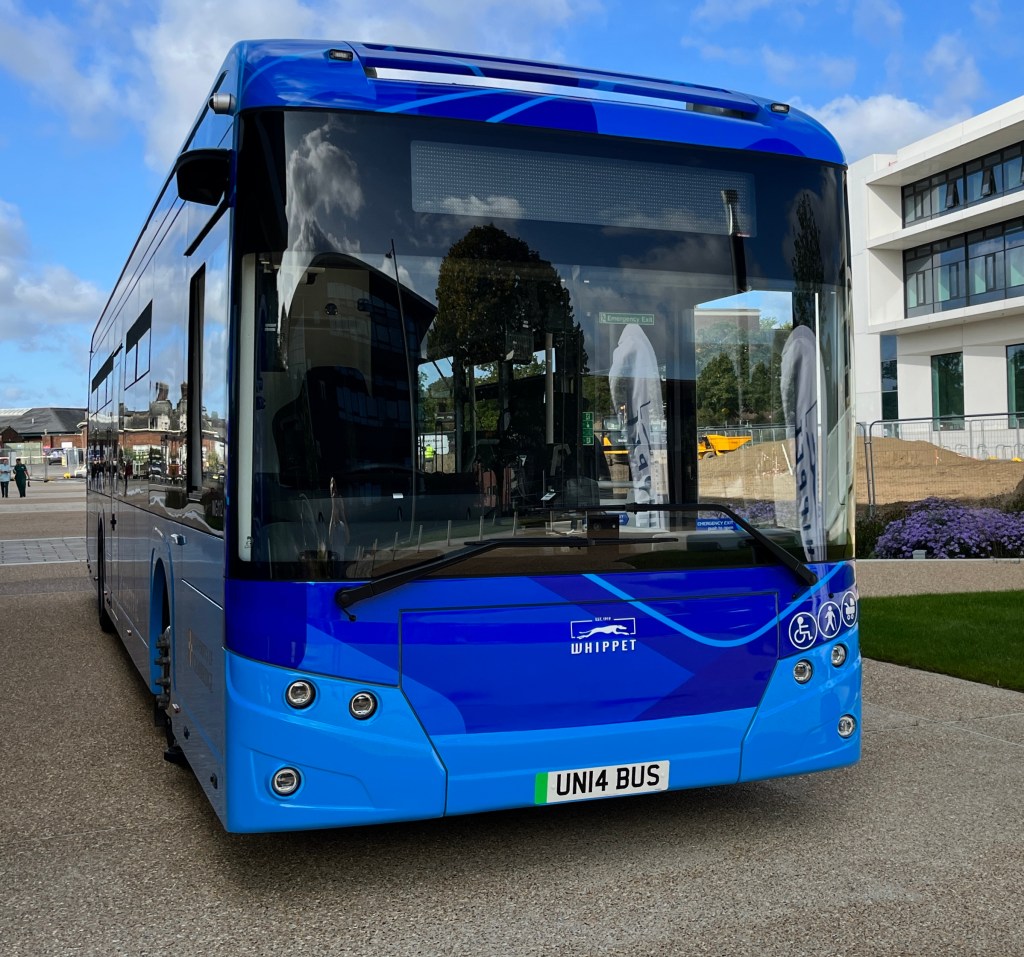
Whippet electric bus
No. None of the nine Mellor Sigma 12 buses serving Whippet’s U1/U2 routes

Nor these thirty…

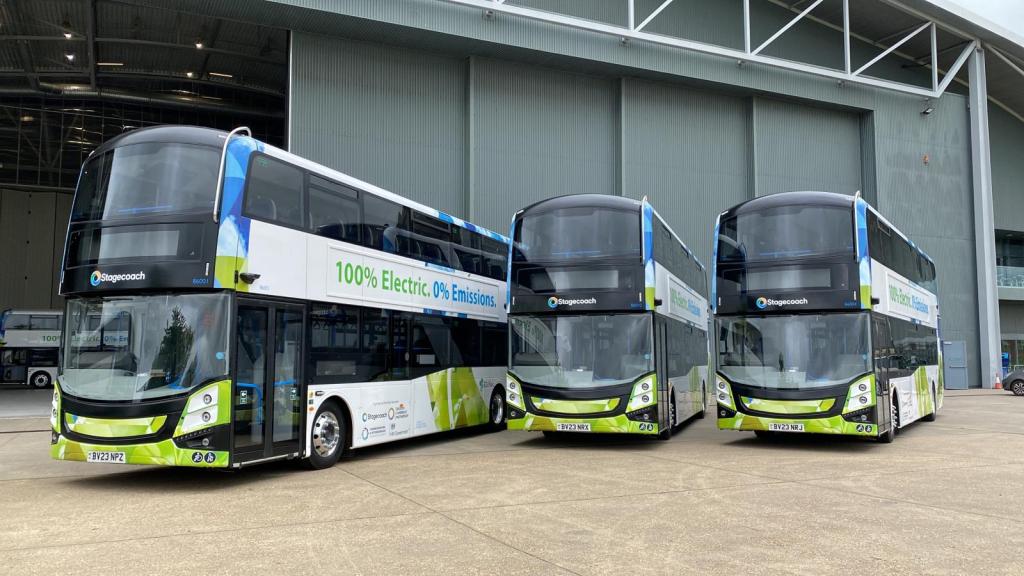
Stagecoach electric buses outside IWM Duxford
No, Not the Volvo electric buses allocated to the P&R routes and the citi2

So, which? And how many?

Just these two…

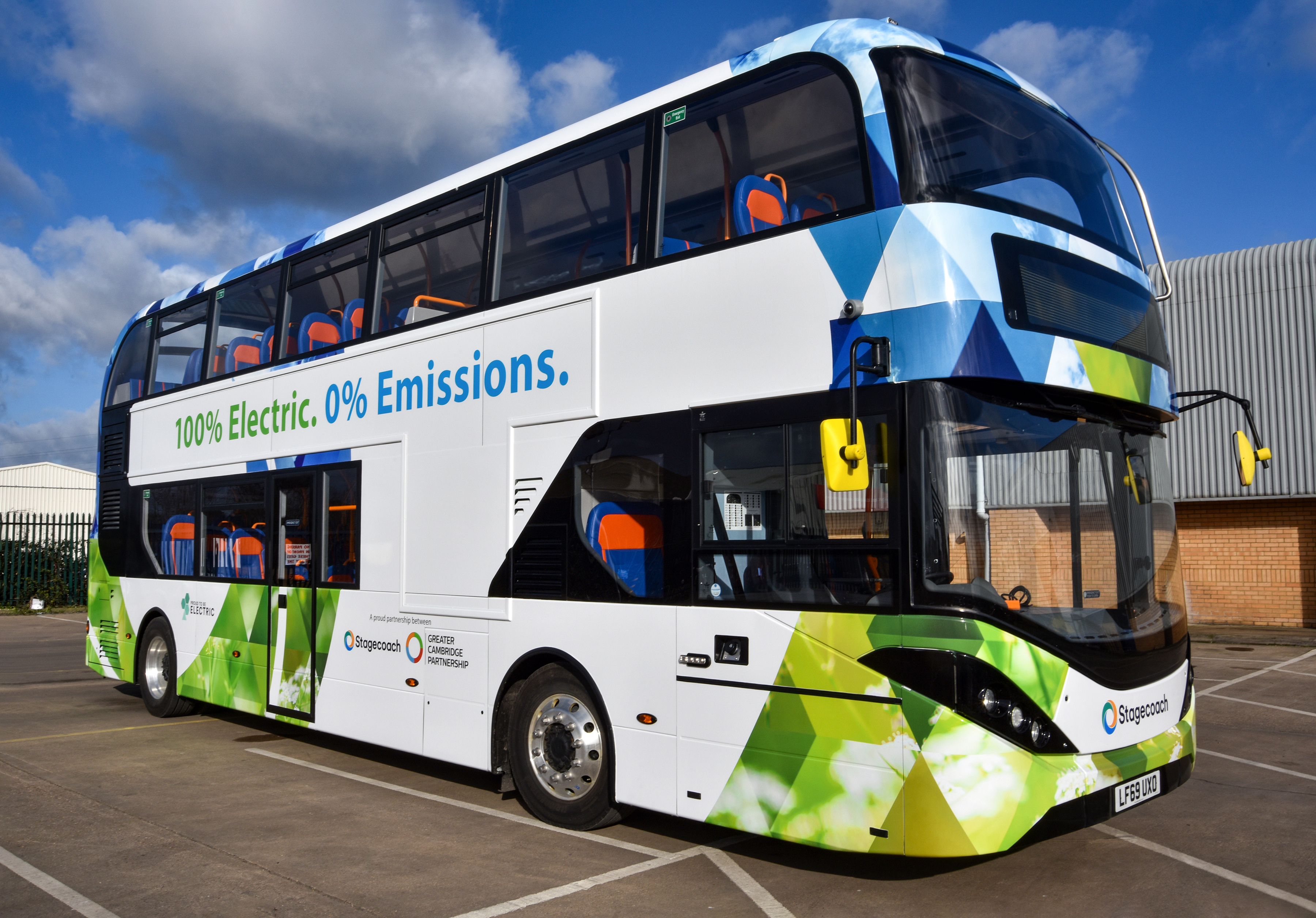
BYD ADL Enviro400EV at Stagecoach's Cowley Road depot
BYD ADL Enviro400EV

Just these two. ⬆︎ The Alexander Dennis electric double deckers supplied to Stagecoach East for a project between the operator and the Greater Cambridge Partnership, supporting an improvement in air quality in the city centre of Cambridge and giving the opportunity to inform potential future investment in a zero emission bus fleet.

So, these two EXPENSIVE BUSES bought with PUBLIC MONEY are going to be off the road over fears they could burst into flames?

Err… No. Stagecoach drivers and mechanics will ensure that the Hispacold HVAC system is switched off when these vehicles are left unattended, pending a permanent fix from manufacturers ADL.


This puts us in mind of…

There was no wrecks and nobody drownded
‘Fact, nothin’ to laugh at at all!

Stanley Holloway – The Lion And Albert (George Marriott Edgar)

Return to Parkside for citi2

photo as caption
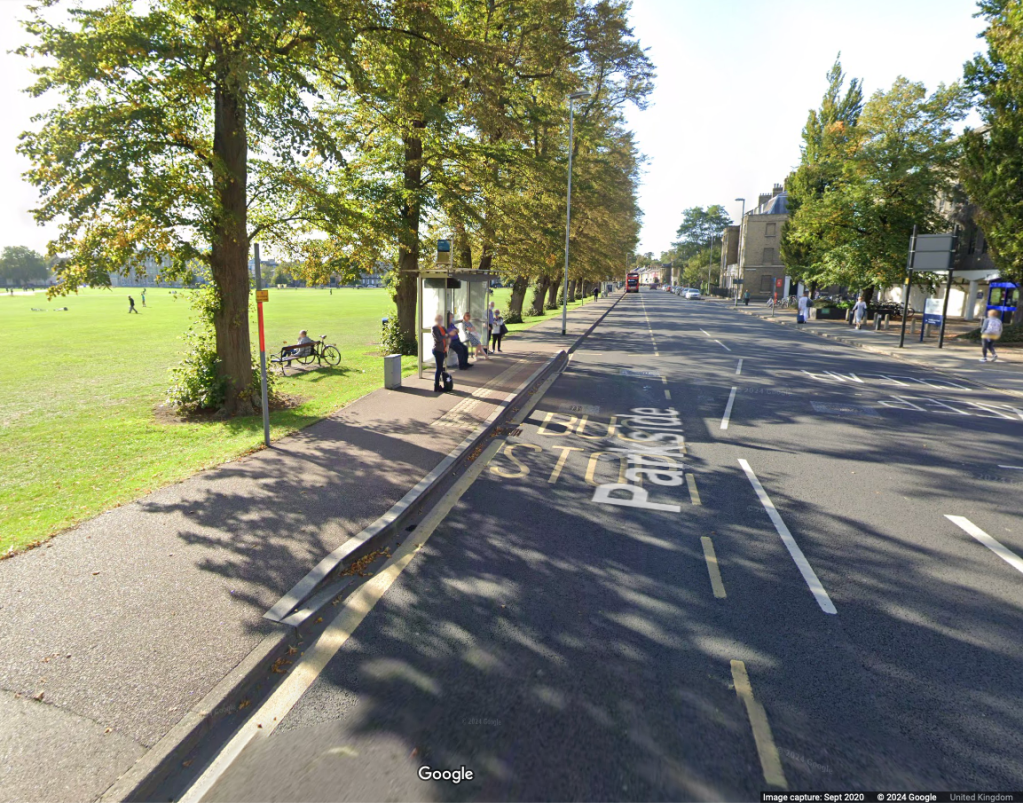
The Volvo electric buses allocated to the citi2 route will serve Parkside

Many years back, before the advent of the Cambridgeshire Guided Busway, Stagecoach’s citi2 route (towards Milton) stopped on Parkside, opposite the Fire Station. Then, as now, in the opposite direction (towards Addenbrooke’s) buses stopped at Mortimer Road (NaPTAN 0500CCITY370).

Cambridge Area Bus Users wondered, with the 905’s move to Drummer Street bus station releasing Parkside, Bay 16 (NaPTAN 0500CCITY476) whether this stop would be available for use by the citi2. So we asked. The response surprised us.

Rather than using Parkside, Bay 16, the citi2 buses will pick up and set down at the stop opposite the Fire Station – now known as The Busway, Parkside (0500CCITY117) – which was previously used.

photo as caption
The Busway Parkside (0500CCITY117) from Google Maps

Cambridge Area Bus Users welcomes this development as the stop…

  • will be useful for Grafton Area shoppers, with a largely traffic-free walking route to Fitzroy Street, via Melbourne Place and Eden Street;
  • will be of some use for passengers to/from Anglia Ruskin University in the evenings and weekends (when the access from Mackenzie Road is closed);
  • will serve students, staff and visitors to Parkside College.

Southern Busway – Planned Reopening

From Stagecoach map annotated by Roger French

Members and others will no doubt have seen reports in the local media about work on the Southern Busway between Hills Road bridge and the Addenbrooke’s Spur Junction, based on this press release –  Guided Busway works begin to allow closure to be lifted, 06 February 2024 – from Cambridgeshire County Council.

Since February 2022, a section of the Guided Busway in one direction has been closed between Cambridge Railway Station and the Cambridge Biomedical Campus. The inbound only track (closest to the maintenance track) was closed to allow for a temporary fence to be installed without reducing the width of the path used by pedestrians and cyclists. This measure has severely impacted the busway service and connections to key employment and health facilities.

The temporary fence was installed whilst we waited for an independent safety review and following ongoing communications with the Health and Safety Executive (HSE) and as part of our continuous review of safety on the busway.

Guided Busway works begin to allow closure to be lifted, Cambridgeshire County Council, 06 February 2024
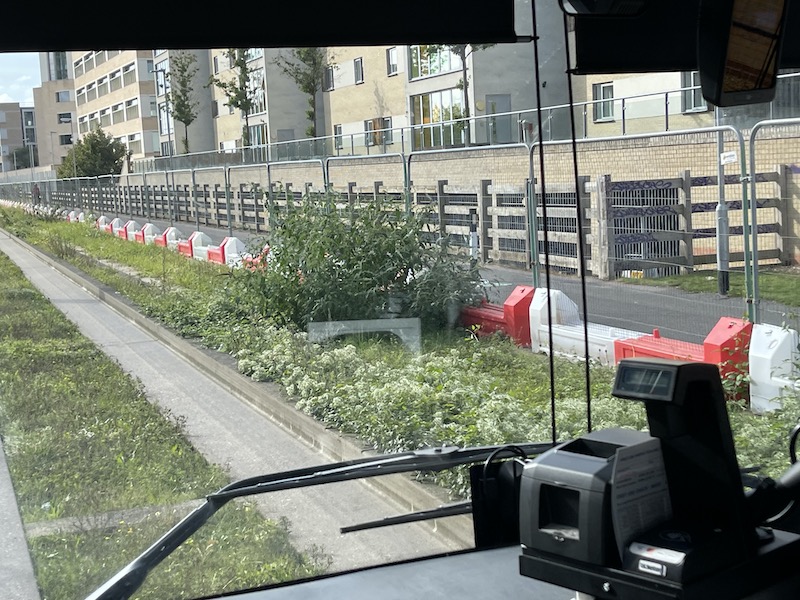
Photo from bus, showing overgrown northbound track
Photo courtesy of BusAndTrainUser

The busway and the maintenance track (foot and cycle track) are currently programmed to re-open on Saturday 30 March.

The questions, and responses from a Cambridgeshire County Council Highways officer are shown below.

  • What northbound speed limit is proposed on the guideway?

The proposed speed limit will be the 30 mph restriction that was in place before the installation of the safety barrier, and which is in place on all of the operational parts of the southern section

  • Will this be mandated by the HSE, or at the discretion of Cambridgeshire County Council?

There has been no reference made by the HSE as to a required speed limit. As mentioned previously, the pre-existing speed limit will be in place when the closed guideway re-opens. 

  • What is the justification for the 15mph limit on northbound buses leaving the guideway towards Station Place?

The speed limit was lowered to 15 mph several years ago, due to the increasing numbers of pedestrians, cyclists and other non-motorised traffic in this area. There is a transition area directly at the northern end of the Cambridge-bound guideway where cyclists cross between the carriageway and the maintenance track in both directions, and where there is more interaction with pedestrians using the maintenance track and the footpath towards Station Place. In addition, there is subsidiary traffic entering and leaving the same are via the access from the Obsidian development adjacent to the Busway.

  • Could this be raised to a 30mph limit? 

While it would be possible to raise the speed limit to any required level, the Council would not wish to exponentially increase the risk of a collision with non-Busway traffic, and the increased likelihood of major injury or death arising from such an increase. The current speed limit allows bus drivers more time to react to what can be unpredictable movement by non-Busway users.

  • What is the justification for the 30mph limit on the southbound guideway to the Addenbrooke’s spur junction?

The speed limit across the entire southern section was reduced to a blanket level of 30 mph some years ago, largely in response to the increased numbers of pedestrians, cyclists and other non-motorised traffic arising from the construction of new housing developments, and the expansion of the Biomedical Campus at Addenbrooke’s Hospital. The speed limit is also in keeping with those in place on the road network around the Busway corridor.

  • Can the southbound guideway – separated from the cycleway/footway/maintenance track by the northbound guideway, and the new fence – revert to the original 56mph limit?

Whilst it would be possible to raise the pre-existing speed limit to the original speed limit of 56 mph, there is no compelling case to do so. The maximum theoretical transit time gained through increasing the speed limit to 56 mph over this limited distance would be approximately 62 seconds, assuming that a bus entered and left this section of guideway at that speed. However, as the speed limits at either end of the section would be lower, there would be a period on entry where a bus would need to accelerate to the maximum permitted speed, and subsequently a period where the bus would need to decelerate before exiting the guideway to match the speed limit in place at the end of the guideway. These actions would reduce the gains in transit time well below the theoretical maximum.

In addition, and possibly of a greater impact , all buses that use the southern section have their speeds regulated by on-bus control systems using GPS-based geo-fencing. The accuracy of these systems does not have sufficient accuracy to allow for differing speeds on the guideway tracks that are immediately adjacent to each other.

  • If the 30mph limit is mandated by the HSE, will the County Council and Combined Authority press the HSE to allow the limit to be raised?

As stated above, the HSE have not made reference to any required speed limit in the southern section. The rationale for the 30 mph has already been addressed in my response regarding your question on the 30 mph limit on the southbound guideway. As I have already stated, there is no compelling case to increase the speed limit, and the technology in use to regulate bus speeds currently in use would preclude a separate speed limit for one section of guideway in this section.

  • Whilst a 15mph limit is required for southbound buses at the point of entry to the southbound guideway, why does this apply from the junction with Station Place?

The reasons are the same as stated above, in response to your question regarding the 15 mph speed limit for buses leaving the northbound guideway.

  • Could this apply only from the overhead hanging height limit warning signs before the Hills Road bridge, with the 30mph limit applicable in Station Place continuing up to this point?

As outlined above, given the levels of non-Busway traffic using the area, there would be little to gain by doubling the speed limit for buses over such a short distance, and any gains in transit time would be negligible. The area between Station Place and the height restriction barrier is where large numbers of pedestrians cross the roadway from the station side to reach the path that eventually joins the maintenance track adjacent to the guideway south of Hills Road bridge, and an increase in the speed limit would increase the likelihood and severity of a collision between buses and non-Busway traffic.


We look forward to the re-opening and, even with the lower speed limits in both directions, buses will, once again be able to avoid the traffic congestion on Hills Road (which the Greater Cambridge Partnership and others seems reluctant to tackle).

Photo courtesy of BusAndTrainUser

The images displayed here are from BusAndTrainUser the retirement activity for Roger French OBE DL MA, former MD of Brighton&Hove Bus Cº, a blogging site which we are pleased to promote.

Cambridgeshire Buses Feedback Forum

image of toy bus
text as per subsequent paragraphs
Click the image to book a place

Long Road Sixth Form College are running an event regarding bus services across Cambridgeshire and surrounding areas, on Tuesday 5th March 2024 5:30pm – 7:00pm.

Pre-booking is required. Click here to book, and for full information. Booking closes at 4pm on Tuesday 5th March.

Since the changes to bus routes in October 2022, many local communities have found their bus service to be less than satisfactory; an issue that is particularly impacting young people accessing a variety of educational, work and social opportunities. We want this to change. 

Share your questions and feedback with Mayor Dr Nik Johnson of Cambridgeshire and Peterborough Combined Authority (our Transport Authority) who are raising additional Council Tax to fund more bus services, and representatives of bus companies Stagecoach, Whippet and Stephensons of Essex, who will be able to talk about any of their bus services; giving young people and their families the opportunity to share their feedback and get their questions answered.

Important information for attendees:

  • You must book 1 ticket for each person attending the event, including parents/carers.
  • On-campus parking is available. Please use public transport or car-share where possible.
  • Long Road Sixth Form College will be taking photos for use in their marketing materials and social media. If you would not like to be photographed please alert their photographer(s) when you see them, or move out of shot.

A1307 road closure, 15-17 July

How will this affect Stagecoach’s route 13?

(We don’t know. Do Stagecoach? Do the Greater Cambridge Partnership?)

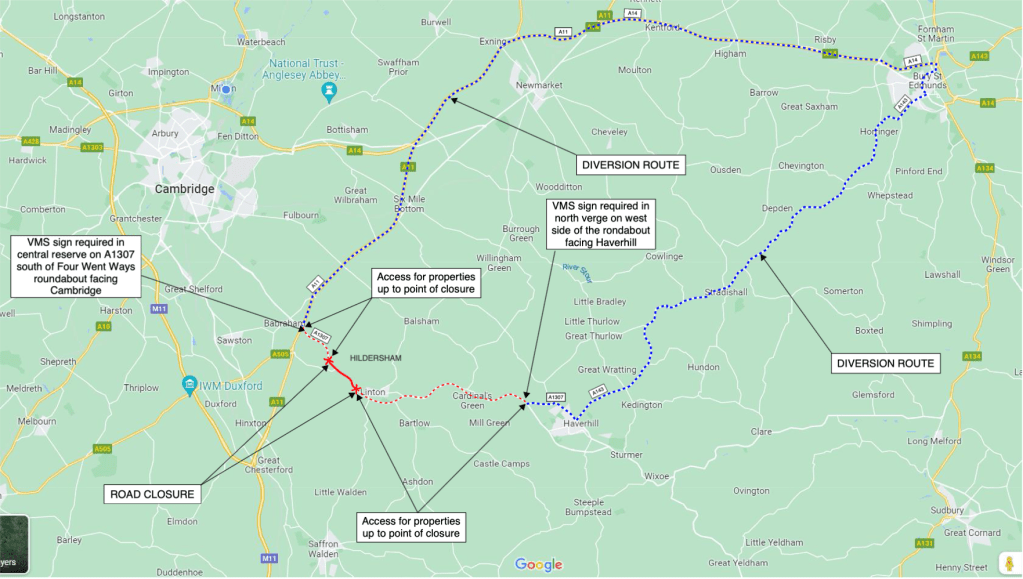
GCP’s contractors will be closing the A1307 between Haverhill and Fourwentways roundabout, from 6am on Saturday 15 July until 6am on Monday 17 July. They have also booked a contingency weekend for 22 – 24 July for further possible overnight closure, but hope to complete the works in full the previous weekend.

A1307 diversionary route 6am Saturday 15 July until 6am on Monday 17 July
Click the image to view/download a higher resolution PDF
A1307 diversionary route 6am Saturday 15 July until 6am on Monday 17 July
Click the image to view/download a higher resolution PDF

The Linton Greenway works from Hildersham to Dale Head Foods has been substantially completed, and the pathway and road are fully open. 

Our original intention was to complete the planned carriageway surfacing by closing the A1307 between Haverhill and Fourwentways roundabout weekdays overnight, and diverting traffic on National Highways roads.

However, we have now been advised that it is only possible to use this diversion at weekends.  

Greater Cambridge Partnership email, 21 Jun 2023, at 10:50

Our secretary promptly raised this with the GCP and senior management at Stagecoach East.

I note that there will be a road closure of the A1307 between Haverhill and Fourwentways roundabout (save for local access) from 6am on Saturday 15 July until 6am on Monday 17 July 2023,  for re-surfacing.

This will impact upon Stagecoach East’s route 13 Cambridge – Haverhill which operates 7 days/week providing important links to Addenbrooke’s and the Cambridge Biomedical Campus.

Has the Greater Cambridge Partnership, prior to this announcement, liaised with Stagecoach East to agree suitable diversionary routing for this key bus service throughout the resurfacing work?

Secretary, Cambridge Area Bus Users email, 22 June 2023 at 12:00

At the time of posting, we have received no response from Stagecoach nor from the GCP.

Stagecoach’s Service Updates (East) page has no mention of changes to route 13 on these dates.

Given the lack of passenger information, and the proximity of the date for the works, this was raised with GCP Board members Cllr Mike Davey (Cambridge city), Cllr Elisa Meschini (Cambs county) and Cllr Brian Milnes (South Cambridgeshire) Cc: Councillor Anna Smith (Cambridge city, and political lead on transport at Cambridgeshire and Peterborough Combined Authority).

I am concerned about bus service arrangements (route 13) for the A1307 road closure, 15-17 July 2023.

Given the lack of response to my email [to the GCP and Stagecoach] I thought it wise to raise this as a urgent matter at the political level of the Greater Cambridge Partnership Board, with Councillor Anna Smith Cc-ed in her capacity as political lead on transport with the Cambridgeshire and Peterborough Combined Authority.

I received no reply [to that earlier email] from any recipient. Nor is there any information on the Stagecoach website about what changes there will be to route 13 from 6am on Saturday 15 July until 6am on Monday 17 July.

Cambridge Area Bus Users are now receiving queries about this service.

I would be grateful if this could be urgently investigated and publicity for intending passengers made available.

Secretary, Cambridge Area Bus Users email, Monday, July 10, 2023 16:09

A brief, but prompt and helpful, response was forthcoming from Cllr Anna Smith…

Thanks,

I’ve forwarded this to officers and ask that we leverage this with Stagecoach.

Anna

Cllr Anna Smith (Cambridge City – Coleridge) email, 10 Jul 2023, at 16:40,

Cambridge Area Bus Users would like to help intending passengers with a service update.
However, we are awaiting information.