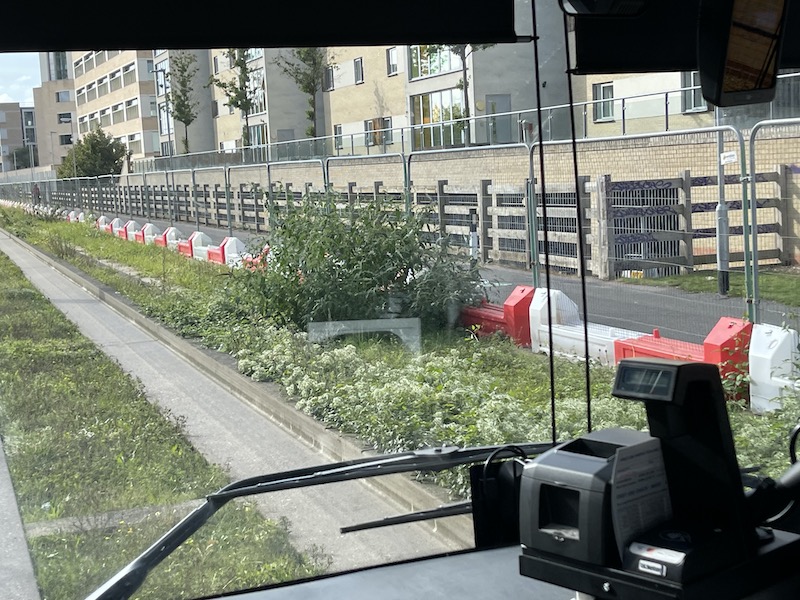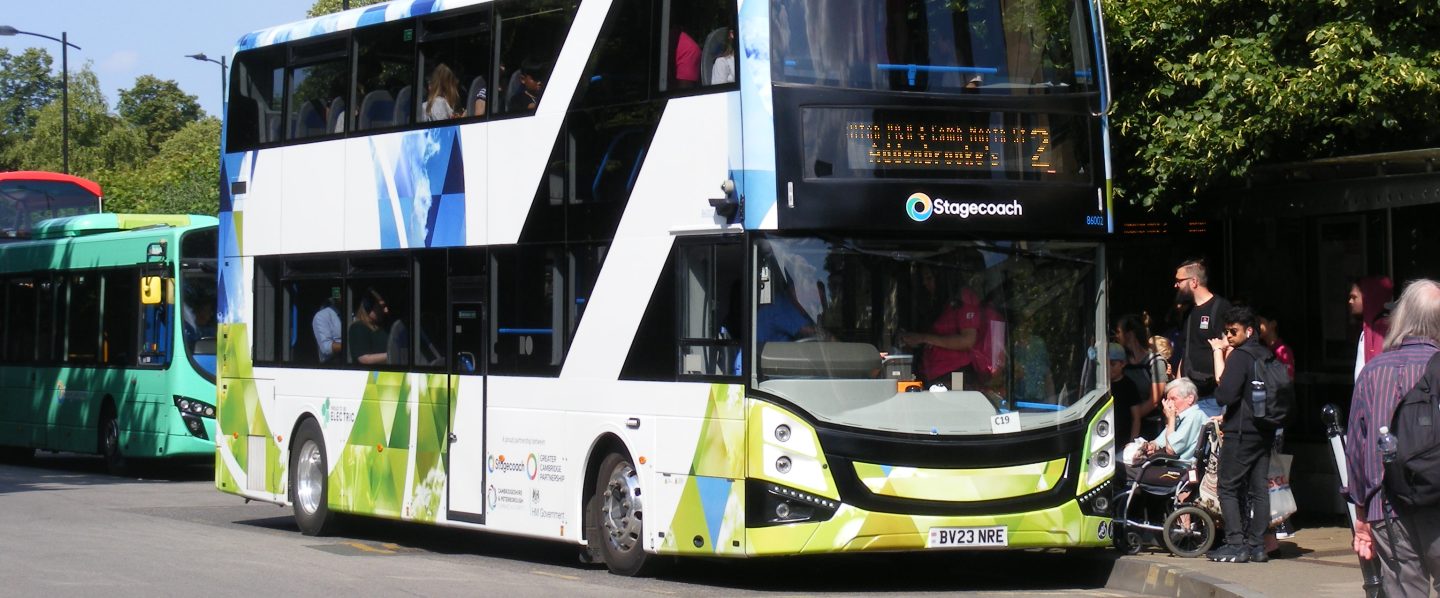
At the July 2026 Cambridge Area Bus Users Annual General Meeting, there was considerable discussion about the poor state of bus stop infrastructure in the Cambridge area. The Executive Committee resolved to create a post about this to inform the membership.
Let’s start with the good
Just an unremarkable stop. What’s special about that?
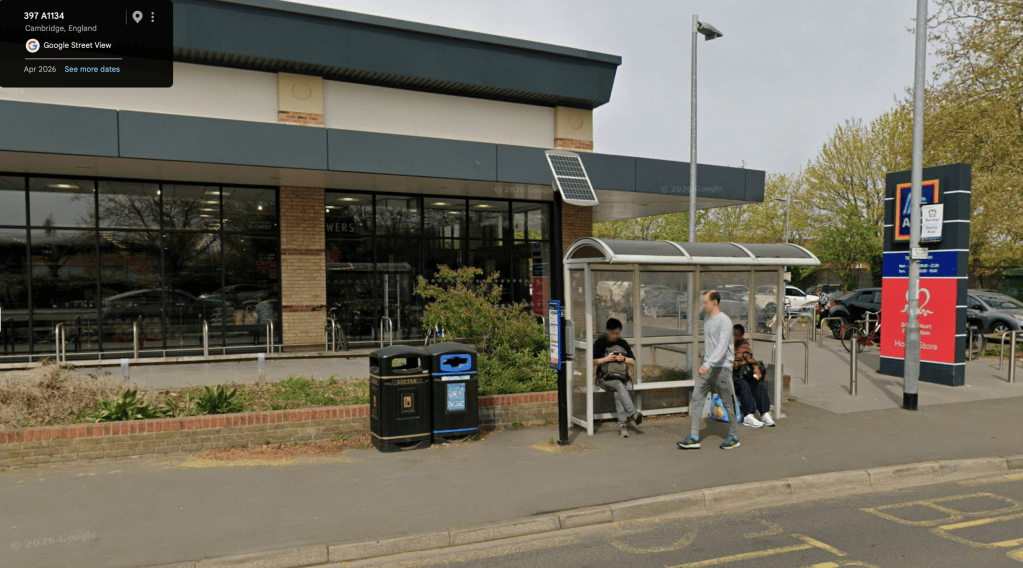
At first glance this is an unremarkable stop. There are, however, a number of features which suggest that whoever commissioned and installed the infrastructure was actually thinking about the needs of bus passengers.
This stop is provided with a shelter, with integral seating, set back at the edge of the highway boundary. A bus stop flag has been mounted on an adjacent street-lighting column. Real-time passenger information, of e-paper type, powered by a solar panel, is installed close to the shelter at the upstream end. A lockable case contains printed route/timetable information. There are no obstructions for passengers boarding/alighting. Litter bins are well-sited. A raised kerb aids easy boarding/alighting, which is of particular benefit to wheelchair-using passengers and parents with children in buggies.
Now a selection of the bad
What’s so bad about that? There’s a shelter.
Addenbrooke’s and city-bound passengers benefit from a shelter with integrated seating and hardstanding, whilst Fulbourn-bound passengers have no shelter. Both stops benefit from timetable cases, although the city-bound timetable is cunningly hidden the wrong side of the lamp-post. However neither stop could be considered accessible. Reaching the stop on the left involves slithering down a grassy bank; the stop on the right additionally involves the hazard of crossing a 40mph road with no pedestrian crossing.
Another one with a shelter? Are we being picky?
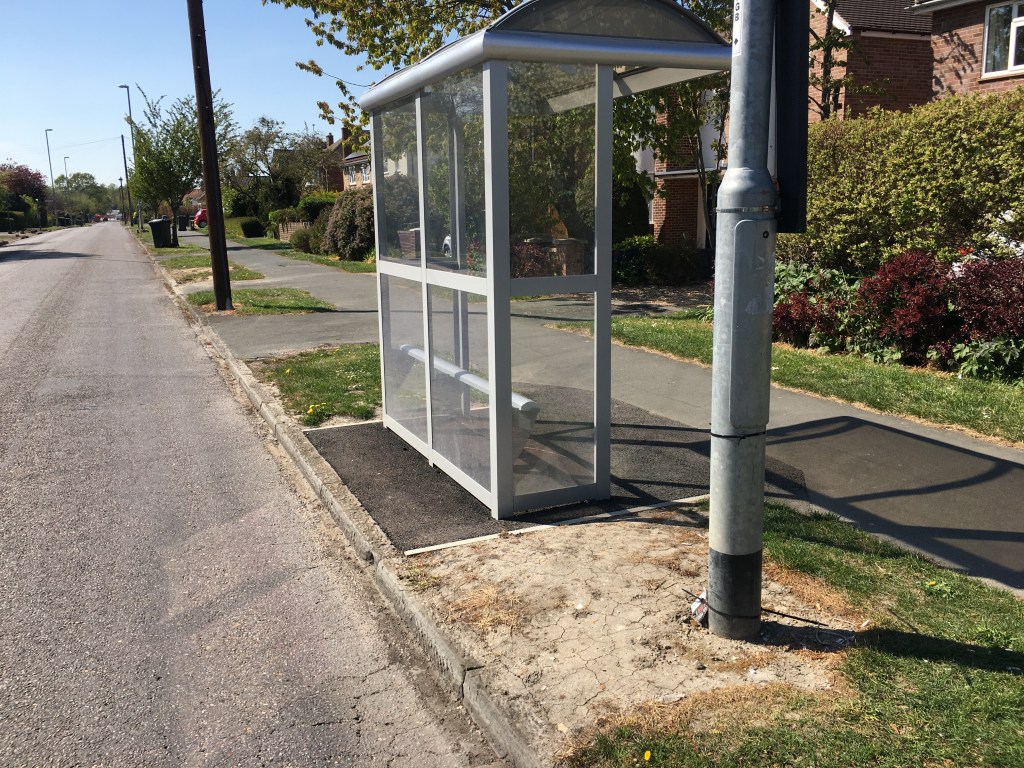
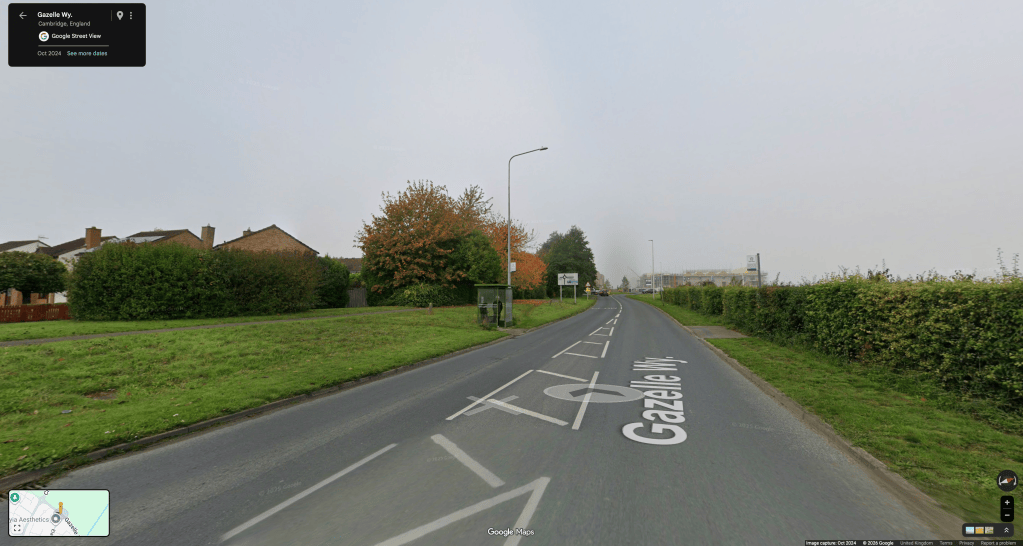
There is, indeed, a shelter, with hardstanding and integrated seating, and a printed timetable in a locked case. However, neither the contractors nor whoever commissioned the infrastructure seem to have considered where passengers would board, or alight from, buses. The adjacent patch of parched, dry soil is fine for able-bodied passengers in good weather.
When that patch is wet, muddy and slippery, it is a hazard for all passengers, but particularly those using wheelchairs or other mobility aids.
PS: explore this stop on Google Maps. Should it now be in the ‘Ugly’ category?
And the ugly
Ah, point taken.
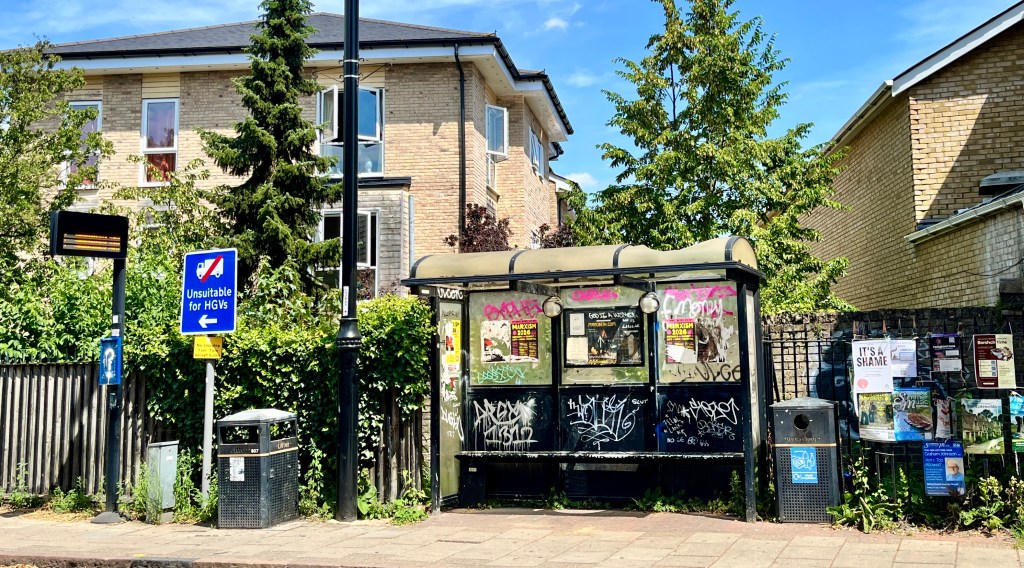
The shelter has a broken roof, is covered in graffiti and fly-posting. The pole supporting the adjacent real-time passenger information display also hosts a timetable case, which is empty and graffitied. We are uncertain who is responsible for this shelter…
Who is responsible for our bus stops?
Responsibility for bus stops in the Cambridge area is split between various bodies. Here is brief digest:
- Cambridgeshire County Council (the Highway Authority) is the body which has traditionally approved the siting of bus stops – although the Cambridgeshire and Peterborough Combined Authority is now the Transport Authority, so there are overlapping responsibilities.
- Bus stop locations should then be entered on the National Public Transport Access Nodes (NaPTAN) database.
- The Combined Authority and/or Highway Authority is responsible for providing good hard-standing for bus stops; and should provide a bus-stop pole, unless an adjacent street-lighting column can be used.
- Provision of a bus stop flag is, currently, the responsibility of the bus operator, as is a timetable case and printed timetable.
- Real-Time Passenger Information displays (pole-mounted, integral within a shelter, or of the more modern, compact e-paper type), if provided, is the responsibility of the Combined Authority. The RTPI feed is operated by contractor Vix Technology on behalf of the Combined Authority.
- Bus shelters are, generally, the responsibility of the lower-tier authorities (eg Cambridge City Council, South Cambridgeshire District Council) who may have agreements with advertising companies (eg Bauer Media Outdoor UK, formerly Clear Channel/JC Decaux) which provide and maintain some shelters (in return for the right to sell static or moving advertisements). Additionally Parish Councils may choose to install shelters and seating. (Good examples can be found in the Histon & Impington and Great Shelford parishes.)
- However, when roads are re-modelled (Hills Road, Histon Road, Milton Road) using Greater Cambridge Partnership money it is unclear who has responsibility for design of siting of stop and shelters.
- Cambridge Area Bus Users is not aware of the existence of any bus stop design manual published or followed by the Combined Authority to guide new installations, or programmes of improvement.
How did it come to this?
Cambridgeshire and Peterborough Combined Authority have a poor inheritance, from when Cambridgeshire County Council were the Transport Authority.
Back in April 2019, a (then) senior county councillor and (then) public transport officer, explained that:
Bus stop locations are the decision of the county council in consultation with bus operators and are then entered on the National Public Transport Access Nodes (NaPTAN) database. A pole may be provided where a convenient piece of street furniture, such as a street lighting column, is not available. It is the responsibility of the operator to mount their flag on the pole. Timetable frame and flag are installed by the bus operator. Only about half the stops have a flag, the rest are unmarked.
It was only on 15th November 2023, following public questions on behalf of Cambridge Area Bus Users, that the Cambridgeshire and Peterborough Combined Authority’s Transport & Infrastructure Committee agreed that:
(7.2.e) The CPCA would go through an options process to understand what was the right approach for a combined authority to take in regard to ownership and maintenance of bus stop infrastructure.
Translation: The Combined Authority know the locations of bus tops (from the NaPTAN database) but we’ve no real idea what’s installed at each location: pole? bus stop flag? timetable case?shelter? seat? Oh, and we don’t really know who installed what, still less who is responsible for maintaining what.
The Deputy Mayor at that time, Anna Smith, did promise that there would be a nominated officer charged with oversight of bus stop infrastructure. See: Transport & Infrastructure Committee Draft Minutes Wednesday 15th November 2023.
Positive developments
At the Cambridgeshire and Peterborough Combined Authority Transport Committee on 4th March 2026 a programme of Bus Stop Infrastructure Improvements was agreed.
To see if there are improvements planned for a bus stop which you use, read/download the Bus Stop/Shelter Infrastructure Improvements programme PDF produced by Systra for Cambridgeshire and Peterborough Combined Authority. The criteria for selection can be found in this report to the committee: Bus Stop/Shelter Infrastructure Improvements Report.
What standards do Cambridge Area Bus Users think Cambridgeshire and Peterborough Combined Authority should be aiming for?
The October 2023 joint position paper from Cambridge Area Bus Users and Living Streets, Cambridge has a good summary of our views. Additional links are provided for those who would like to read more.
- Bus stop infrastructure – Siting and Design (A joint position paper from Cambridge Area Bus Users and Living Streets Cambridge) [October 2023]
- Vix Technology supports campaign for national bus stop standard [Paul Halford, RouteOne, 24 November 2025]
- Bus Stop Stories (Video) [Campaign for Better Transport, December 2024]
- Better Bus Stops: Creating a national bus stop standard PDF [Campaign for Better Transport, December 2024]
- Better Bus Stops: Setting a standard for printed passenger information PDF [Campaign for Better Transport, October 2025]
- Accessible bus stop design guidance [Public Transport Team, Surface Strategy & Planning, Transport for London, January 2017]
The (un)reliability of RTPI and the lack of printed timetable
- Our Executive Committee diligently report failures of the RTPI system – both of hardware and data.
- We are looking, more strategically, on why some services do not seem to track, or to give a realistic estimate of bus arrival times.
- A survey of printed information (or the lack thereof) at key locations is also being undertaken.
- Our Executive Committee member for St Ives has worked with others to produce an information leaflet and vastly improved printed information in and around St Ives Bus Station.
All of these will form the subject of forthcoming posts.