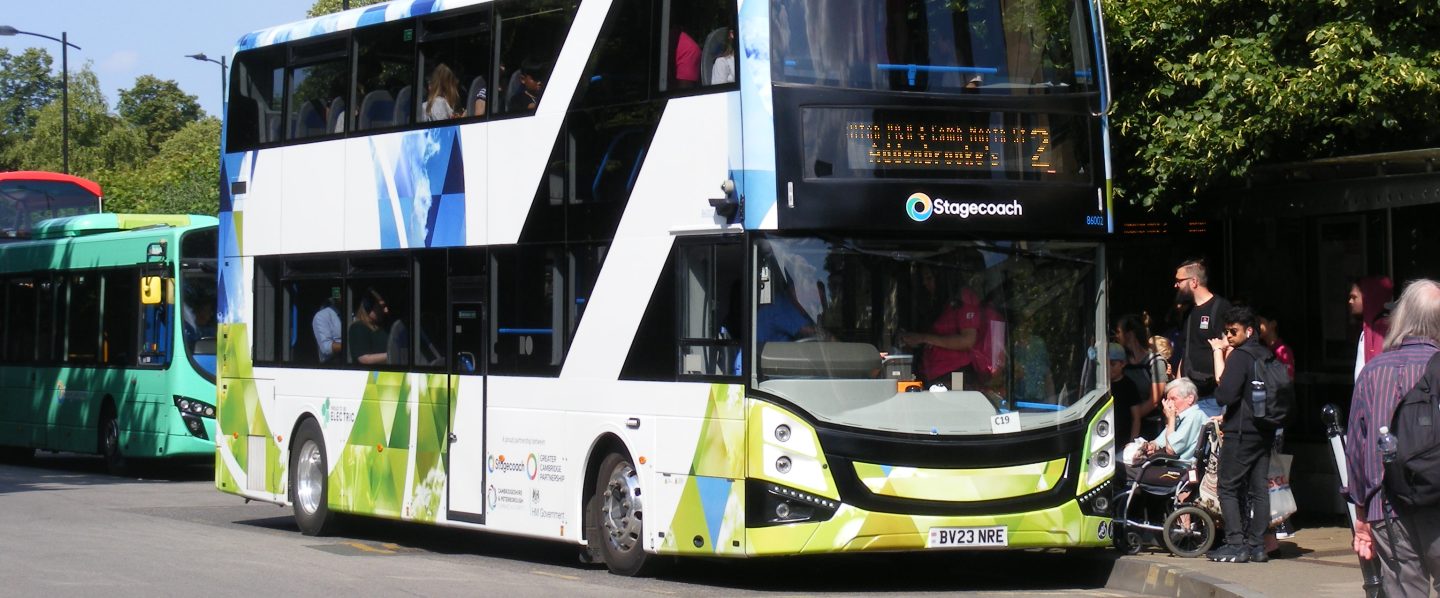
Greater Cambridge Shared Planning invited representations on the draft update to the Greater Cambridge Local Plan. Cambridge Area Bus Users collaborated closely with Cambridgeshire Sustainable Travel Alliance to scrutinise the policies’ provision for sustainable and active travel.
Cambridge Area Bus Users was particularly concerned about Policy I/ST – Sustainable Transport and connectivity. In our view this policy is ineffective in ensuring that new developments are highly permeable by buses.
(Note: Greater Cambridge Shared Plannning is the Shared Planning Service between Cambridge City Council and South Cambridgeshire District Council. It is not the same body as Greater Cambridge Partnership which is the delivery body for the devolved City Deal signed in 2014)
Our PDF – New Developments – street layout for efficient bus operation – is based on our response to the Greater Cambridge Local Plan. It draws heavily on advice contained in two publications:
- Bus Services & New Residential Developments Second Edition January 2025 [Go-Ahead, Stagecoach and Bus Centre of Excellence, January 2025]
- Buses in Urban Developments [Chartered Institution of Highways and Transportation, January 2018]
Below are some excerpts from our supporting evidence.
How not to create a new development: (1) Bar Hill, established in the 1960s
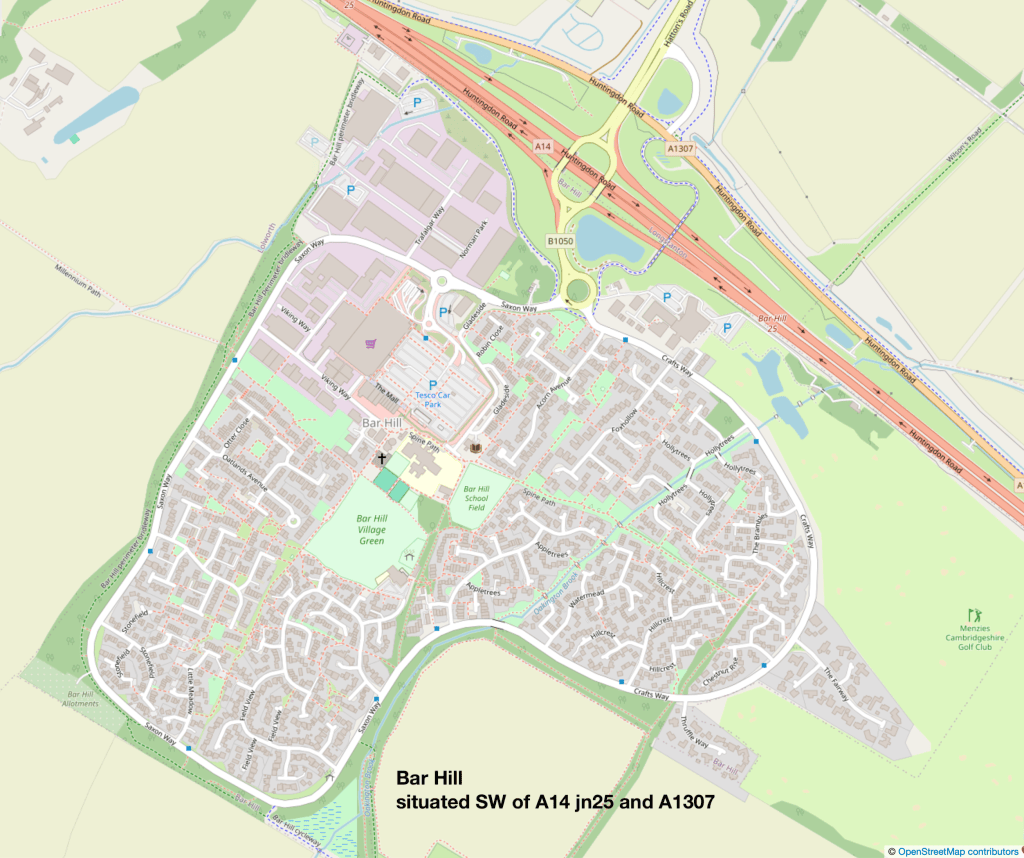
Bar Hill, established in the 1960s, SW of what was, at the time, the A604 Cambridge – Huntingdon road was a missed opportunity for bus permeability. In particular the possibility of being served by attractive, fast, Cambridge – Bar Hill – Huntingdon services, was lost as a result of the car-centric layout of an orbital distributor road with residential culs-de-sacs. This imposes an unattractive, loop service on the bus operator, with a time penalty of around 10 minutes to access, loop and exit the settlement. Albeit there is a network of footways throughout the village, to encourage active travel, the highway layout is fundamentally flawed in failing to plan for attractive bus services.
How not to create a new development: (2) Cambourne, established in the late 1990s
Construction of Cambourne, situated south of the A428 and east of the A1198, began in June 1998, with the first house occupied in August 1999. The road layout exemplifies the gratuitous curves and tight bends with poor visibility which should be avoided in planning for bus permeability in new developments.
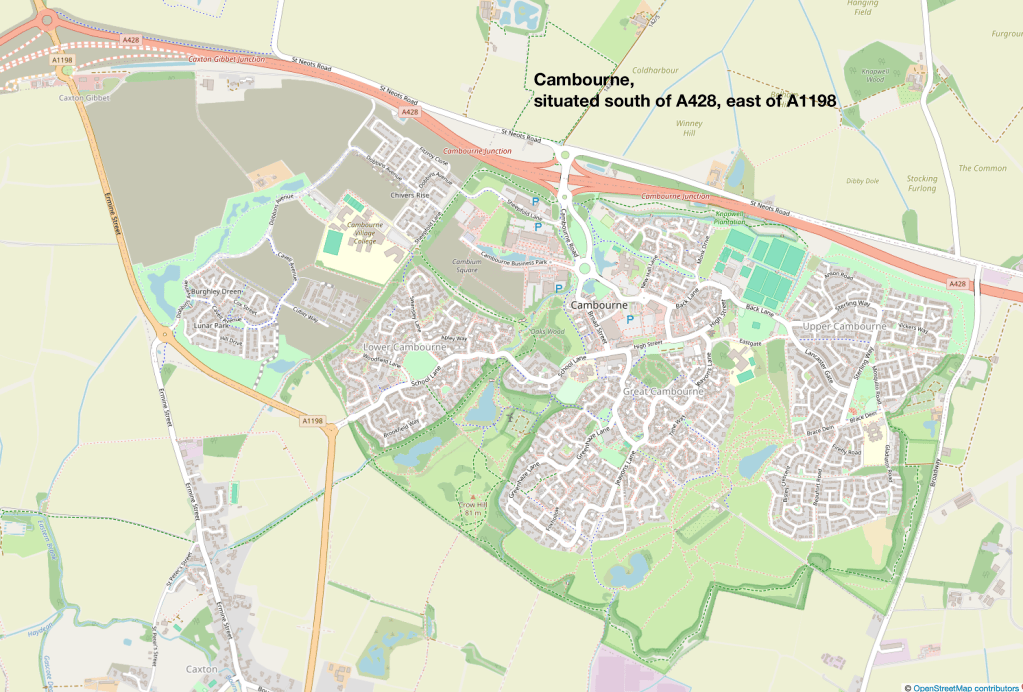
With only northern (A428) and western (A1198) entry/egress to the ‘super village’, Stagecoach East’s service 4 must follow a difficult and indirect pair of loops, to serve Great Cambourne and Upper Cambourne, as shown on the route map, below.
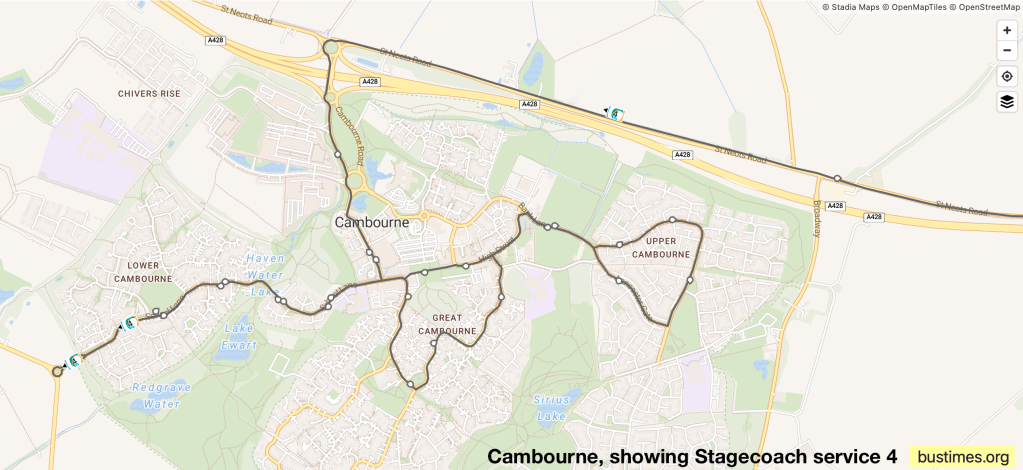
Passengers travelling to/from Cambridge thus have much slower services because of the lack of planning for any direct, east-west bus priority route through the settlement. The time penalty disadvantage of the sub-optimal nature of bus route 4 further imposes costs on the bus operator, threatening the sustainability of the service. Furthermore, the southernmost parts of the settlement are not served by buses, leaving residences in Jeavons Lane and Whittle Way some considerable distance (600m – 800m) from the nearest bus stop.
Additionally, the smooth operation of Stagecoach’s route 4 and the two through services – Whippet’s routes 18 and X3 – are hampered by the gratuitous curves, tight bends and poorly regulated car parking on the shared section along School Lane and Broad Street.
A positive exemplar: Waterbeach New Town, being constructed 2020s
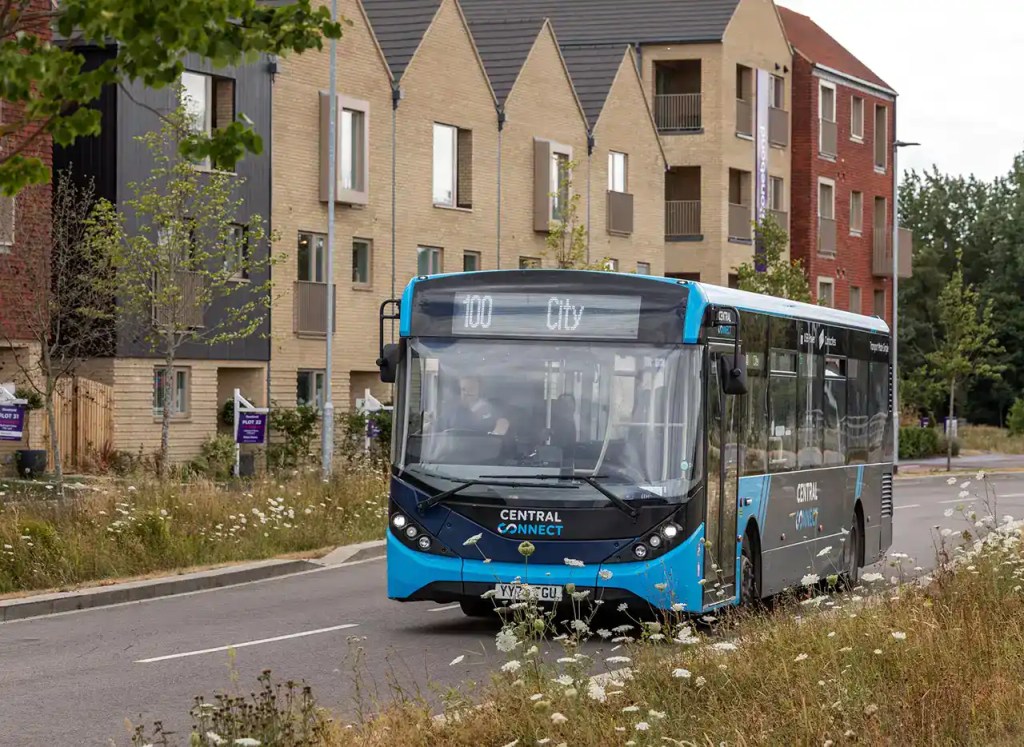
The Waterbeach new town development of around 11,000 homes, being built on the site of the former Waterbeach Barracks and Airfield, has been designed to prioritise active travel and public transport from the start. The western sector of the development is led by Urban&Civic as the master developer and has included a Sustainable Travel Hub, installed ready for the arrival of the first residents, and an initially half-hourly shuttle bus service connecting to Waterbeach Station, the Science Park, and Cambridge city centre [Waterbeach website: Connections]. Phase 2 will include a “bus only main link” through the site, connecting destinations including schools, a health facility and a new town centre [Waterbeach website, news blog, 19 May 2026].
For the full details of our submission see – New Developments – street layout for efficient bus operation – which is based on our response to the Greater Cambridge Local Plan.
For more on the Cambridgeshire Sustainable Travel Alliance’s objections see: Travel Alliance’s objections to the Local Plan.


