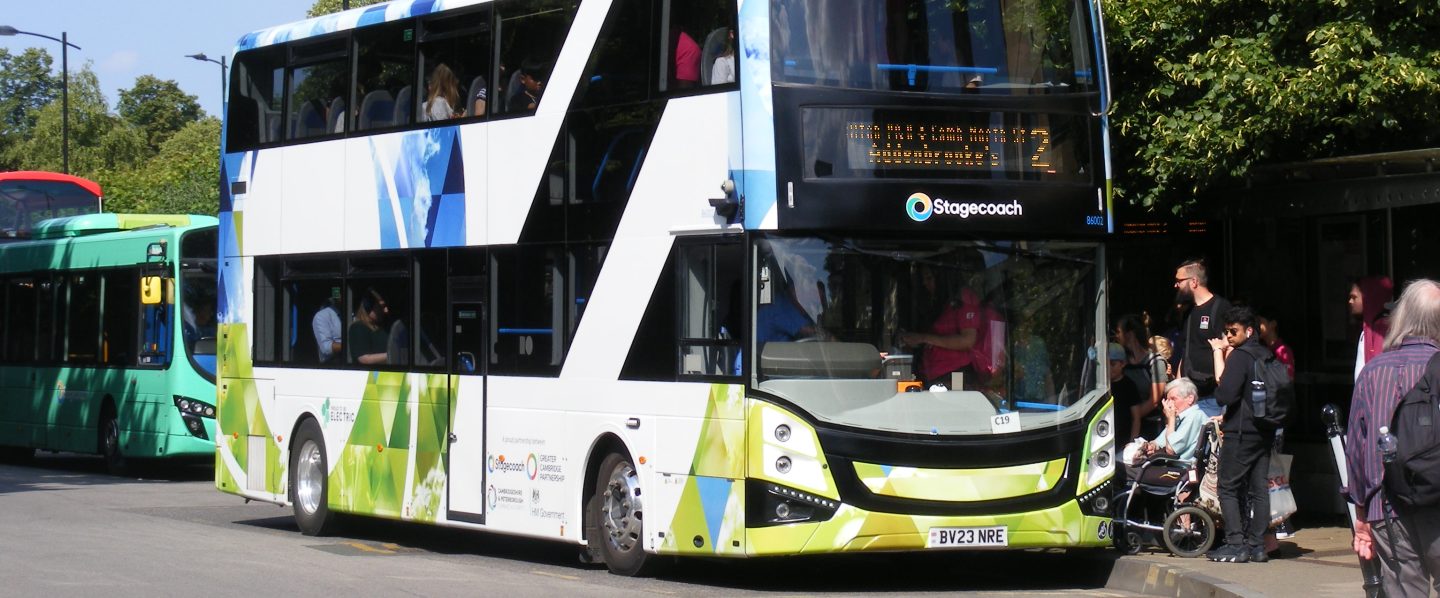
Greater Cambridge Growth: Planning for Bus Services

Cambridge Area Bus Users was particularly concerned about Policy I/ST – Sustainable Transport and connectivity. In our view this policy is ineffective in ensuring that new developments are highly permeable by buses.


(Note: Greater Cambridge Shared Plannning is the Shared Planning Service between Cambridge City Council and South Cambridgeshire District Council. It is not the same body as Greater Cambridge Partnership which is the delivery body for the devolved City Deal signed in 2014)


Our PDF – New Developments – street layout for efficient bus operation – is based on our response to the Greater Cambridge Local Plan. It draws heavily on advice contained in two publications:

Below are some excerpts from our supporting evidence.


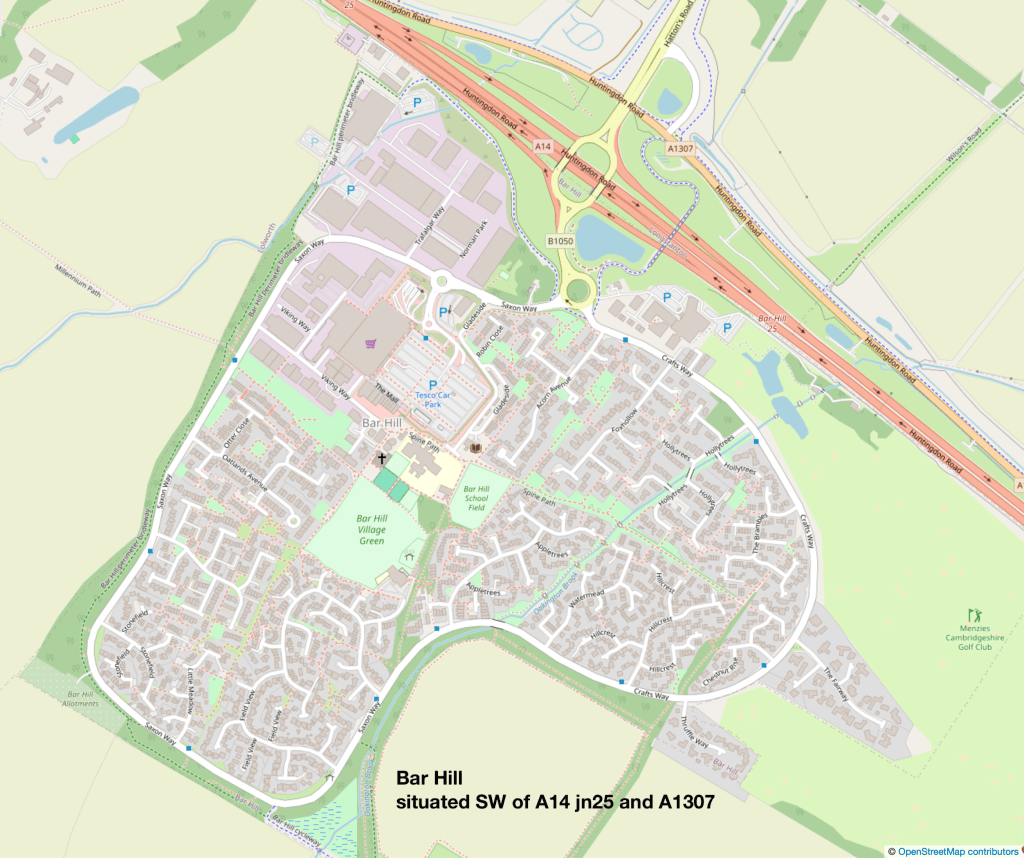
Map of Bar Hill

Bar Hill, established in the 1960s, SW of what was, at the time, the A604 Cambridge – Huntingdon road was a missed opportunity for bus permeability. In particular the possibility of being served by attractive, fast, Cambridge – Bar Hill – Huntingdon services, was lost as a result of the car-centric layout of an orbital distributor road with residential culs-de-sacs. This imposes an unattractive, loop service on the bus operator, with a time penalty of around 10 minutes to access, loop and exit the settlement. Albeit there is a network of footways throughout the village, to encourage active travel, the highway layout is fundamentally flawed in failing to plan for attractive bus services.

Construction of Cambourne, situated south of the A428 and east of the A1198, began in June 1998, with the first house occupied in August 1999. The road layout exemplifies the gratuitous curves and tight bends with poor visibility which should be avoided in planning for bus permeability in new developments.
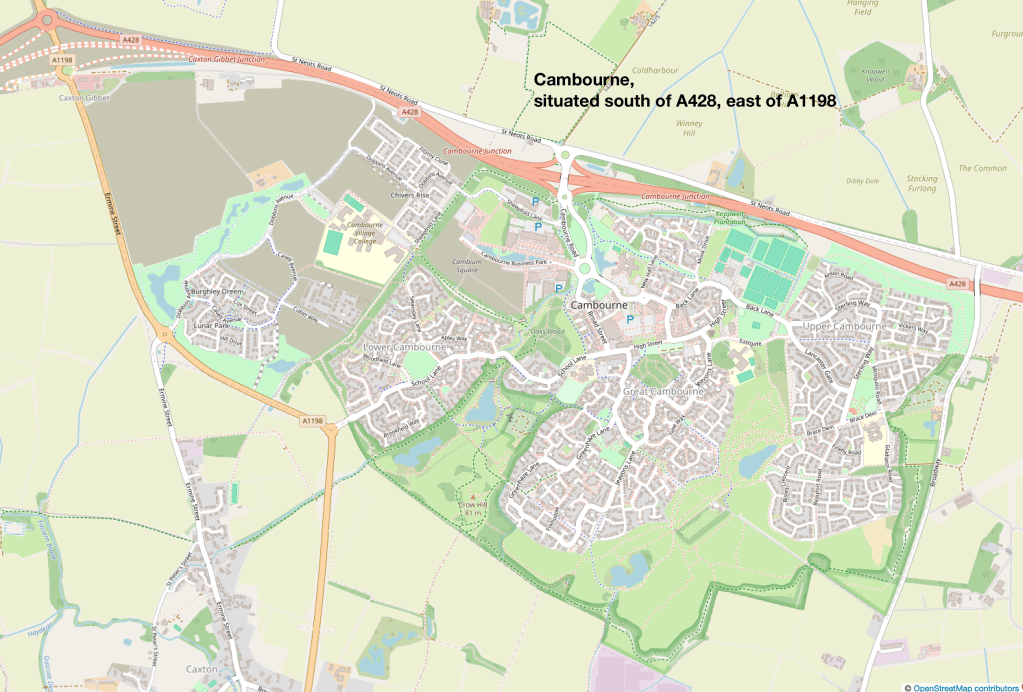
Map of Cambourne

With only northern (A428) and western (A1198) entry/egress to the ‘super village’, Stagecoach East’s service 4 must follow a difficult and indirect pair of loops, to serve Great Cambourne and Upper Cambourne, as shown on the route map, below.
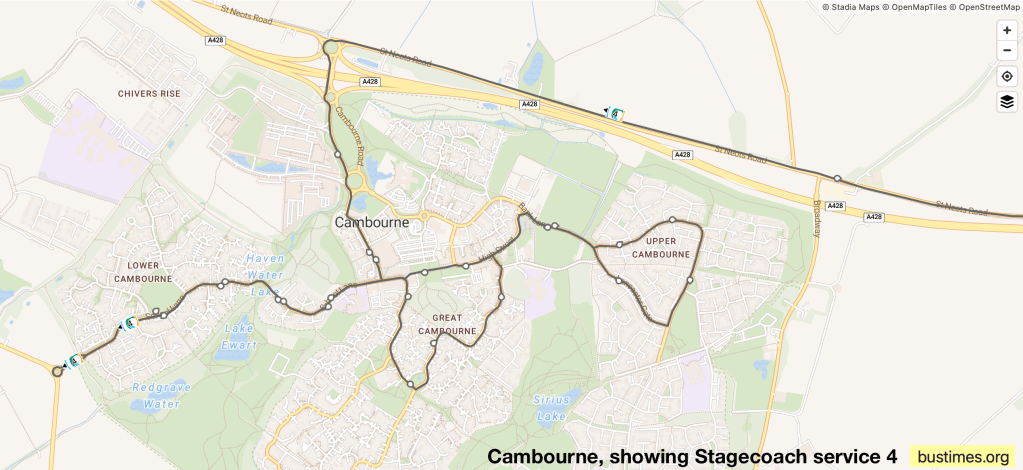
Map of Cambourne, showing route of Stagecoach citi 4

Passengers travelling to/from Cambridge thus have much slower services because of the lack of planning for any direct, east-west bus priority route through the settlement. The time penalty disadvantage of the sub-optimal nature of bus route 4 further imposes costs on the bus operator, threatening the sustainability of the service. Furthermore, the southernmost parts of the settlement are not served by buses, leaving residences in Jeavons Lane and Whittle Way some considerable distance (600m – 800m) from the nearest bus stop.

Additionally, the smooth operation of Stagecoach’s route 4 and the two through services – Whippet’s routes 18 and X3 – are hampered by the gratuitous curves, tight bends and poorly regulated car parking on the shared section along School Lane and Broad Street.


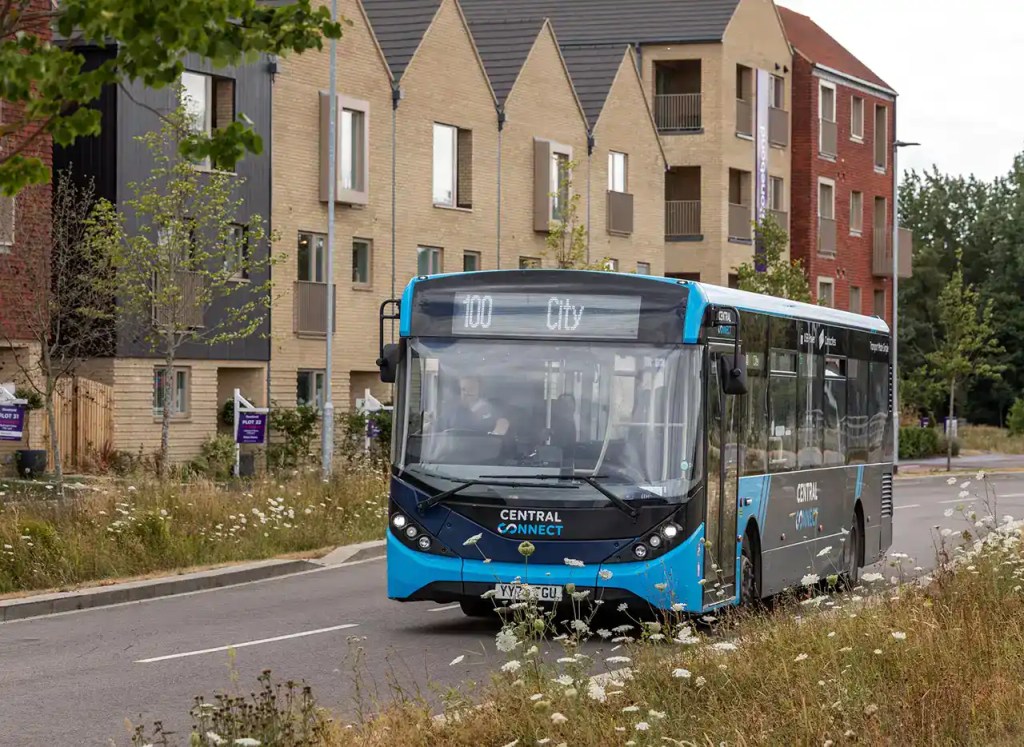
central-connect-bus-service-waterbeach

The Waterbeach new town development of around 11,000 homes, being built on the site of the former Waterbeach Barracks and Airfield, has been designed to prioritise active travel and public transport from the start. The western sector of the development is led by Urban&Civic as the master developer and has included a Sustainable Travel Hub, installed ready for the arrival of the first residents, and an initially half-hourly shuttle bus service connecting to Waterbeach Station, the Science Park, and Cambridge city centre [Waterbeach website: Connections]. Phase 2 will include a “bus only main link” through the site, connecting destinations including schools, a health facility and a new town centre [Waterbeach website, news blog, 19 May 2026].


For the full details of our submission see – New Developments – street layout for efficient bus operation – which is based on our response to the Greater Cambridge Local Plan.

For more on the Cambridgeshire Sustainable Travel Alliance’s objections see: Travel Alliance’s objections to the Local Plan.
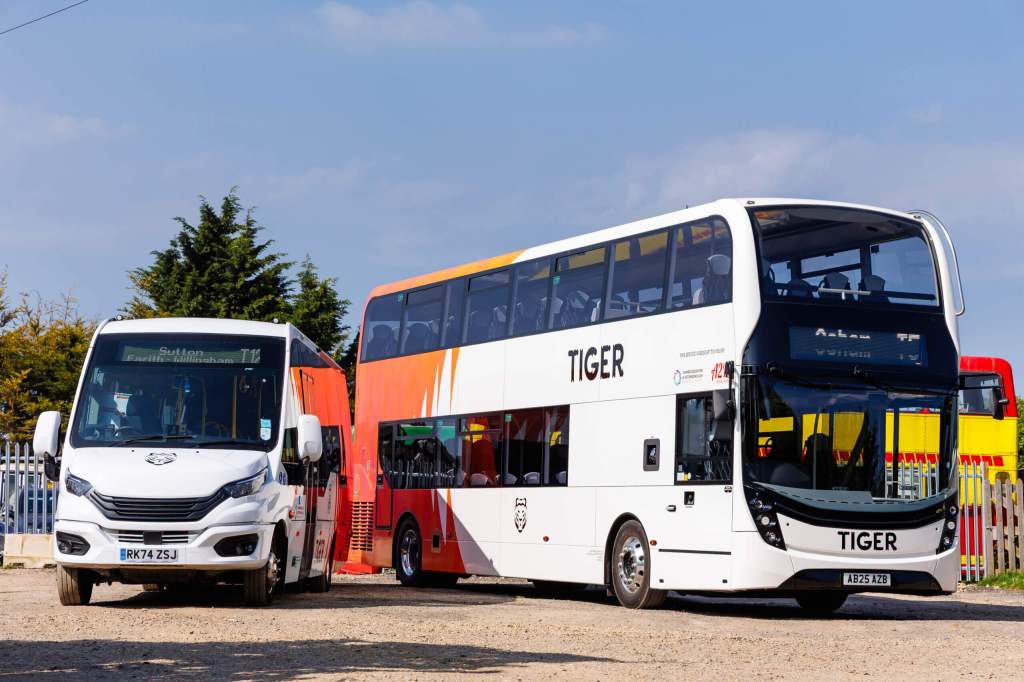
Combined Authority Must Invest in Improved Bus Services


Cambridgeshire and Peterborough Combined Authority is holding an additional bus franchising consultation. Changes to how buses would be brought under local control are proposed, in large part as a consequence of Mayor Paul Bristow’s decision to freeze the Mayoral precept (the portion of council tax the Mayor levies). The Travel Alliance urges you to respond to the consultation questionnaire calling for increased investment by the Combined Authority in buses and an expanded public transport network.

Image from Cambridgeshire and Peterborough Combined Authority of two buses in the 'Tiger' colours.

The Mayor’s decision to freeze the Mayoral Council Tax Precept has led to a significant change in the financial assumptions underlying the original franchising business case. The previously planned Mayoral Precept increase for an average Band D household from the current 10p/day to 16.5p/day by 2032 and 20p/day in 30 years time is much lower than the amount of Council Tax currently levied by the Police and Crime Commissioner (86p/day), and by the Fire Authority (25p/day). It is also lower (in some cases much lower) than many parish precepts: South Cambridgeshire’s parish precepts, for example, are currently as much as 53.5p/day (Great Shelford) with a South Cambridgeshire average of 26.5/day.


Cambridge Area Bus Users collaborated with Cambridgeshire Sustainable Travel Alliance to produce a guide to the Combined Authority’s Bus Franchising Supplementary Consultation

The full guide can be found on the Travel Alliance website: Consultation guide – Don’t miss your chance to call for more investment in buses.

Making Connections

Image from Greater Cambridge Partnership's Making Connections webpage, showing:
image of two happy, young heterosexual couples, in a circle with imagine bubbles captioned "Imagine if We had £50Million a year to invest in public transport.
Also shown are the logos of Greater Cambridge Partnership and Cambridgeshire County Council.

The Greater Cambridge Partnership proposals

Better bus services and a Sustainable Travel Zone

Recent bus service withdrawals had people worrying how they would get to work or college. And it necessitated a breakneck scramble to find new operators by the Cambridgeshire and Peterborough Combined Authority.

Together with the continuing disruption caused by cancellations, this rather makes the case for democratic control over bus operators.

We need better reliability, more services, and more affordable fares.


The Greater Cambridge Partnership’s City Access proposals are riding to the rescue

If you want safe walking and cycling, reliable buses and a positive future for everyone, make your voice heard today!

The Greater Cambridge Partnership have promised £50 million annually for radically-improved bus services, funded by money from the city deal, signed with central government in 2014 and not from council tax or business rates.

But, longer-term, this money will run out and a sustainable revenue-stream will be required. Under national legislation, this will be legally ring-fenced for transport improvements.

And public money must be safeguarded: the benefits should be for bus passengers, not for bumper payouts to bus company shareholders (and foreign owners in some cases).

The GCP is working closely with the Cambridgeshire and Peterborough Combined Authority who can exercise powers (under the Bus Services Act 2017) to prevent bus operators ever again causing such disruption to people’s lives.


More about the Cambridgeshire and Peterborough Combined Authority’s potential powers

Image of single-deck bus overlaid with text:
Cambridge Area Buses
Under Public Control?

The Bus Services Act 2017 – passed under a Conservative government, with all-party support – provides Mayoral Combined Authorities (including the Cambridgeshire and Peterborough Combined Authority) with a number of options to improve bus services, including powers to implement bus franchising, akin to the system operated by Transport for London.

Full details and links to publications can be found here: Bus Franchising, Quality Partnerships, and other ways of Improving bus services


Making Connections Consultation

The Greater Cambridge Partnership has launched a City Access Public Consultation under the title Making Connections 2022.

How should Cambridge Area Bus Users members and supporters respond?

Take a look at this handy 5-minute Consultation response guide, compiled by the Cambridge Sustainable Travel Alliance.


Cambridge Sustainable Travel Alliance logo

Cambridge Area Bus Users’ secretary has been working closely with the other members of the Cambridge Sustainable Travel Alliance (mainly Camcycle and Cambridge Living Streets) to raise awareness of the Greater Cambridge Partnership proposals and to compile this Consultation response guide.

Bus Users group contributions to this Consultation response guide are taken from our Aims & Priorities document (PDF). In general, The GCP proposals are in line with what we set out in that 2019 document: more services, better frequencies, lower fares and improved reliability.

However, whilst that document called for operators and local authorities to co-operate on reliability (which implies tackling congestion) and for the GCP to generate funding for unprofitable routes, we have no existing policy on a congestion charge. It was, therefore, not possible to contribute a Cambridge Area Bus Users’ view on that aspect of the consultation. You will need to make up your own mind.


What are the Greater Cambridge Partnership proposing?

Image from Greater Cambridge Partnership's Making Connections brochure, showing:
image of two happy, young heterosexual couples, in a circle with imagine bubbles captioned "Imagine if We lived in a place that prioritised people over cars."
Also shown are the logos of Greater Cambridge Partnership and Cambridgeshire County Council, with the text: "MAKING CONNECTIONS
Have your say on proposals for faster, cheaper, more reliable bus services and safer cycling through the introduction of a Sustainable Travel Zone. A City Access Public Consultation."
  1. Transforming the bus network: From as early as mid-2023, The GCP are proposing to transform the bus network through more services to more locations, with cheaper fares set at £1 (city zone) and £2 (wider area).
  2. Investing in other sustainable travel schemes: Alongside the bus network, the GCP areproposing to invest in new sustainable travel schemes, such as better walking and cycling links.
  3. Creating a Sustainable Travel Zone: The GCP areproposing the introduction of a Sustainable Travel Zone in the form of a road user charge on behalf of Cambridgeshire County Council. Vehicles would be charged for driving within the Zone between 7am and 7pm on weekdays, and money raised would fund improvements to the bus network and other sustainable travel schemes. The Zone would be fully operational in 2027/28 but only once the first bus improvements are introduced.

The proposals will see:

  • Double the hours of service and miles covered of the pre-pandemic Greater Cambridge bus network
  • £1 flat fares for single journeys in the Cambridge bus zone, and £2 fares in the wider area
  • 50% expected reduction of traffic in Cambridge

Full details are in the Greater Cambridge Partnership Making Connections booklet (PDF).


How can you help?

It is important that as many bus users as possible give their views on the Greater Cambridge Partnership proposals, before the consultation closes on Friday 23 December 2022.

Complete it yourself and encourage your spouse/partner, your teenage children, your parents and your neighbours to give their views.

It’s easy:

You don’t need to live within the Greater Cambridge boundaries. If you and/or a member of your household uses buses to travel in and around Cambridge, the survey needs your views. 


Get involved in promoting sustainable travel!

Cambridge Sustainable Travel Alliance's If Not Now Then When? logo

Cambridge Sustainable Travel Alliance needs individual supporters who can help promote the campaign.
Contact Cambridge Sustainable Travel Alliance by email to find out more. 

  • Could you tell your story about how poor bus services have impacted on your life?
  • Could you tell people about how better bus services would improve your life?
  • The CSTA team need online stories, stories for press releases and stories for online videos.
  • Could you help distribute the IF NOT NOW THEN WHEN? leaflets around your streets, your village or join other members, leafleting in the city centre, or other locations?
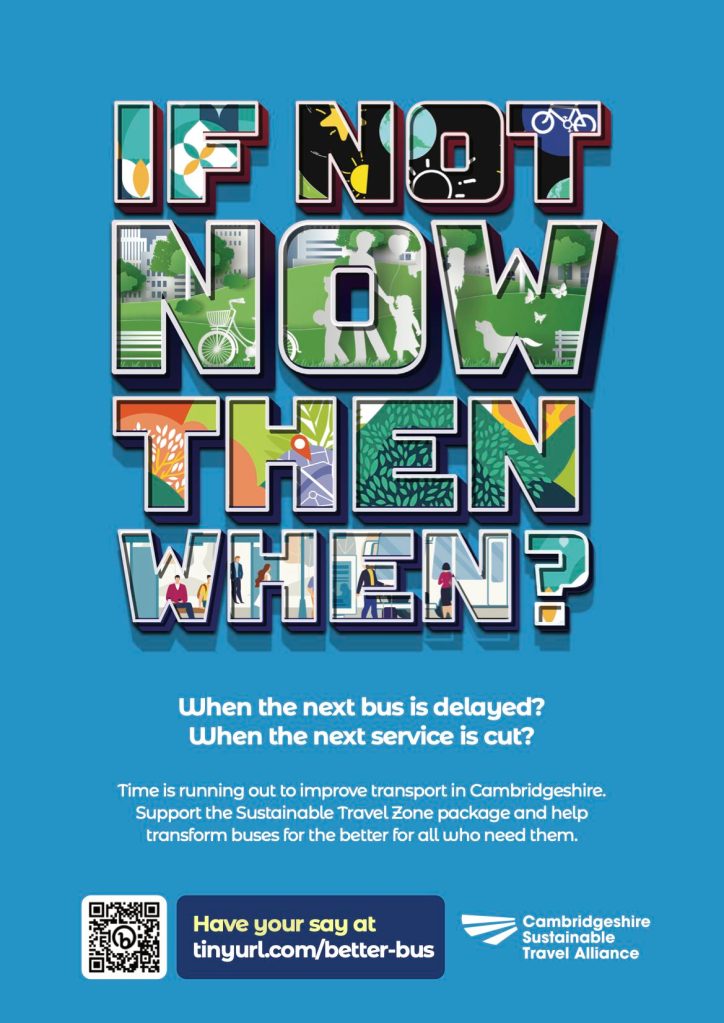
Front of Cambridge Sustainable Travel Alliance's If Not Now Then When? leaflet with text:
If Not Now Then When? 
When the next bus is delayed? When the next service is cut?
Time is running out to improve transport in Cambridgeshire. Support the Sustainable Travel Zone package and help transform buses for the better for all who need them.
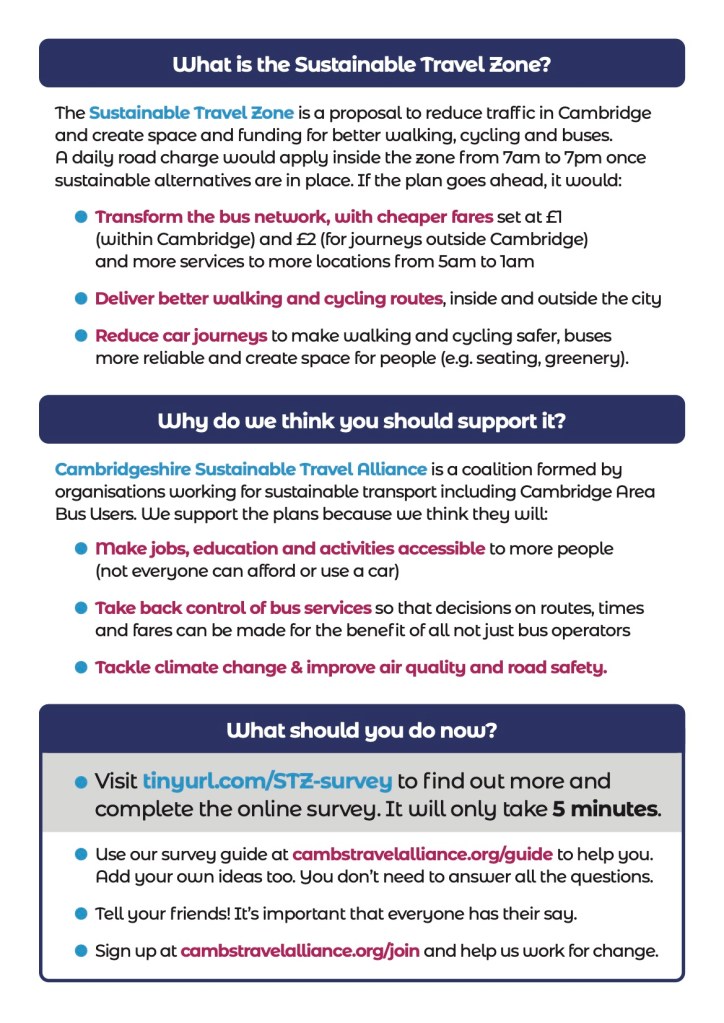
Rear of Cambridge Sustainable Travel Alliance's If Not Now Then When? leaflet with text:
 What is the Sustainable Travel Zone?
The Sustainable Travel Zone is a proposal to reduce traffic in Cambridge and create space and funding for better walking, cycling and buses.
A daily road charge would apply inside the zone from 7am to 7pm once sustainable alternatives are in place. If the plan goes ahead, it would:
● Transform the bus network, with cheaper fares set at £1 (within Cambridge) and £2 (for journeys outside Cambridge) and more services to more locations from 5am to 1am
● Deliver better walking and cycling routes, inside and outside the city
● Reduce car journeys to make walking and cycling safer, buses
more reliable and create space for people (e.g. seating, greenery).
Why do we think you should support it?
Cambridgeshire Sustainable Travel Alliance is a coalition formed by organisations working for sustainable transport including Cambridge Area Bus Users. We support the plans because we think they will:
● Make jobs, education and activities accessible to more people (not everyone can afford or use a car)
● Take back control of bus services so that decisions on routes, times and fares can be made for the benefit of all not just bus operators
● Tackle climate change & improve air quality and road safety.